
US-Brazil trade dashboard – Atlantic Council
Our programs and centers deliver in-depth, highly relevant issue briefs and reports that break new ground, shift opinions, and set agendas on public policy, with a focus on advancing debates by integrating foundational research and analysis with concrete policy solutions.
When major global news breaks, the Atlantic Council’s experts have you covered—delivering their sharpest rapid insight and forward-looking analysis direct to your inbox.
Reports from the front lines of global policy—by the experts shaping it.
A weekly column by Atlantic Council President and CEO Frederick Kempe, Inflection Points focuses on the global challenges facing the United States and how to best address them.
UkraineAlert is a comprehensive online publication that provides regular news and analysis on developments in Ukraine’s politics, economy, civil society, and culture. UkraineAlert sources analysis and commentary from a wide-array of thought-leaders, politicians, experts, and activists from Ukraine and the global community.
MENASource offers the latest news from across the Middle East, combined with commentary by contributors, interviews with emerging players, multi-media content, and independent analysis from fellows and staff.
Econographics provides an in-depth look at trends in the global economy utilizing state-of-the-art data visualization tools.
This dashboard was last updated on May 12, 2026.
The United States and Brazil have a long-standing trade relationship and decades of robust economic ties. The United States runs a persistent bilateral trade surplus with Brazil and has emerged as Brazil’s primary source of foreign direct investment. But new US tariffs on Brazil in 2025 have altered that relationship. This tracker monitors the evolving trade dynamics between the United States and Brazil, providing essential context on the underlying effects of tariffs and how they are reshaping the trajectory of US-Brazil commerce and trade dynamics more broadly.
In April 2025, US President Donald Trump imposed a 10 percent tariff on Brazil as part of the administration’s “Liberation Day” tariffs on nearly every country in the world. Then in July 2025, Trump imposed an additional 40 percent tariff on Brazil specifically, which further raised tariffs on products not affected by the Trump administration’s other Section 232 duties on certain industrial goods. Our analysis of both US and Brazilian trade data shows that initially, since the implementation of these new tariffs, US imports of Brazilian products have deviated significantly from the pre-tariff trend line. At the same time, US exports to Brazil have remained consistent with the pre-tariff trend line
US purchases of products in which Brazil plays a key role as a supplier have also decreased significantly since the imposition of the new tariffs. Brazil supplied at least 20 percent of US imports for a number of goods in 2024, including coffee, orange juice, cane sugar, iron ore, aluminum oxides and hydroxides, vanadium products, various tropical woods, pig iron, fuel ethanol, meat, and a range of agricultural byproducts.
Our analysis shows that US imports of these products declined dramatically through September 2025; however, as of November 13, 2025, several categories, including coffee, orange juice, and meats, were granted exemptions from both the reciprocal and Brazil-specific tariffs.
Data through December 2025 shows a slight narrowing of the gap between actual imports and pre-tariff trends following the November elimination of the 40 percent duties on certain goods. More specifically, and as the following section shows, coffee imports from Brazil dropped to around 17,000 tons in September (when effective tariffs hit 46.5 percent) but bounced up to around 21,500 tons in December as the effective tariff dropped back to zero. For context, the monthly average from January 2024 to March 2025 had been slightly above 38,000 tons.
But in sectors where the tariffs remained high without new exemptions, such as worked granite and organic honey, imports continued to decrease. Brazil’s share of the US worked granite market collapsed between July and December 2025, with alternative supplies from other countries unable to fill the gap. US exports to Brazil, meanwhile, significantly exceeded the projected trend line in October and December.
The February 2026 US Supreme Court decision to terminate the Trump administration’s tariffs issued under the International Emergency Economic Powers Act (IEEPA) shook up the tariff picture significantly. Following the ruling, Brazilian products still exposed to the 50 percent tariff saw their tariffs reduced to 10 percent, at least at first, as the Trump administration imposed a global tariff under a different legal authority.
This section analyzes a subset of specific products for which Brazil is a key supplier to the US market.
The United States has consistently posted trade surpluses with Brazil.
In goods, US exporters have seen strong Brazilian demand for machinery, chemicals, aircraft, and high-value manufactured products, helping sustain a steady merchandise trade surplus over many years. The US advantage is even more pronounced in services, where American firms lead in sectors such as finance, technology, and professional services, generating a reliable services surplus. Tourism flows further reinforce this trend as part of the services trade: Brazilian travelers visiting the United States typically spend significantly more than US visitors to Brazil, adding to the overall US surplus.
Despite the trade frictions, the US trade surplus with Brazil has only increased. As of the third quarter of 2025, the overall US trade surplus with Brazil reached a multi-year high of $33.5 billion, driven by a resilient services sector and steady demand for US goods, even as Brazilian exports to the United States faced headwinds.
Since the imposition of new US tariffs on Brazil, Brazil’s export markets have changed significantly, while the source of its imports, particularly from the United States, has remained relatively stable.
The US export market share declined 5.3 percent in October 2025 compared to October 2024, while China’s rose by 5.2 percent. Meanwhile, the US market share of Brazil’s imports grew 1.2 percent year over year in October 2025.
Authors: Ignacio Albe, assistant director, and Valentina Sader, Brazil lead, from the Adrienne Arsht Latin America Center.
Data: All data used in this dashboard can be found here.
The research team would like to thank Apex Brazil, the Brazilian Trade and Investment Agency, for its support for this research project.
New Atlanticist Jul 17, 2025
By Valentina Sader, Ignacio Albe
The US president has threatened to impose a 50 percent tariff on Brazil in August. Before then, take a deep data dive into the current bilateral trade relationship.
New Atlanticist Nov 20, 2025
By Jorge Gastelumendi
Throughout COP30, there has been a recognition that the public and private sectors cannot act alone when it comes to climate finance.
Issue Brief Sep 9, 2024
By Valentina Sader, Peter Engelke
How can the world meet the growing demand for food while also adapting to climate change?
The Adrienne Arsht Latin America Center broadens understanding of regional transformations and delivers constructive, results-oriented solutions to inform how the public and private sectors can advance hemispheric prosperity.
Valentina Sader and Ignacio Albe
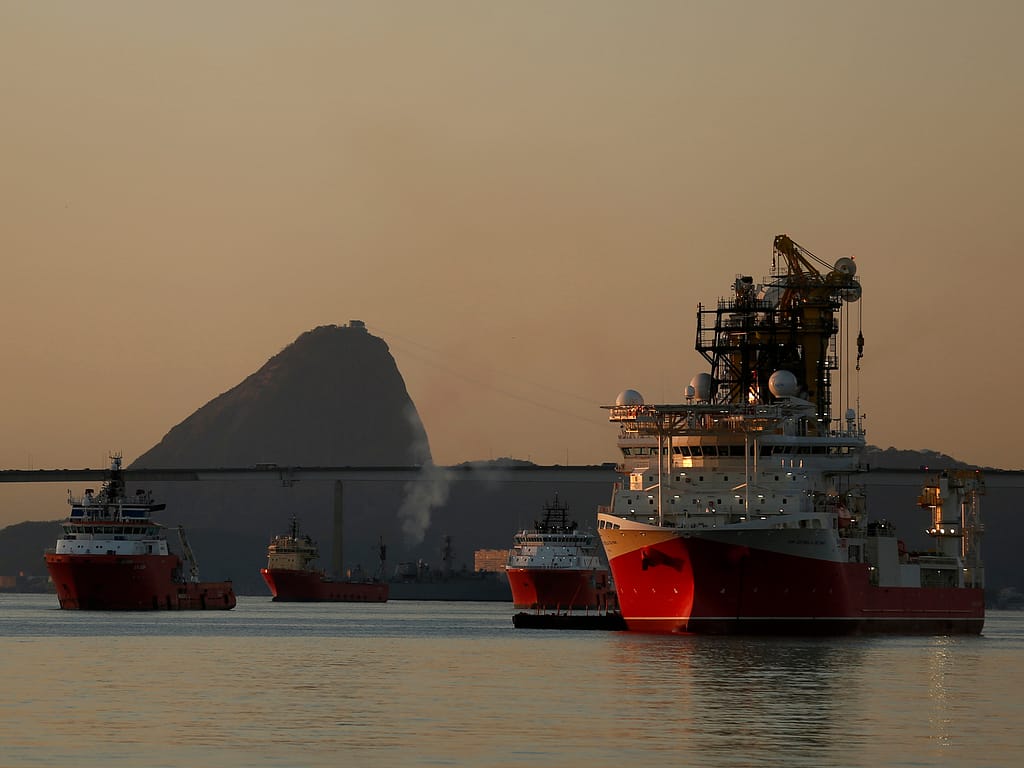
Image: Ships docked at the Guanabara Bay are pictured with the Sugar Loaf mountain in the background in the state of Rio de Janeiro, November 19, 2014. REUTERS/Pilar Olivares (BRAZIL – Tags: MARITIME SOCIETY)
Sign up to receive expert analysis from our community on the most important global issues, rapid insights on events as they unfold, and highlights of the Council’s best work.
© 2026 Atlantic Council
All rights reserved.
If refreshing the page doesn’t resolve the issue you could try clearing the sites browser cache.


