
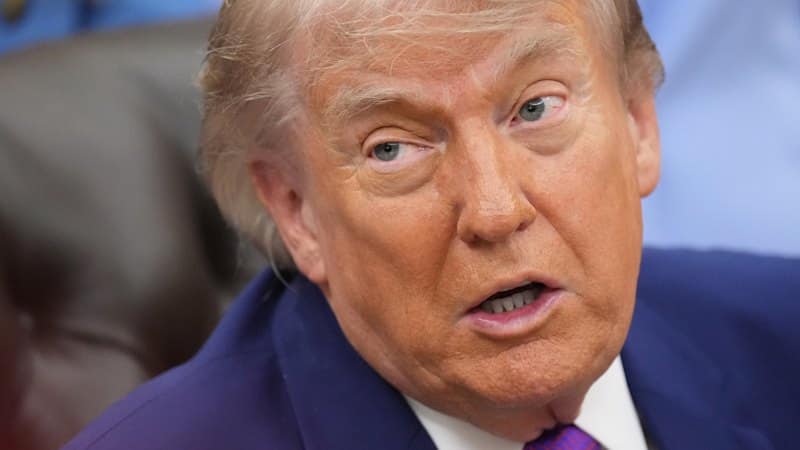
Trump’s war a $15 billion budget hit – and it could get much worse – The Age
You have reached your maximum number of saved items.
Remove items from your saved list to add more.
US President Donald Trump’s war with Iran has forced the government to spend an extra $15 billion over four years, slashing economic growth forecasts and spurring warnings of a disastrous spike in inflation if the conflict drags on and oil prices surge to as much as $US200 a barrel.
Iran seized control of the key shipping channel, the Strait of Hormuz, when the conflict began on February 28, disrupting about one-fifth of global oil supply.
The resulting oil shock has sent the global economy into a tailspin, including Australia, where growth is forecast to slow from 2.25 per cent this financial year to 1.75 per cent in 2026–27.
Treasurer Jim Chalmers used his budget night address to say that Australians have been “paying a hefty price for this war at the bowser and beyond”.
These pronouncements are based on an assumption that the oil price stays around $US100 a barrel and falls to $US80 by mid next year, a scenario that would require a swift end to the conflict and a resumption of shipping from the Middle East.
The global oil price was about $US60 a barrel before the war started and has been hovering around $US100 a barrel for most of the past two months.
However, Chalmers warned the “biggest oil shock in history” may become even worse. Under a dire scenario modelled by Treasury, the conflict would drag on and oil would rise to $US200 a barrel and take three years to fall down.
“We would still avoid a recession but unemployment would spike to pre-pandemic levels, and inflation would peak above 7 per cent,” Chalmers said.
Australia imports nearly 90 per cent of its petrol, diesel and aviation fuel, and with much of the Middle East’s oil production cut off, the government will spend $14.8 billion over the next four years to secure additional supplies and build extra storage.
This includes $3 billion on a temporary cut to diesel and petrol excise, to lower fuel costs for motorists. The government has not ruled out an extension, should the conflict continue, which would blow an even bigger hole in the budget bottom line.
The budget papers make clear that uncertainty over the war is playing havoc with Treasury forecasts, with much hinging on whether the US and Iran can reach a long-term settlement or whether they return to active fighting.
In the short term, the war has improved the budget bottom line by $9.5 billion over the next four years because of increased tax revenue from coal and gas exports.
Over the long term, however, lower economic activity, investment and labour demand would lead to a downgrade in receipts.
“The risks to the global economic outlook are largely contingent on the duration and severity of the conflict in the Middle East,” the budget papers state.
“If the resolution to the conflict and sustained reopening of the Strait of Hormuz is quicker than market expectations, this could result in upside to the global economic growth forecasts.”
The budget papers warn that global inflation is driving protectionism around the world, putting upward pressure on prices.
Meanwhile, prices are also rising for other key Middle Eastern exports that are in short supply, including chemicals, aluminium, plastics and fertiliser – which is a particular risk to food prices.
While the central forecast in the budget assumes that Australia’s regional oil benchmark price for Tapis crude will average $US100 per barrel in the June quarter 2026, before declining until the middle of 2027.
However, as the budget was being written, Tapis has fluctuated significantly and reached as high as $US125 a barrel in early May.
The budget papers say that the Iran War “has had a substantial impact on the Australian economy, and the domestic outlook remains highly uncertain”.
And that the conflict in the Middle East “is adding to inflationary pressures and supply constraints in parts of the economy”.
“Prior to the conflict, inflation was already above the RBA’s target band, and the economy was operating close to its maximum capacity.
“Inflation is forecast to be 5 per cent through the year to the June quarter 2026, with most of the pick-up attributable to the sharp rise in fuel prices.”
While acknowledging the economic hit of the war and the uncertainty it has unleashed, the budget urges Australians not to despair and realise they could have it worse elsewhere.
“Despite the substantial economic impact of this global shock, Australia confronts these challenges from a position of strength,” the budget papers state.
“The Australian economy is growing faster than any major advanced economy, has low unemployment, solid wage growth, and our public finances are among the strongest in the developed world.”
You have reached your maximum number of saved items.
Remove items from your saved list to add more.
More: