
Trump’s riding a bubble that’s set to burst – Socialist Worker
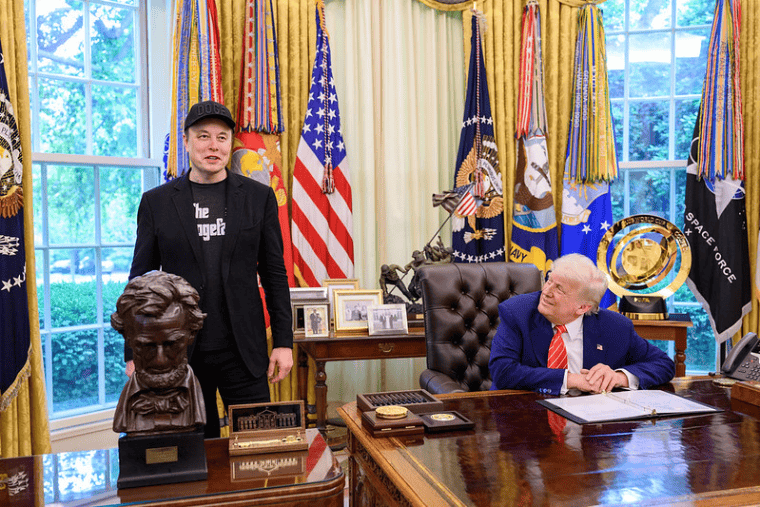
Donald Trump and tech trillionaire Elon Musk (Picture: The White House)
Donald Trump’s second presidency is shaping up to be an even bigger car crash than his first. His fragile peace deal with Iran is an acceptance of defeat.
The war has pushed inflation up and Trump’s approval numbers down. The Ice anti-migrant terror was blunted by resistance in Minneapolis.
And yet, the US ruling class, which shunned Trump after the 6 January 2021 far right assault on the Capitol in Washington, shows no sign of getting restive.
The fundamental reason for this is the continual rise in the stock markets that is making corporate bosses even richer.
Trump is very aware of this. He has timed his endless, premature announcements of peace in the Gulf to keep share prices rising.
The same will happen this week, until the next blip caused by Israel’s sabotage.
But Trump is benefitting from a much larger process—the giant financial bubble that has been inflating in the US economy around artificial intelligence (AI).
This isn’t just a mirage.
Leading Big Tech companies (the “hyperscalers”) have been investing phenomenal amounts of money in AI hardware—for example, the data centres required to feed the different AI algorithms under development.
It’s symptomatic of the changes in productive capital that the share price of Nvidia, which manufactures advanced semiconductors, has sailed far ahead of those of the other Magnificent Seven tech giants.
But—like the railway mania in Britain in the mid-19th century and the dotcom boom of the 1990s—this is a bubble.
In other words, the expected profits on AI won’t arrive, irrespective of the eventual economic benefits it produces.
The Marxist economist Michael Roberts writes, “If the hyperscalers need to generate, say, a 10 percent return on investment, they would have to find an additional $2-5 trillion in revenue a year. That’s a tall order for a group of companies that generates revenues of just $1.5 trillion per year. The other option is that the planned investment in data centres, computer chips and other areas never materialises.”
Given that the US economy is now being driven by tech investment, the latter outcome would probably mean a recession.
The launch of Elon Musk’s SpaceX last week on the US stock market is the latest sign of this bubble.
Musk’s ascent to the paper status of the world’s first trillionaire was hyped to the skies by supposedly respectable institutions such as the BBC and the Financial Times newspaper.
The left-liberal economist Paul Krugman cut through the boosterism. “His wealth has historically rested mainly on self-fulfilling faith—investors believing in Musk’s genius have piled into stocks in Musk-controlled companies, and the rising value of these companies has enhanced his reputation for genius.
“We have a term for enterprises that look successful because they keep drawing in new investors and keep drawing in new investors because they look successful. They’re called Ponzi schemes. And Musk is basically a human Ponzi scheme.”
The Financial Times’s top market expert, Robert Armstrong, concedes “two related concerns” about the SpaceX launch.
“One is that it was a massive fix by the finance industry, motivated by a mad grab for fees. The other is that putting a $1.75 trillion valuation on a cash-burning company in industries that are somehow both speculative and incredibly competitive is plain” irrational.
The banks, headed by Goldman Sachs, that managed the launch made $500 million in fees.
Some stock exchanges, notably Nasdaq, changed their rules to rush SpaceX onto their indexes.
This will keep its shares rising because “passive investors,” such as giant asset managers like BlackRock, must buy into companies that are on the index.
New technology, old scams. There’s nothing here that would have surprised Karl Marx, who analysed many stock‑exchange fixes in his time.
Trump is as much a beneficiary of this process as Musk and Goldman Sachs.
The economic optimism generated by the AI bubble has allowed him to ride out the scandals created by his own family’s profiteering and by his political failures, above all in the Middle East.
The other side to this is that, when the bubble bursts, he will become much more vulnerable.
The US president needs a deal with Iran fast
The Labour right’s first loyalty has always been to British imperialism
US is down but not out
Starmer brings back Blairites
"*" indicates required fields


