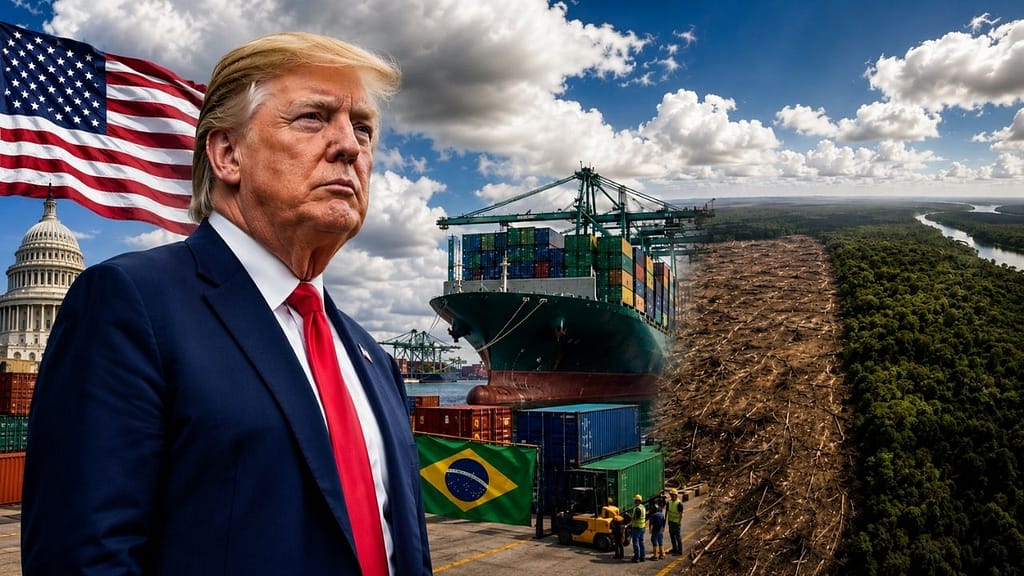
Trump threatens Brazil with a 25% tariff and uses illegal deforestation as an argument to pressure exports; US report accuses environmental failures, while recent decline in the Amazon exposes a dispute that could impact Brazilian trade and politics. – CPG Click Petróleo e Gás
Economy
The Donald Trump administration opened a new front of pressure on Brazil, and this time the chosen argument was environmental. In a report released this Tuesday (2), the United States included illegal deforestation among the justifications for proposing 25% tariffs on Brazilian products. The central claim is that the commercialization of wood and meat produced in illegally deforested areas would reduce costs and generate a competitive advantage considered unfair by the Americans.
Trump’s measure places the environmental issue at the center of a trade dispute that could have significant economic and political ramifications for Brazil. The document states that the country fails in environmental oversight, points to alleged fraud in the timber and livestock chains, and cites studies according to which 91% of deforestation in the Amazon between 2023 and 2024 was illegal. The Brazilian government, in turn, rejects the accusation of systematic omission in combating environmental crimes.
The American document builds its argument around the idea of unfair competition. According to the United States, by allowing wood and meat to come from illegally deforested areas, Brazil would be reducing production costs in these sectors, giving Brazilian goods an unfair competitive advantage in the international market. It is based on this logic that the 25% tariff is proposed.
While banks see the risk of default and difficulty in recovering financed motorcycles, the Lula government is considering using a guarantee fund to unlock credit for delivery workers; the measure could reach up to 1.2 million workers linked to digital platforms.
SpaceX sets share price at $135 and targets a historic $75 billion IPO to debut on Nasdaq with a trillion-dollar market value
While the world rushes to mine lithium from Congo and Chile, Brazil sits on one of the largest reserves and has barely begun to explore.
Heir worked at thirteen in an ice cream factory without revealing he was the owner’s son; today, at twenty-five, he leads the best-selling ice cream brand for home consumption in the Northeast, grosses almost R$ 300 million, has 145 stores, and competes with multinationals with regional flavors.
The report also points to alleged fraud in the timber and livestock production chains. Among the cited data is the estimate that 91% of deforestation in the Amazon between 2023 and 2024 was illegal, a number used to support the thesis of failure in Brazilian environmental oversight. The text also mentions the advance of deforestation in 2021, during Jair Bolsonaro’s government, when outlining the historical environmental issue in the country.
One of the most relevant points of the analysis is precisely what the United States report does not mention. Although it cites deforestation data from previous years, the document leaves out more recent information that shows a trend of decreasing rates. This omission is central to understanding the dispute, as it significantly changes the portrayal of the Brazilian environmental situation.
In 2025, Brazil recorded the lowest rate of deforestation in the Amazon in over ten years. Additionally, the Atlantic Forest reached the lowest level of deforestation in the last 41 years, according to data circulated among researchers. By not incorporating these recent numbers, the report presents a picture that emphasizes historical problems without reflecting recent advances, a point that the Brazilian government is likely to explore in its defense against American accusations.
Despite the strong tone of the report, Trump’s tariff proposal did not affect all products from the sectors mentioned in the document. This selectivity reveals that, behind the environmental argument, there are also commercial and diplomatic calculations that shape which goods are targeted by the tariffs.
This difference between broad discourse and selective application raises questions about the real motivations of the measure. When a report accuses entire sectors of unfair practices, but the tariff does not apply to all products in those sectors, it leaves open the discussion about how much the environmental justification is the central reason or just one of the arguments of a broader commercial strategy. For analysts, this type of inconsistency often indicates that economic and political interests weigh as much as the declared concerns.
Trump’s tariff threat has the potential to directly affect important sectors of the Brazilian economy, especially those linked to the export of wood and meat. Tariffs of 25% would make these products more expensive in the American market, reducing their competitiveness and potentially causing significant losses for producers and exporters who depend on trade with the United States.
But the impact is not limited to the economy; it also crosses into the political field. At a time when trade and environmental issues are gaining weight in the Brazilian public debate, external pressure of this magnitude tends to resonate in internal discussions, potentially being used by different political actors according to their interests. The combination of foreign trade, environment, and diplomatic tension with the United States creates a scenario where the dispute goes beyond economic borders and enters the political realm, in a year of great sensitivity in this aspect.
The case highlights how the environment has become a negotiation tool in international trade. Using deforestation as an argument to justify tariffs shows that environmental issues have ceased to be just a topic for climate summits and have started to occupy space at trade negotiation tables, with concrete economic weight.
For Brazil, this represents a dual challenge. On one hand, the country needs to respond to the accusations with data and diplomacy, defending its recent trajectory of reducing deforestation. On the other, it sees a legitimate issue, the preservation of the Amazon, being instrumentalized within a commercial dispute whose motivations are not always exclusively environmental. The outcome of this clash will depend both on Brazil’s negotiation capacity and the evolution of relations between Brasília and Washington in the coming months.
What do you think about using deforestation as an argument for trade tariffs? Do you believe the environmental concern is genuine or just a justification for economic pressure? And how should Brazil respond to this type of measure? Leave your opinion in the comments, but let’s maintain respect, because the topic involves many different angles.
I produce daily content on economics, diverse topics, the automotive sector, technology, innovation, construction, and the oil and gas sector, with a focus on what truly matters to the Brazilian market. Here, you will find updated job opportunities and key industry developments. Have a content suggestion or want to advertise your job opening? Contact me: carlatdl016@gmail.com
© 2026 Click Petróleo e Gás – All rights reserved