
Trump isn't losing MAGA. Not even close. – Seth Masket | Substack
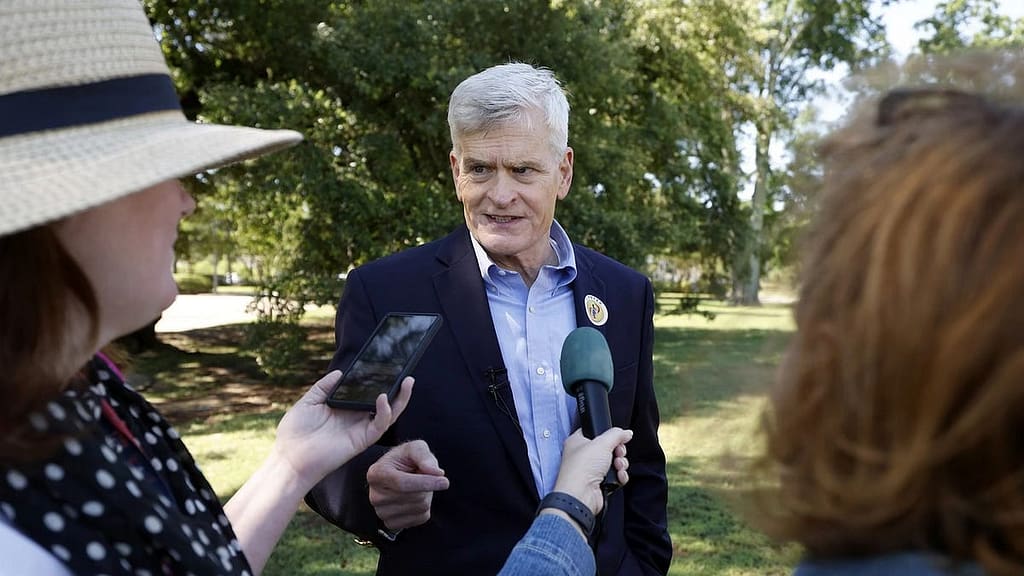
There’s been a lot of speculation in recent months that Donald Trump is losing favor with his MAGA base — that the combination of the Epstein files and the war with Iran is tearing away the supporters that Trump has drawn into politics since 2015. Senator Bill Cassidy’s loss in this past weekend’s Louisiana Republican primary election pins a lie to such claims.
the @smotus report is a reader-supported publication. To support this work, please consider becoming a paid subscriber.
Cassidy is a two-term senator and the chair of the influential Senate Health, Education, Labor, and Pensions (HELP) Committee. He’s served as a Republican since 2006 as a state legislator, House member, and senator. While once a conservative southern Democrat, he has advocated traditional conservative Republican causes for decades, including numerous votes for tax cuts and abortion restrictions.
But he lost the favor of Donald Trump on one key vote cast more than five years ago: his vote to convict Trump in his impeachment trial for helping to organize a riot to prevent Joe Biden’s presidency. Cassidy, a physician, has also been a vocal critic of Health and Human Services Secretary Robert F. Kennedy, Jr. on vaccine policy and other issues, although others have done that and lived to tell the tale. In this weekend’s primary, Trump endorsed Rep. Julia Letlow, who came in 20 points ahead of Cassidy. State Treasurer John Flemming also surpassed Cassidy and will face Letlow in the runoff election.
In my forthcoming book, I examine Trump’s continued influence and control over other elected officials in the Republican Party. He has a few tools for achieving this, but the most significant is his control over party nominations. As any 19th or 20th century party boss would tell you, whoever controls the nomination controls the party. Nomination control is not always easy in an age dominated by primary elections, but Trump retains a very passionate and devout following among those voters who show up for such contests.
I write in the book about how Trump drove most of the House Republicans who voted for his impeachment out of politics in short order:
In January 2021, a week before President Donald Trump left office, ten Republican members of the US House of Representatives joined all their Democratic colleagues in voting to impeach him for his role in fomenting a violent riot at the Capitol. Two years later, eight of those Republicans were gone from Washington, while Trump was the frontrunner for the 2024 Republican presidential nomination.
Among those ten Republican House members who voted for impeachment were two particularly high-profile members: Reps. Liz Cheney of Wyoming and Adam Kinzinger of Illinois, who served on the House select committee investigating the January 6th riots in 2021. For their efforts… they were censured by state and local Republican parties, and, in February 2022, by the Republican National Committee. (In describing their work investigating the riots, the Republican National Committee’s censure resolution accused Cheney and Kinzinger of “participating in a Democrat-led persecution of ordinary citizens engaged in legitimate political discourse.”) Kinzinger declined to run for another term in Congress after redistricting placed him and another Republican incumbent in the same district. Cheney overwhelmingly lost her party’s 2022 primary election to political newcomer Harriet Hageman, who had Trump’s backing.
Among the others who voted to impeach Trump, Reps. Tom Rice of South Carolina, Peter Meijer of Michigan, and Jamie Herrera Beutler of Washington lost their Republican primary contests in 2022. Reps. John Katko of New York, Fred Upton of Michigan, and Anthony Gonzales of Ohio declined to run for another term. (In an interview, Gonzales said that it would be a “brutally hard primary” if he had decided to run again, since Trump had endorsed his main rival.) Only Reps. David Valadao of California and Dan Newhouse of Washington were still in Congress when Trump returned to office.
In research I conducted with Mike Cowburn and Rachel Blum, we examined Trump’s endorsements in all the Senate and gubernatorial primaries in 2022. We found that, even controlling for things like fundraising, media coverage, and social media exposure, Trump’s endorsement was worth about 16 percentage points in the primary. That is a profoundly large effect for a single person’s endorsement. In many cases it’s the difference between a win and a loss, and it can turn what would otherwise be a longshot candidacy into a competitive challenge. Keep in mind that this 16 percentage point boost was achieved while Trump was an ex-president. We don’t know how powerful his endorsement is now, but it doesn’t seem to have lost its sting.
Did other presidents have this kind of influence on primary voters in their own party? It’s hard to say, because other presidents just don’t get involved in their own party’s primary contests. (On those rare occasions they do, it’s often for reasons like when President George H.W. Bush opposed the nomination of Klan leader David Duke for a Louisiana statehouse seat in 1989 — he was trying to protect his party’s brand.) Most other presidents are typically concerned with keeping their party together and avoiding factional fights; Trump instead leans into factional fights in an attempt to reshape the party in his own image. He has been quite successful in this.
We know Trump’s overall popularity has been inching downward all year, and he’s losing a chunk of the folks who elected him in 2024. If there were somehow a presidential election this year Trump would almost certainly lose it. But within his party, he is still the kingmaker. The most passionate Republican voters — the ones who turn out for primary elections — still follow his cues. That will likely be true as long as he lives.
Thanks for reading the @smotus report! This post is public so feel free to share it.
Share
Some people are just not able to look at themselves in the mirror and say, "That was a mistake." Others look in the mirror and say, “I have to be right, because all the others are wrong (thus says my White Christian Nationalist Faith)”. Finally, there are those who lack self-awareness. But in truth, most Germans knew what was going on at the concentration camp in their backyards. And for MAGA, it is the same. Go with the flow. Or as Hannah Arendt summarized it, “The banality of evil." Why should we be any different?
Well done, SM.
No posts


