
Trump DOJ wants to sideline citizens in pollution fights – E&E News by POLITICO
 Full access to essential energy & environment news for professionals.
EXPLORE COVERAGE
GET ACCESS
EXPLORE COVERAGE
By Ariel Wittenberg | 06/17/2026 01:28 PM EDT
In a court filing backing Elon Musk’s AI company, the Trump administration said the federal government can stop Americans from suing over air pollution.
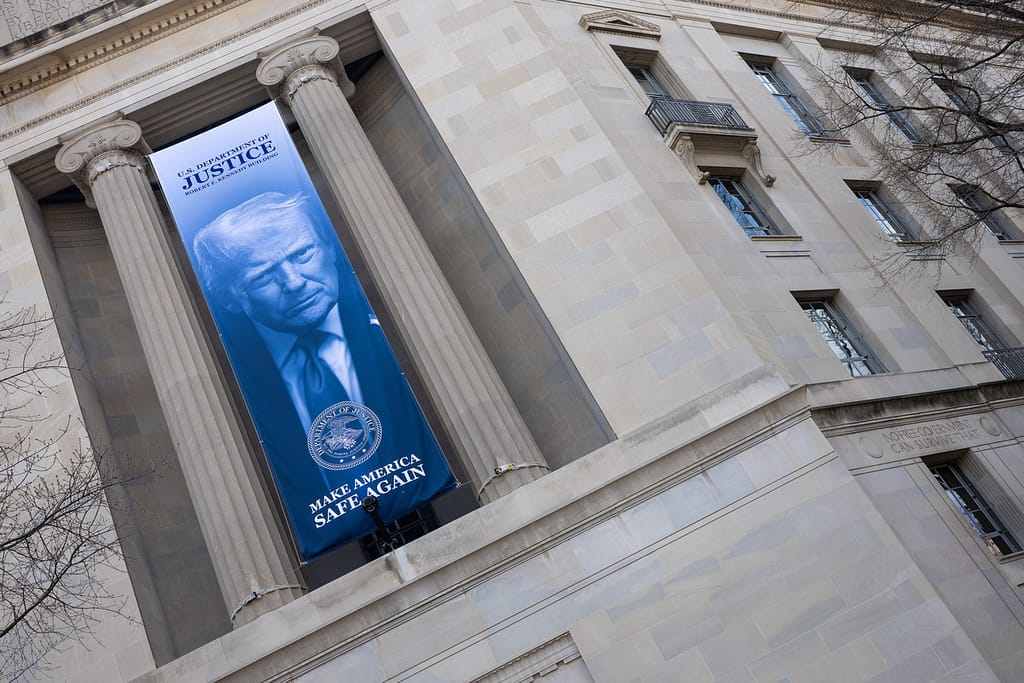
A banner with an image of President Donald Trump hangs outside Department of Justice headquarters in Washington on March 11. Francis Chung/POLITICO
The Trump administration is making the case that the federal government can quash citizen Clean Air Act lawsuits against polluters, a move environmental lawyers warn would rewrite decades of enforcement law.
If successful, the argument, made by the Department of Justice in a court filing supporting Elon Musk’s artificial intelligence company, would dramatically undermine the power of U.S. residents to fight pollution at tens of thousands of industrial sites across the country.
“It would be a pretty sweeping change in the way enforcement works for the federal pollution control statutes,” said Tom Mariani, former chief of environmental enforcement at DOJ.
The Clean Air Act allows citizens and environmental groups to sue alleged polluters. Typically, the federal government or a state can move to intervene if it has plans to step in and take over enforcement of the case. The act itself only limits citizen suits once the government has “commenced and is diligently prosecuting a civil action.”
But now, DOJ says it can intervene if it does not want to prosecute a case and prevent citizens from taking actions themselves. The department says the Clean Air Act gives the government a “right of dismissal” that “entitles the United States to dismiss the entire action” and that preventing the government from dismissing citizen suits would violate the Constitution.
“Ultimate responsibility for enforcing federal law belongs to the Executive Branch, not private interest groups,” said Associate Attorney General Stanley Woodward Jr., DOJ’s No. 3 official, in a press release supporting the motion. “The Department of Justice is committed to maintaining that constitutional order while protecting national security and promoting American energy and innovation.”
Legal experts say DOJ’s approach is the opposite of how things are supposed to work.
“This is the government saying we can intervene for the purpose of not prosecuting and making sure nobody else can either,” Mariani said.
Pat Parenteau, an emeritus professor at the Vermont Law and Graduate School, agreed. He said DOJ’s position “is insane” and incorrectly interprets the law. Still, it could have sweeping implications for environmental challenges beyond the Clean Air Act.
“When you invoke Article 2 of the Constitution to say that citizens have no rights to enforce the law, that sweeps across everything — that’s what’s at stake here,” he said.
Similar arguments have recently been deployed by a conservative law firm in a Clean Water Act case, but this is the first time the federal government has co-signed the position.
DOJ’s filing comes amid controversy over Musk’s artificial intelligence company, xAI, and the way it has powered its data centers near the Tennessee-Mississippi border.
The NAACP, Earthjustice and the Southern Environmental Law Center sued the company in April. The groups allege xAI has been running at least 59 polluting turbines at its gas plant without first obtaining permits or installing pollution controls required by the Clean Air Act. Such turbines can emit cancer-causing chemicals and ones that cause respiratory illnesses. The groups sued, in part, because Mississippi environmental regulators have told xAI the company does not need permits for turbines that operate for less than a year.
DOJ says that means no one else can sue.
“The best interpretation of the Clean Air Act — which ensures the Executive Branch retains its primacy over the enforcement of federal law — is also necessary to avoid grave constitutional problems with the statute’s citizen-suit provisions,” the department told Chief Judge Debra Brown, who was appointed by former President Barack Obama to the federal court in Mississippi that is handling the xAI case.
DOJ said it also opposes the suit over national security concerns because the department relies on xAI’s Grok government model, which is powered by the data center at issue.
XAI, for its part, also argued that “the Clean Air Act’s citizen-suit provision itself violates Article II of the U.S. Constitution because it vests federal law enforcement authority outside of the executive branch.” It argued in legal briefs that the case should be dismissed and noted that Mississippi regulators had confirmed the company did not require permits for “temporary” gas turbines.
The company’s legal opponents slapped back against those arguments in a Tuesday press release.
“At a time when the ultra-rich seem to be protected and supported by some of our government entities, it is important that polluting industries don’t get to benefit at the expense of the health of Black communities,” said Abre’ Conner, NAACP director of environmental and climate justice. “Laws like the Clean Air Act are a bedrock insurance policy for communities to hold polluters accountable for decisions that cause them harm. This should not be up for debate, and the NAACP will continue to stand up for democracy and against federal bullying and authoritarianism.”
DOJ’s motion to intervene has made waves across the broader environmental community.
John Walke, federal clean air director for the Natural Resources Defense Council, said he does not believe DOJ’s motion holds water. He wants the judge to reject it.
Still, he noted, that “there are tens of thousands of industrial facilities in the United States regulated by the Clean Air Act.”
“If the Trump Justice Department gets away with this maneuver, the administration can block citizen enforcement cases whenever they wanted to help a polluter, whenever they did not like the Clean Air Act rules,” he said.
Walke also noted that the specific circumstances of the xAI case make DOJ’s position “all the more extraordinary.”
This is the second data center where xAI has been accused of generating electricity without federal pollution permits in two years. In the two months since environmental groups filed their lawsuit, xAI has allegedly continued to increase the number of unapproved natural gas turbines on-site from 27 to 57.
“For this to be the case that the Trump administration wants to be the test case for shutting down citizen’s rights to stand up for their health — it’s literally breathtaking,” Walke said.
The transformation of the energy sector.
Policy. Science. Business.
Congress. Legislation. Politics.
The leader in energy and environment news.
Late-breaking news.
© POLITICO, LLC


