
Trump arrives in China with Iran war looming over talks – Al-Monitor
Welcome back to the Daily Briefing.
This is Ezgi Akin, filling in for Gabrielle.
In today’s edition:
Thanks for reading,
Ezgi (ezgi_akin)
Trump arrives in China on high-stakes visit
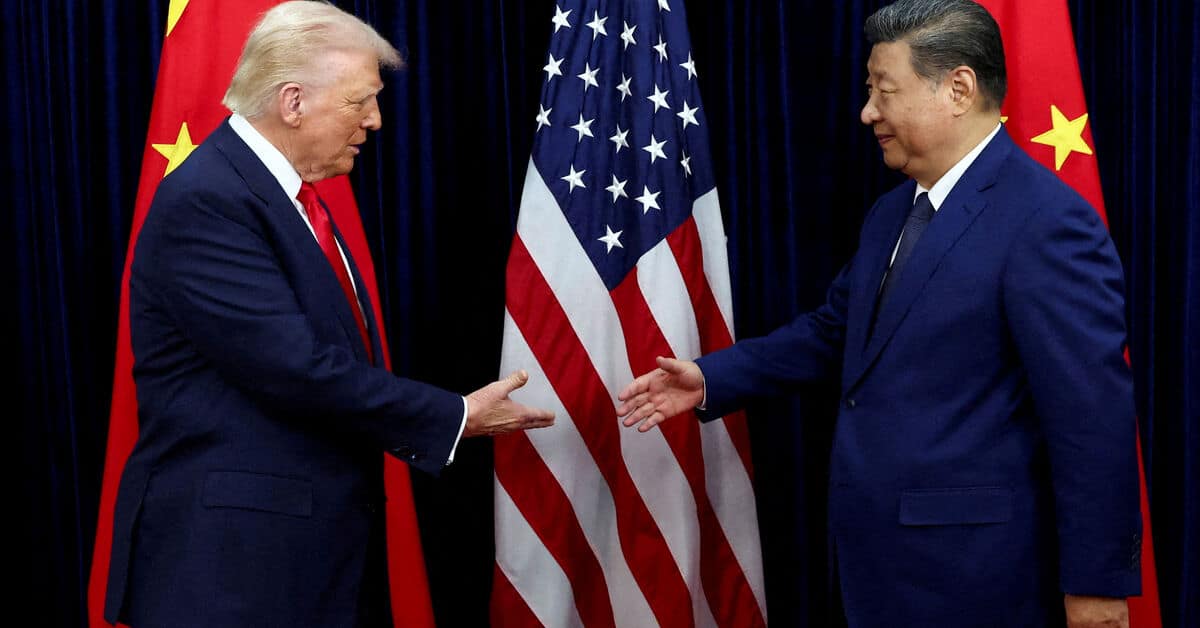
US President Donald Trump shakes hands with Chinese President Xi Jinping as they hold a bilateral meeting at Gimhae International Airport, on the sidelines of the Asia-Pacific Economic Cooperation (APEC) summit, in Busan, South Korea, Oct. 30, 2025. REUTERS/Evelyn Hockstein/File Photo
President Donald Trump arrived in Beijing on Wednesday for his much-anticipated two-day visit to China, where the US-Iran war is expected to loom over talks with Chinese President Xi Jinping.
The visit was initially scheduled for the first week of April but postponed after the conflict broke out. Tehran will be watching the visit closely, as it deems Beijing the only global power capable of simultaneously restraining Washington, preserving regional stability and preventing Iran from slipping into deeper isolation.
Ahead of Trump’s visit, Iranian Foreign Minister Abbas Araghchi was in China last week for talks with Chinese officials as part of broader diplomatic efforts.
China is the world’s biggest buyer of Iranian oil, accounting for roughly 80% to 90% of Tehran’s oil exports before the war, much of it moved by a shadow fleet of vessels to evade sanctions.
Last week, China’s Ministry of Commerce ordered domestic companies to defy US sanctions targeting five Chinese oil refiners linked to Iranian crude imports. On Monday, the US Treasury Department announced new sanctions targeting Chinese purchases of Iranian oil.
For Tehran, the summit could bring relief if China restrains Washington — or alarm if Beijing quietly aligns with US pressure on shipping security, oil exports and broader Gulf stability, our correspondent in Tehran writes.
Trump showed little appetite to discuss the Iran war with his Chinese counterpart. Ahead of his departure from Washington, Trump said, “I don’t think we need any help with Iran. We’ll win it one way or the other, peacefully or otherwise.”
Iran condemns Kuwait over accusations of IRGC infiltration plot
An Islamic Revolutionary Guard Corps commander gives directions to speedboats on the water during a ceremony to commemorate the 24th anniversary of the downing of Iran Air flight 655 by the US Navy, at the port of Bandar Abbas on July 2, 2012. — ATTA KENARE/AFP/GettyImages
On the ground in the Gulf, tensions between Tehran and other Gulf capitals have risen.
On Wednesday, Iran’s Foreign Ministry reacted to Kuwait’s accusations that an Iranian team had sought to infiltrate the country by sea.
Kuwaiti authorities said on Tuesday that they had uncovered an Iranian plot to infiltrate the country, accusing a six-member armed team from Iran’s Islamic Revolutionary Guard Corps of attempting to do so earlier this month. Four members were detained, two escaped and one Kuwaiti security official was wounded, according to Kuwait’s Interior Ministry.
In response, the Iranian Foreign Ministry said on Wednesday that the four detained individuals were carrying out a routine maritime patrol when their navigation system malfunctioned and led them into Kuwaiti territorial waters. The statement dismissed the accusations as “unfounded claims.”
The exchange follows months of Iranian attacks on Kuwait and other Gulf countries, including Saudi Arabia and the United Arab Emirates, Beatrice Farhat reports.
US Ambassador to Israel Mike Huckabee confirmed on Tuesday that Israel had sent air defense systems and personnel to the UAE to help counter Iranian missile and drone attacks.
Saudi Arabia, meanwhile, launched numerous unpublicized strikes on Iran in retaliation for attacks inside the kingdom, Reuters reported Tuesday, citing two Western officials and two Iranian officials.
Lebanon authorities release Salafist cleric Khaled Hablas
Khaled Hablas is pictured in Tripoli, Lebanon, on May 12, 2026 following his release from prison. — @jezzinesociety
A controversial Sunni Salafist cleric Sheikh Khaled Hablas was released from a Lebanese prison on Tuesday in a move that could inflame tensions but is likely to please neighboring Syria.
Hablas came under scrutiny for his role in sectarian violence in northern Lebanon in 2014, calling on Sunnis to defect from the Lebanese military, accusing it of becoming “an Iranian army” targeting Lebanon’s Sunnis.
He was arrested in 2015 over his role in sectarian unrest tied to the Syrian civil war.
His release comes as Beirut and Damascus discuss prisoner transfers, a priority for Syrian President Ahmed al-Sharaa, though Hablas is Lebanese. Adam Lucente has the details here.
Israel’s drone dilemma: Hezbollah’s low-cost threat reshapes Lebanon front
Artillery units are positioned near the Lebanese border in northern Israel, May 4, 2026. — Erik Marmor/Getty Images
Despite Israel’s technological and military edge, it is struggling to stop one of the cheapest weapons now used by Hezbollah: small explosive drones targeting Israeli troops.
Israel’s defense spending, totaling more than $47 billion, appears to offer little protection against drones that can reportedly be bought online for as little as $300 each. Over the past month, the devices have killed four Israeli soldiers in southern Lebanon and along the border and wounded 28 others, despite the US-brokered ceasefire. Israel’s difficulties point to a broader problem: the lack of a clear strategy for containing Hezbollah, even after Iran’s weakening. Read Ben Caspit’s analysis.
Keep up with AL-MONITOR’s top stories with a morning digest from across the region.
For subscription inquiries, please contact subscription.support@al-monitor.com.
For all other inquiries, please use contactus@al-monitor.com.