
Trump administration faces bipartisan pushback as lawmakers vet a slew of nominees – Federal News Network
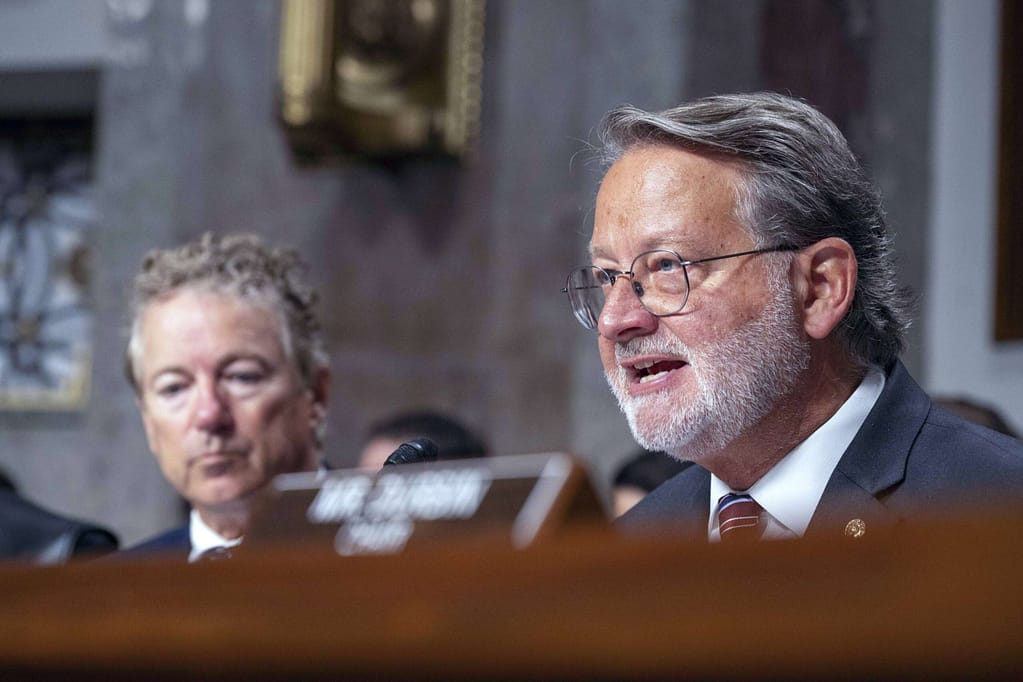
In several cases, Republican lawmakers joined Democrats on the committee in pushing back on some agency actions under the Trump administration.
The Senate Homeland Security and Governmental Affairs Committee heard from 11 of the Trump administration’s nominees in a jam-packed confirmation hearing Wednesday.
Senators heard from a slew of President Donald Trump’s nominees — including picks for three top jobs at the Department of Homeland Security, the second-in-command at the Office of Management and Budget, a Justice Department watchdog and two individuals tapped to serve on the Postal Service’s leadership board.
The committee also heard from Trump’s nominees to run an appeals board where federal employees can contest adverse personnel actions, and a watchdog office that broadly protects them against prohibited personnel practices.
Committee Ranking Member Gary Peters (D-Mich.) raised concerns about an “overcrowded lineup” of nominees put before the committee and said the confirmation process for these individuals has been “unnecessarily rushed.”
See how leaders are modernizing cloud with confidence in a new ebook, sponsored by Pega and AWS.
Charles Baldis, Trump’s pick to serve as special counsel at the Office of Special Counsel, did not receive any individual questions from lawmakers during the hearing.
Nominees did not provide opening statements, and Peters said the committee had not received written testimony from the nominees before the hearing.
According to Peters, Baldis and Cameron Hamilton, Trump’s pick to permanently lead the Federal Emergency Management Agency, have not completed FBI background investigations.
“To my knowledge, it is completely unprecedented for this committee to proceed to a hearing before these very fundamental vetting steps are complete,” Peters said. “It does a disservice to these nominees as well as to members.”
In several cases, Republican lawmakers joined Democrats on the committee in pushing back on some agency actions under the Trump administration.
Hal Duncan, tapped to serve as OMB’s deputy director, touted the administration’s launch of an interagency fraud task force that’s led by the White House, but also fielded bipartisan questions about OMB’s delays in responding to Government Accountability Office audits.
Peters said that OMB is refusing to cooperate with at least 14 audits underway from the Government Accountability Office — and that at least 10 of them are statutorily required.
Sign up for our daily newsletter so you never miss a beat on all things federal
“These are independent watchdogs, and their work has literally saved billions in taxpayer money from fraud, from abuse, and you’re ignoring those. OMB is ignoring them,” Peters said.
Duncan said GAO has seven times as many employees as OMB, and that it had 50 open inquiries from GAO in mid-2025.
Sen. Joni Ernst (R-Iowa) said OMB “has been very slow to respond to some of [GAO’s] investigations.”
“The legislative branch conducts oversight, and this is one of the most foundational parts of the back and forth between the executive and the legislative branches. The Government Accountability Office conducts different in-depth investigations, and a lot of that work is done on behalf of a number of us,” Ernst said.
OMB, in a proposed rule released earlier this month, sought to have political appointees do a “pre-issuance review” to ensure discretionary grants advance the president’s policy priorities.
“The ultimate deciders of these grants will be the political employees at the agencies,” Duncan said, adding that OMB does not issue grants but does issue guidance to agencies on how to administer grants.
Trump’s pick to lead FEMA told lawmakers that the agency is hiring for hundreds of positions. The administration previously considered downsizing FEMA’s workforce or eliminating the agency.
Hamilton said DHS has approved hiring for roughly 350 positions at FEMA, and that DHS Secretary Markwayne Mullin “cares very deeply about ensuring that the workforce is sufficiently staffed commensurate to the responsibilities.”
FEMA in May reinstated about 180 disaster workers whose contracts the agency did not renew in January. The agency recently announced it would make hundreds of new hires, but those plans fall well short of replacing all the employees who have left under the Trump administration. The agency has lost approximately 5,000 staff since January 2025.
Read more: Congress
Hamilton briefly served as FEMA’s acting leader last year, but was fired in May 2025 after telling lawmakers that he said he did not “believe it is in the best interest of the American people to eliminate” FEMA. If confirmed, he would be FEMA’s first permanent administrator in Trump’s second term.
A Trump-appointed council backed off on proposing deep staffing cuts to FEMA’s workforce in a report released last month. A draft version of the council’s report had included a recommendation to reduce FEMA’s overall staffing by approximately 50% over the next two to three years.
Sen. Josh Hawley (R-Mo.) told Hamilton that “I think what your agency does is hugely important,” but urged FEMA to speed up approval of disaster declarations.
“My question is, will you come in and take the reins of this agency and make it actually work for the people of my state and every state who, when they’re facing these disasters, they need quick relief, they need quick responses,” Hawley said.
Brian Cavanaugh, tapped to serve as DHS under secretary for management, told lawmakers that he would commit to reviewing severe staffing cuts at DHS’ Office of Civil Rights and Civil Liberties.
David Cummings, tapped to lead the Transportation Security Administration, told lawmakers that TSA workforce morale “is quite low right now,” after its employees were not paid on time following a 76-day DHS funding lapse this year and a 43-day government shutdown last year.
Cummings said workforce morale would be his “number one priority” if confirmed, and encouraged lawmakers to avoid a similar lapse that would put paychecks on hold.
“I would hope that this Congress keeps that in mind, and for future appropriations and spending bills, that if we should care about the essential workers we should care about those that are protecting our borders, those that are protecting our airports, our transportation systems,” Cummings said.
The Merit Systems Protection Board is generally responsible for adjudicating appeals on federal personnel cases, aiming to protect federal employees against prohibited personnel practices such as whistleblower retaliation.
James Woodruff, Trump’s pick to serve as the MSPB’s chairman, told lawmakers that “it is up to the board to protect those protections that have been brought,” but said its jurisdiction is fairly narrow.
“What we look at, when we’re deciding these cases and having them brought before us, is what did Congress give us as far as authority goes? And within that small jurisdiction, whether or not we have the authority to act,” Woodruff said.
Trump fired a Democratic member of the MSPB early last year. Over the last several months, the Office of Personnel Management has proposed various regulations to change the appeals processes for federal employees who believe their agency wrongfully terminated them.
Charlton Allen, nominated to serve as general counsel of the Federal Labor Relations Authority, fielded questions about a NOTUS article published Wednesday stating that Allen, while in college, “ran a student newspaper that belittled and disparaged Black, LGBTQ+, Jewish groups and individuals.”
The American Federation of Government Employees called on Allen to withdraw his nomination, calling the actions described by NOTUS as “inexcusable” and “disqualifying.”
Allen told lawmakers that some of the student newspaper’s content was taken out of context, but said it was a “mistake” to run a cover story featuring a Jewish student running for student body president with horns and a pitchfork.
“If I were 30 years ago advocating for the review, I would say don’t run that cover. I think it was a mistake,” Allen said.
The FLRA oversees labor relations between the federal government and its employees. The Trump administration has barred a wide swath of the federal workforce from collective bargaining through a pair of executive orders.
Bradford Wilson, Trump’s nominee to lead the National Archives and Records Administration, told lawmakers that he would uphold laws governing federal records retention and disposal.
Before his second term in office, Trump faced federal charges involving retention of classified federal records at his Mar-a-Lago estate, although the charges were ultimately dismissed.
“I’m a rule-of-law man, and I intend to follow the law, including on the subject of the disposition of federal records,” Wilson said.
Don Berthiaume, Trump’s pick to serve as the inspector general for the Justice Department, agreed with a district court’s opinion that Trump unlawfully fired 17 agency IGs at the start of this second term, but said agree with the court’s finding that reinstatement was unnecessary, because “there was not irreparable harm to the IGs by him doing so.”
“I agree with the court’s decision on that one,” Berthiaume said.
Two of Trump’s picks to serve on the Postal Service’s Board of Governors dismissed the agency’s current 10-year reform plan and called for drafting a new long-term strategy to keep the agency from running out of cash. The board currently has five vacancies. By law, no more than five of the board’s nine presidential-appointed governors may belong to the same political party.
Jeffrey Brodsky, one of Trump’s picks, said USPS has fallen short of its break-even goals under the 10-year Delivering for America plan launched by former Postmaster General Louis DeJoy.
“We have to come up with a new plan, a long-term plan,” Brodsky said.
William Gallo agreed that the 10-year plan hasn’t improved the agency’s finances and that the agency needs to take a new approach.
“You’re supposed to make it break-even over 10 years. You’re six years into it, and you’re still losing the same amount of money,” Gallo said.
Gallo said the Postal Service’s issues are “fixable,” but that USPS would likely have to reduce its workforce.
“Obviously, the workforce at over 600,000 people is too high. And you need to figure out who’s performing. Who’s coming to work and who’s not? Who’s getting paid and not coming to work? All of this has to be looked at,” he said.
Trump’s two other nominees for the USPS Board of Governors, Anthony Lomangino and Robert Steffens, did not testify at Wednesday’s hearing, but were originally scheduled to appear before the committee.
A Senate HSGAC aide for the minority told Federal News Network that committee Chairman Rand Paul (R-Ky.) did not specify why the nominees were taken off the hearing, but said Lomangino and Steffens had not yet completed the committee’s required ethics paperwork. The aide said it’s not yet clear when the committee will hold a confirmation hearing for those two nominees.
If you would like to contact this reporter about recent changes in the federal government, please email jheckman@federalnewsnetwork.com, or reach out on Signal at jheckman.29
Copyright © 2026 Federal News Network. All rights reserved. This website is not intended for users located within the European Economic Area.
Jory Heckman is a reporter at Federal News Network covering the Postal Service, Department of Veterans Affairs, IRS, big data and technology issues.
Follow @jheckmanWFED


