
Third Circuit greenlights Trump removal of exhibit on Washington's slaves – Courthouse News
Wednesday, April 23, 2025
Philadelphia sued the Trump administration in January, arguing alterations to the exhibit required city approval.
PHILADELPHIA (CN) — A Third Circuit panel on Thursday ruled that the Trump administration’s efforts to alter an exhibit on people enslaved at George Washington’s and John Adams’ Philadelphia presidential home can proceed.
Published by the appeals court one day before Juneteenth — the federal holiday commemorating the end of slavery in the U.S. — the ruling marks a judicial affirmation of Trump’s push to sanitize the nation’s history by altering national park displays his administration argues “inappropriately disparage” the United States.
When asked by Courthouse News to comment on the ruling, an Interior Department spokesperson replied with just three words:
“Trust in Trump.”
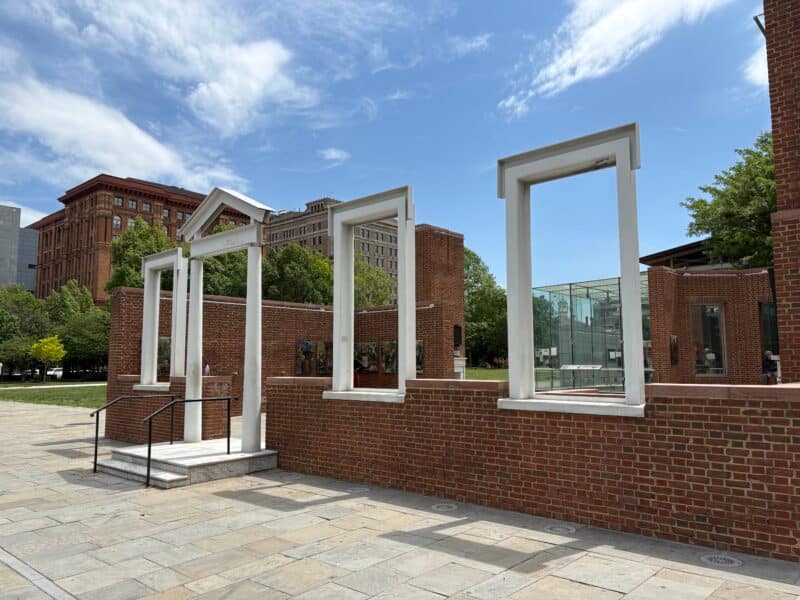
Philadelphia officials first sued the Department of the Interior and National Park Service in January, after federal employees removed informational panels and shut off video presentations at the President’s House site, where Washington held nine enslaved people during his presidency one block from Independence Hall.
Asserting Administrative Procedure Act violations, the city argued any alteration to the exhibit required city approval.
While the city had previously ceded the site’s ownership rights to the National Park Service, it argued a contractual survival clause required the agency to receive city approval before making alterations to the exhibit.
Because the agency did not do so, it violated the Administrative Procedure Act, the city argued.
Senior U.S. District Judge Cynthia M. Rufe sided with the city in February, comparing Trump’s removal of the exhibit as Orwellian and issuing an injunction ordering the agency to restore the panels and videos.
On appeal, however, the Third Circuit panel disagreed with the George W. Bush appointee that a final agency action even occurred, noting the National Park Service designed replacement informational panels “and stood ready to install them should the injunction dissolve.”
Those panels, while less critical of Washington and Adams compared to the original exhibit — one panel reads that both presidents opposed the slave trade — still ultimately acknowledge the presidents’ use of enslaved people and support for pro-slavery legislature, including Washington’s signing of the 1793 Fugitive Slave Act.
“These new panels are full of historical context,” wrote U.S. Circuit Judge Thomas M. Hardiman, a fellow George W. Bush appointee, in the panel’s opinion. “They highlight the momentous events that took place in the President’s House and the other sites at Independence National Historical Park. They acknowledge the evil of slavery, including its injustices and hypocrisies, and, by telling the story of the nine slaves that Washington kept in the President’s House, remind us of their essential humanity. And they recall the price our nation paid ‘to finish the work that the Founders had begun and end slavery in the United States once and for all.’”
Without a final agency action, Hardiman added, the National Park Service’s conduct is not applicable for judicial review.
“Given all these developments,” Hardiman wrote, “we cannot agree with the district court that the exhibit removal six months ago was NPS’s last word on the matter.”
The appeals panel didn’t stop there, however, finding that the National Park Service didn’t even conduct an agency action, let alone a final one.
Throughout litigation, the city has posited that the exhibit removal qualifies as a “sanction” because the agency engaged in the “destruction, taking, seizure or withholding of property” — an argument the three-judge panel succinctly shut down as false.
“This theory is a nonstarter because the city does not own the President’s House or anything in it,” Hardiman wrote, noting the National Park Service assumed ownership of the President’s House upon its completion and the city had waived any claim to any property interest.
U.S. Circuit Judges Peter J. Phipps, a Donald Trump appointee, and L. Felipe Restrepo, a Barack Obama appointee, joined Hardiman in the opinion.
Our weekly newsletter Closing Arguments offers the latest about ongoing trials, major litigation and rulings in courthouses around the U.S. and the world, while the monthly Under the Lights dishes the legal dirt from Hollywood, sports, Big Tech and the arts.


