
The man who watches Trump all day, every day – The Times
The psychological demands of Aaron Rupar’s work are immense. He counts himself lucky to have remained more or less healthy after a decade in his job.
“I certainly wouldn’t say that I’m like a model of mental health,” says the father-of-two from Minnesota. “But for the most part, especially considering what I do and how much time I spend doing it, I think I’ve been able to emerge relatively unscathed.”
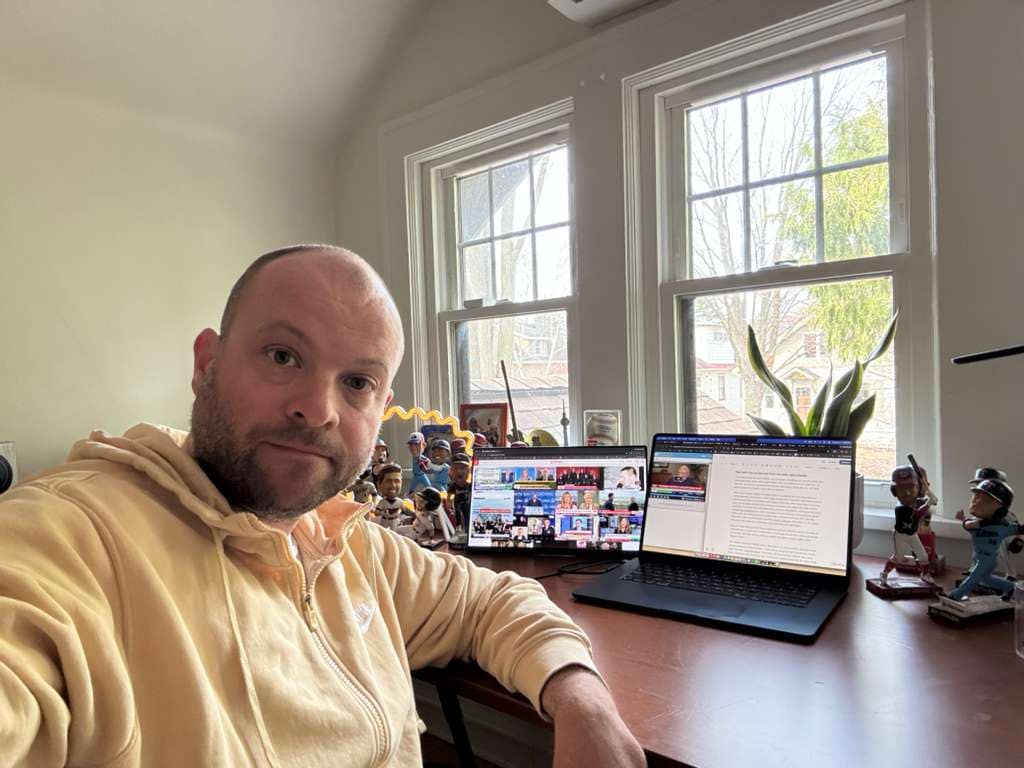
Rupar works from his spare room in his Minneapolis house. His job is to watch President Trump. All day, every day.
Spread over two laptop screens, Rupar, 42, follows the frenetic schedule of the president, from the meandering speeches to the impromptu press conferences, the middle-of-the-night social media rants to the sudden interviews on TV.
Rupar is a one-man news agency, running accounts with a million followers on X and another 930,000 on BlueSky. He also writes a Substack with 274,000 subscribers. A small fraction of those subscribers pay $50 per year, his main source of income.
He sees it as his duty to keep the world informed of almost everything Trump and members of his administration say and do. He clips videos of Trump’s noteworthy remarks and shares them instantly on social media, monitoring 12 different TV channels simultaneously. His clips bounce back and forth across the internet.
“I’ve certainly had some days over the years that have been 18-20 hours of pretty much nonstop work,” he says. “I remember he gave some sort of speech to the Korean legislature that started at my time, like four in the morning, that I woke up for. I’d been working till midnight the night previous. So that’s not super uncommon.”
Rupar started clipping Trump in 2017. He has a strong claim to have watched more of the president’s appearances than anyone else.
For those who think they know Trump, Rupar invites them to buckle up and watch a full speech.
During a recent cabinet meeting that lasted an hour and 40 minutes, Trump veered from talking about his love of Sharpie pens to his hatred of the “disgusting” country Somalia, his disdain for Britain’s “toy” aircraft carriers, to his dream that one day an interior decorator would invent 24-carat gold wallpaper. “I’m a gold person,” he said.
Following that cabinet meeting, Trump delivered a speech to celebrate Greek Independence Day. He then did a long interview with Fox News.
“It’s really difficult to cover him in a way that conveys how unhinged he is,” says Rupar. “That’s kind of how people are trained to do political journalism. It’s like, ‘OK, what did he say that was newsworthy, what’s new?’ So you kind of pick up those things and convey them to your audience. But in reality, when you actually watch his rallies, you see that they’re full of hatred, he’s lying constantly, and a lot of it is incoherent.”
Regularly on camera for several hours a day, Trump has contrasted his stamina with the reluctance of Joe Biden, the former president, to appear in public. In his first year after his return to the White House, Trump answered questions in the Oval Office at 95 events, the most of any president since at least the early 1980s, and more than three times as many as Biden, according to a study by political scientist Martha Kumar reported by the New York Post.
“It’s true that he talks to the press a lot,” says Rupar. “But he doesn’t really convey meaningful information.”
As someone with progressive politics, Rupar selects clips of Trump from a critical perspective. He is aware, nonetheless, that Trump thrives off social media, and the president’s viral personality appears particularly well suited to the short-form clip.
“I would take the less clippable administration for the more functional country and world,” he says. “But if you just look at it purely from the standpoint of what’s going to do better numbers on social media, I mean, certainly the Trump world stuff does.”
More than half of Americans consume news via social media often or sometimes, according to the Pew Research Center. The feeds of Facebook, YouTube, Instagram, TikTok and X are all weighted towards short-form videos. In total, 20 per cent of Americans regularly get their news on TikTok. That rises to 43 per cent of those aged 18 to 29.
Trump’s outrageous and quick-witted comebacks make engaging videos on social media. When he recently made a joke about Pearl Harbor to the prime minister of Japan, even Rupar acknowledged the humour, although he did not laugh himself.
“I will say that when that happened, that did occur to me that was a little bit of the vintage Trump,” says Rupar. “I certainly think there’s a big difference for anyone between being 80 and 70. He’s certainly slowed down. I don’t think he’s quite as quick-witted as he was.”
This year, the Trump administration deployed thousands of Immigration and Customs Enforcement (ICE) agents to Rupar’s home town of Minneapolis.
Rupar’s wife took part in the protests, ferrying children whose parents were at risk of deportation to school. The demonstrators blew whistles to alert undocumented migrants to the presence of ICE agents and filmed the actions of officers on their phones.
“That was a really bleak time here. It felt like we were occupied by a hostile force,” he says.
By using their phones to record the actions of ICE agents, the protesters ended up documenting the deaths of Renee Nicole Good, 37, and Alex Pretti, also 37. Footage shared on social media provoked a public backlash, forcing Trump to withdraw ICE agents from Rupar’s hometown.
He fired Kristi Noem, his homeland security secretary, and reined in his immigration crackdown — in no small part because protesters were filming everything and posting clips online.
“I think they played very poorly for the Trump people. The one that comes to me right away is the woman who had a disability who was dragged out of the car by ICE agents. I’m sure there is some small fringe of Trump supporters who see something like that and think it’s cool because they’re ‘owning the libs’ and they’re the big tough guys. But for the vast majority — left to centre to probably even centre right — I don’t think stuff like that plays well,” he says. “The proof is kind of in the pudding when they fired Kristi Noem.”
Before the president was suspended from Twitter in 2021, Trump himself retweeted Rupar, who acknowledges the toll of trying to keep up with the president, regularly clocking up to 80-hour weeks.
“I think certainly covering this stuff over the last decade has probably negatively affected my mental health just because it’s pretty bleak most of the time,” he says. “But I still get up and feel privileged in some ways to be able to cover historic events for a living. And to have the audience that I have.”
Promoted Content
© Times Media Limited 2025.
Registered in England No. 894646. Registered office: 1 London Bridge Street, SE1 9GF.
Enjoy unlimited access to all articles. Ends soon.
Enjoy unlimited digital access.
Already have an account? Log in