
One Trump Obsession Says More About Him Than Any Other – Slate Magazine
Enter your email to receive alerts for this author.
Sign in or create an account to better manage your email preferences.
Are you sure you want to unsubscribe from email alerts for Christina Cauterucci?
Trump Brain is a series about what’s really going on in the president’s head, on his 80th birthday.
Four decades ago, Donald Trump was a New York City developer at work on an apartment complex that would bear his name. The 36 stories of Trump Plaza were lined with balconies, offering would-be residents spectacular views across the Upper East Side. Construction was going swimmingly, until Trump decided that the color of the balcony handrails was all wrong.
In a 1984 interview with the New York Times, Irving R. Fischer, the head of one of New York’s largest construction companies, said Trump didn’t show up with paint swatches or a mood board to express his vision. Instead, he pointed at a gold Cadillac down the street and yelled out, “That’s the color!”
The contractors leaped into action. “We had to go out and buy goddamned Cadillac paint for the railings,” Fischer said.
Though Trump is a man of specific tastes, his aesthetic thrust is neither complicated nor refined. A maximalist to the end, he likes things ornate. He likes them newly constructed but grounded in centuries-old design. And above all else, he likes them gold.
As a color, material, and metaphor, gold has been a trademark of Trumpworld since the 1980s, a decade of excess that found Trump building and gilding various real estate holdings. News reports referred to his “Midas touch” in business and noticed when it “tarnished.” As his star rose, he attracted amused attention with his Manhattan penthouse and Palm Beach compound, both outfitted to the gills in golden decor. Ivana even covered their New York kitchen in gold linoleum.
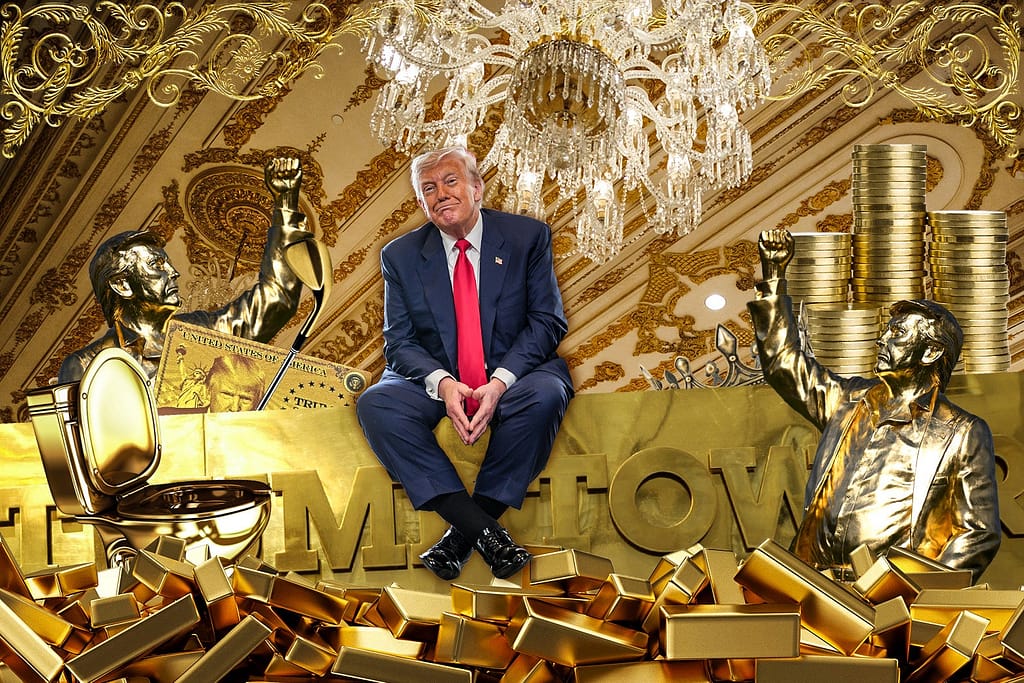
Since then, every major chapter of Trump’s story has been suffused with the gleam of his favorite metal. When he announced his run for president in 2015, dramatically diverting the course of the American project, it was after a ride down a gold-mirrored escalator. Today the shameless self-enrichment and authoritarian aspirations of his second presidential term have found their emblem in a 22-foot gold-leaf statue of the guy that now stands, fist raised, at the Trump National Doral Miami golf club. Dedicated by a group of clergy members in May, the idol is everything Trump wants to be: larger than life, fit to be worshipped, an embodiment of excess that thumbs its nose at notions of democratic propriety.
As far as design fetishes go, gold is a logical one. In ancient civilizations as in ours, it was status made manifest. Societies across the world valued gold as a symbol of divinity, immortality, and authority; its rarity made it a special privilege to behold and possess. In recent eras, as power became increasingly synonymous with wealth, gold turned into shorthand for prosperity itself. A frenzied grab for easy money is a “gold rush,” recalling the drive for power and riches that instigated a genocide of Indigenous people and shaped the U.S. as we know it.
In this context, like many of Trump’s cultural fixations, his love of gold is painfully on the nose. He thirsts for the kind of ultimate supremacy and luxury enjoyed by monarchical figures of the past, who built the likes of Egyptian temples and Versailles, leaving lasting marks on their national landscapes. This chafes against the restraint demanded by his current role, which has historically been carried out in humbler fashion.
While the White House has always been a grand structure—and the president’s salary nothing to sniff at—it has lacked much of the ostentatious ornamentation that defines what Peter York, author of Dictator Style: Lifestyles of the World’s Most Colorful Despots, calls “dictator chic.” Leaders of Western democracies mostly strive to project humility, relatability, and an aversion to corruption; the government is multibranched and by the people, after all. There should be no single, all-powerful character around which a democracy revolves, so it is considered unseemly to lavish excessive finery on the head of state.
But Trump has never let social and political mores keep him from what he wants. Recently, he has accepted extravagant gifts from foreign and domestic business leaders (a gold-plated desk clock from the CEO of Rolex, a personalized gold bar from the CEO of a gold-refining company, a 24-karat gold plaque from Apple CEO Tim Cook) in thinly veiled exchanges for breaks on tariffs. Gold is a simple preference that is easy to accommodate, a way to signal allegiance by nodding to Trump’s personal taste. The president has always understood the utility of recognizable, replicable branding.
Trump is also remaking the White House to his own specifications with a rococo renovation of the Oval Office, which now looks like a slapdash Mar-a-Lago. He has added gold trim to the crown molding, smothered the walls with gold-framed artworks and gold-painted embellishments, placed inch-thick gold coasters on the desk, and lined up gold urns on the mantel. After I laid eyes on the current Oval Office, photos of the former version looked to me as if they were taken in a chain hotel suite, and not a particularly plush one. It was befitting of an important office job, with only the lightest indicators of riches and omnipotence. The new decor, by comparison, suggests its countrymen eat cake. In his previous administration, Trump was playing the part of the president. This time, he’s rewriting the entire script, to be staged on a set decked out in the definitive material of autocratic decadence: gold.
The president’s craving for kingliness is even more obvious in his proposed $400 million, 90,000-square-foot gold ballroom, for which he demolished the White House East Wing without congressional permission, input, or review. After a federal judge in March issued an injunction that blocked the ballroom, Trump doubled down on replacing a historic building that reflected generations of presidential leadership with something fully his own, something golder and gaudier. He took his case to an appeals court, which put a hold on the injunction and allowed construction to continue while litigation proceeds. Now Trump has proposed turning the roof of the ballroom into a port for military drones, a vision that would make the symbolic dominance of gold into something brutally literal.
To critical observers, Trump’s lifelong attempt to project superiority through gold has had the exact opposite effect. Fran Lebowitz had Trump’s number when she called him “a poor person’s idea of a rich person”; Dolly Parton got it right when she pointed out the high cost of looking cheap. Gold is garish, obvious, a rejection of respectability—the decor equivalent of Mar-a-Lago face. An overreliance on precious metals in the flaunting of one’s wealth can give the impression of protesting too much. It reveals not just an absence of original taste but deep insecurity. Trump is soothed by his gold surroundings, which remind him that his assets will protect him from the worst this cruel world has to offer.
And when his time on Earth draws to a close? Even mortality can be staved off by enough gold, Trump seems to believe. At this point in his public arc, his affinity for the material is more like a colonizing claim. As with red baseball caps, it is a calling card that evokes his presence without explanation. Trump loves to plaster his name on things, but barring that, gold leaves his imprint just the same. Long after Trump is gone, Americans will look on his works—the gilded White House ballroom that will be considered, if not named, the Trump Room—and despair.
But like Ozymandias, and like all the monarchs whose reigns and empires ultimately ended, Trump cannot buy his way out of death, nor can he take his riches with him when he goes. Human civilizations across the ages have understood this to be an important lesson, which is how gold became the go-to cautionary symbol for greed, vanity, and the hollow existence to which they lead. From King Midas to Chaucer’s “Pardoner’s Tale,” from Goldfinger and Smaug to the crab obsessed with all things “shiny” in Moana, gold has provided the simplest illustration of how wealth can distract a fool from what really matters, often at his own eventual expense.
The moral vacuum at the heart of Donald Trump’s character is so cavernous it can be hard to describe in direct language. It is useful, then, that his aesthetic signature is an ancient, enduring allegory for a life poorly lived. That goes for his followers too. In February, Trump posted an A.I.-generated video on Truth Social that depicted a vision of a ritzy “Trump Gaza” resort town, complete with a shiny gold statue of Trump towering above a palm tree–lined strip, not unlike the one erected IRL months later at the Trump National Doral Miami. The image called to mind the golden calf of Abrahamic religious texts, worshipped by the Israelites to Moses’—and God’s—dismay.
Evangelical leaders and the president himself speak of Trump as a divinely ordained instrument of God’s will; among his adoring base, he inspires the unconditional obedience of a prophet. Gold is the color of false idolatry, the material of gratuitous wealth, a hallmark of authoritarian style, and a metaphor for the folly of prioritizing personal enrichment and glory over everything else. If gold didn’t already exist, Trump would have had to invent it.
Slate is published by The Slate Group, a Graham Holdings Company.
All contents © 2026 The Slate Group LLC. All rights reserved.
Slate relies on advertising to support our journalism. If you value our work, please disable your ad blocker. If you want to block ads but still support Slate, consider subscribing.
Already a member? Sign in here