
KSTP/SurveyUSA poll: Walz, Trump approval ratings sink to lows; disapproval over Iran – 5 EYEWITNESS NEWS
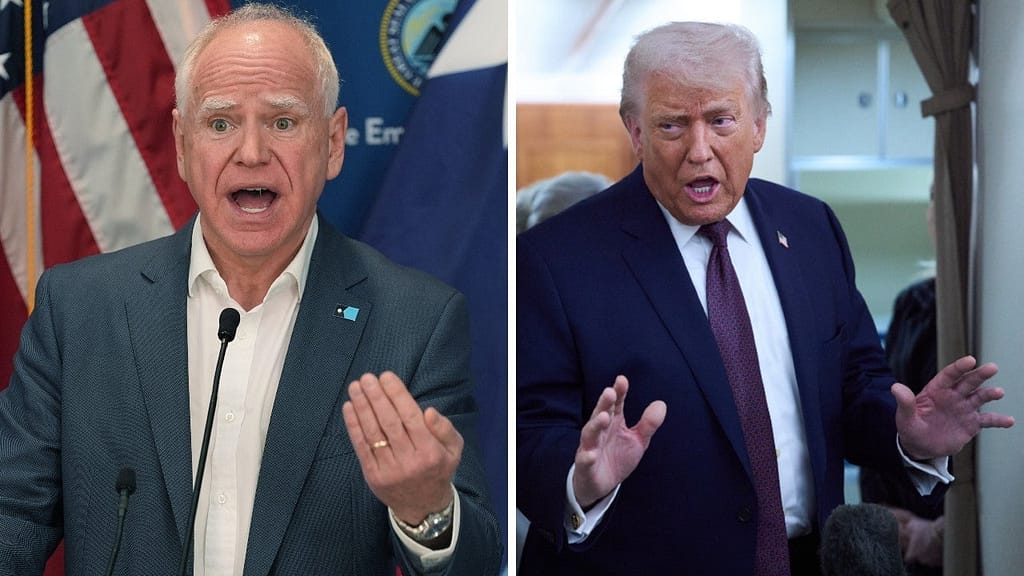
A majority of Minnesotans are unhappy with the work of Gov. Tim Walz and President Donald Trump, and roughly two-thirds oppose the war in Iran.
Results of a new KSTP/SurveyUSA poll reveal that Minnesotans’ approval ratings for the governor and president have sunk to new lows, and others didn’t fare much better.
Voters were also asked about the Iran war, which the U.S. and Iran have now agreed to end, at least temporarily.
Find more poll results here. See a breakdown of these poll results below.
One year ago, Walz reached the highest approval rating of his tenure. Today, it’s at an all-time low of -8.
Only 43% of respondents approve of the job the governor is doing, while 51% disapprove, including 38% strongly disapproving.
By demographic:
Trump had an all-time low approval rating back in January but that has fallen further, sitting today at -24.
Only 36% of respondents approve of the job the president is doing, while 60% disapprove, including 49% strongly disapproving.
Minnesotans were even lower on Trump’s handling of the economy and war.
By demographic:
The longtime senator now running for governor has long been popular in Minnesota, but her approval rating today (+10) is barely above her December low of 9.48%. For reference, that’s currently the same as outgoing Sen. Tina Smith, although more respondents are unsure of Smith.
By demographic:
SurveyUSA has only polled on the AG three times but his approval rating is negative for the first time at -1, down from +4 in January.
He’s running for reelection this fall and, as the data shows, may be vulnerable.
By demographic:
The Legislature’s rating comes in at -13, with the majority of Minnesotans (61%) nearly split between “somewhat approve” and “somewhat disapprove” — perhaps the result of a split Legislature. Those who felt strongly, however, were more disapproving than approving (18% vs. 6%).
By demographic:
Nearly two-thirds of Minnesotans did not agree with President Donald Trump’s decision to go to war with Iran.
Additionally, more than half of voters “strongly” opposed the war, while only 13% “strongly” supported it.
By demographic:
As for how important an issue the Iran war is, voters overwhelmingly care more about the cost of living and things like health care and immigration. Only 5% said the war will be most important to them when voting this year.
Analysis: “The war has not been popular in Minnesota, and of course, Trump hopes the conclusion of the war will improve his standing nationally and in the state,” Carleton College political analyst Steven Schier said.
Find more KSTP/SurveyUSA poll results here.
SurveyUSA is an independent, non-partisan, apolitical research company that conducts opinion surveys for media, academic institutions, commercial clients, non-profits, governments, agencies, and elected officials. SurveyUSA opinion research is conducted using a methodology optimized for each particular project. In some cases, this means data is collected 100% by telephone; in some cases, 100% online; and in other cases, a blend of the two. For those projects that are conducted “mixed-mode” (or “multi-mode”): Respondents who have a home (landline) telephone are interviewed by phone, sometimes using live interviewers, other times using the recorded voice of a professional announcer. The youngest male is requested on approximately 30% of calls to home phones, the youngest adult is requested on approximately 70% of calls. This method of intra-household selection reduces the potential for age and gender imbalance in the unweighted sample. Re-attempts are made to busy signals, no-answers, and answering machines. Landline telephone sample is purchased from Aristotle of Washington DC. Respondents who do not use a home telephone are interviewed on an electronic device, which means, for some projects, that call-center employees hand-dial cell phones and interview respondents verbally on the respondent’s cell phone, and means, for other projects, that SurveyUSA displays the questions visually on the respondent’s phone, tablet, or other device. Sample for respondents who do not use a home telephone is purchased from Aristotle or from one of several other research companies that provide access to cell respondents. Where meaningful, SurveyUSA indicates the percentage of respondents who use a home phone and the percentage who do not, and crosstabs by this distinction. Responses are minimally weighted to U.S. Census or voter file targets for gender, age and race. Target (cell) weighting is used. On questionnaires that ask about political party identification, SurveyUSA may or may not weight to Party ID, depending on client preference. If a region crosstab is shown, the geographies included in each region are defined here. Where necessary, questions and answer choices are rotated to prevent order bias, recency, and latency effects. On some studies, certain populations are over-sampled, so that the number of unweighted respondents exceeds the number of weighted respondents. Each individual SurveyUSA release contains the date(s) on which interviews are conducted and a release date. If interviewing for a particular study is conducted in Spanish, or in any other foreign language, it will be noted on the specific release. If no notation appears, interviews are conducted in English. Where respondents are filtered, such as adults, filtered to registered voters, in turn filtered to likely voters, SurveyUSA describes the filtering on the specific release. On pre-election polls in geographies with early voting, SurveyUSA differentiates between respondents who have already voted and those who are likely to vote but have not yet done so. On research completed prior to 12/31/16, SurveyUSA assigned to each question within the instrument a theoretical margin of sampling error. Effective 01/01/17, SurveyUSA assigns to each question within the instrument a credibility interval, which better reflects the sampling uncertainties associated with gathering some percentage of respondent answers using non-probability sample. Though commonly cited in the presentation of research results, “sampling error” is only one of many types of error that may influence the outcome of an opinion research study. More practical concerns include the way in which questions are worded and ordered, the inability to contact some, the refusal of others to be interviewed, and the difficulty of translating each questionnaire into all possible languages and dialects. Non-sampling errors cannot be quantified. This statement conforms to the principles of disclosure as recommended by the National Council on Public Polls (NCPP).
Any person with disabilities who needs help accessing the content of the FCC Public File may contact KSTP via our online form or call 651-646-5555
This website is not intended for users located within the European Economic Area.
© KSTP-TV, LLC
A Hubbard Broadcasting Company

KSTP Follow


