
Iran-US war live: Trump threatens to ‘take over’ Iran if Strait of Hormuz is closed – The Independent
Notifications can be managed in browser preferences.
Please refresh the page or navigate to another page on the site to be automatically logged inPlease refresh your browser to be logged in
Swipe for next article
US president’s threats come as Vance joins other US officials in Zurich to hammer out peace deal terms with a battery of Tehran’s leaders
Removed from bookmarks
From reproductive rights to climate change to Big Tech, The Independent is on the ground when the story is developing. Whether it’s investigating the financials of Elon Musk’s pro-Trump PAC or producing our latest documentary, ‘The A Word’, which shines a light on the American women fighting for reproductive rights, we know how important it is to parse out the facts from the messaging.
At such a critical moment in US history, we need reporters on the ground. Your donation allows us to keep sending journalists to speak to both sides of the story.
The Independent is trusted by Americans across the entire political spectrum. And unlike many other quality news outlets, we choose not to lock Americans out of our reporting and analysis with paywalls. We believe quality journalism should be available to everyone, paid for by those who can afford it.
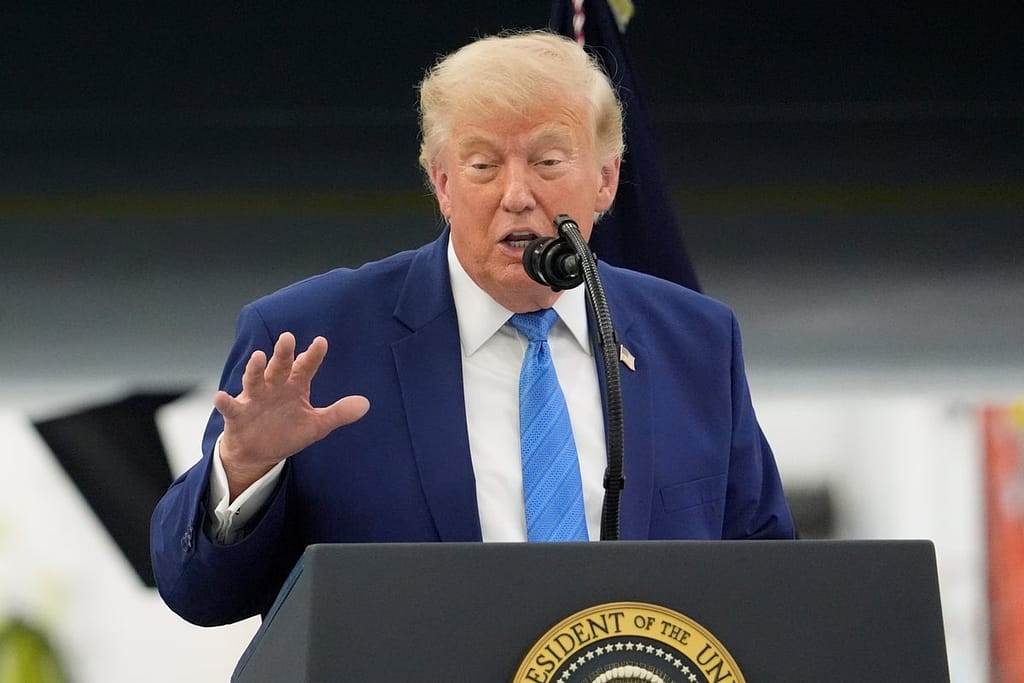
Donald Trump threatened to “take over” Iran if they try to close the Strait of Hormuz again during a turbulent weekend for diplomacy as negotiators met in Switzerland to begin a period of high-stakes talks to end the war.
The US president said he had warned Iranian officials directly that “you close [the strait] and you won’t have a country”, Fox News’s Trey Yingst reported on Sunday, as Iran again restricted maritime traffic in response to Israel’s clashes with Hezbollah.
“You won’t even make it back to your f***** country,” the president said he told the Iranians, adding: “We’ll take over the rest of the country.”
High stakes talks aimed at finalising a deal to end the war are expected to continue through the week, after a “difficult” start that saw Iranian negotiators walk out over Trump’s “insults”.
The first round of talks nonetheless concluded early on Monday morning, with Iranian foreign minister Abbas Araghchi praising Pakistan and Qatar for their mediation and saying they “delivered major progress”.
And despite the public bluster, JD Vance told reporters that Trump had “asked us to turn over a new leaf to transform our relationship with the people of Iran”.
The dust has barely settled in Tyre after weeks of Israeli airstrikes on the ancient city along Lebanon ‘s Mediterranean coast. Despite the relative calm, life remains largely at a standstill.
A new ceasefire between Israel and the Iranian-backed Hezbollah militant group is in effect. But previous ceasefires have broken down.
Uncertainty and fear linger, even as the U.S. and Iran meet for talks in Switzerland that Lebanese residents hope will bring calm to their troubled country.
Here’s how Tyre is weathering the latest conflict as the war in Lebanon threatens to derail the peace process:
Donald Trump threatened to “take over” Iran if the Strait of Hormuz was not immediately re-opened, the president told Fox News.
His latest round of threats came in response to news Saturday that Iran was once again closing the key waterway, just days after signing an agreement to ensure that traffic could flow through. Iran announced that it would close the Strait of Hormuz after Israeli forces continued an all-out assault into Lebanon aimed at dislodging Hezbollah militants.
Fox’s Trey Yingst reported Sunday that in an early morning phone call, the US president said he’d warned Iranian officials directly that “you close [the Strait of Hormuz] and you won’t have a country.”
“You won’t even make it back to your f***** country,” Yingst said the president claimed to have relayed to the Iranians, adding: “We’ll take over the rest of the country.”
Read the full story here:
The chief negotiators in Switzerland for the US include JD Vance, the vice president; special envoy Steve Witkoff, and Jared Kushner, the son-in-law of the president.
Iran is represented by Mohammad Bagher Qalibaf, the parliamentary speaker, and foreign minister Abbas Araghchi.
It’s unclear when Vance will depart Switzerland, although he told Fox News in an interview on Saturday that he anticipated only staying for a “day or two”. Kushner and Witkoff are handling much of the technical details on behalf of the US delegation.
In a joint statement, Pakistan and Qatar said the high-level talks had ended on Sunday and that technical negotiations would continue in Switzerland for the rest of the week.
The statement said the sides had agreed to establish a “communication line” to ensure safe passage of ships in the Strait of Hormuz, as well as a mechanism to bring about an end to the fighting between Israel and the Iranian-backed militant group Hezbollah in Lebanon.
The US offered no immediate comment, while Iran praised the meditators’ work. Araghchi wrote on X that the first “real test” of negotiations would be whether the mechanism succeeded in halting the fighting between Israel and Hezbollah.
The senior US diplomat said among the issues discussed was Iran’s messaging as it related to the Strait of Hormuz, which Iran’s military said it closed Saturday in response to continued fighting in Lebanon. US Central Command has disputed that Iran closed the strait again.
Negotiators from the US and Iran are set to engage in a second day of talks today to agree a permanent end to their war, after a first day got off to a rocky start.
Mediators Qatar and Pakistan hailed what they called “encouraging progress” made during the talks. A senior US diplomat claimed progress on multiple fronts, including the establishment of “mechanisms” to ensure the Strait of Hormuz remains open and that a ceasefire in southern Lebanon holds.
Yet the first full day of talks was overshadowed by blistering statements from US president Donald Trump, who from thousands of miles away from the Swiss negotiating venue was firing off comments that offended the Iranians.
Iranian state media said talks had paused after the “publication of an insulting message by the US president.” The Iranian delegation then met with Qatari mediators and left the negotiating site, state media said. The senior US diplomat, who spoke on condition of anonymity to brief journalists on the ongoing talks, said late on Sunday that the Iranians remained on site and the negotiations were still on.
At least 54 people were injured and another 18 were missing after an explosion at Qatar’s core LNG processing site of Ras Laffan on Sunday, authorities said.
Qatar’s Interior Ministry attributed the explosion to a “technical accident” and said there was no leak that posed a threat to public safety.
An incident during the start-up of operations at Ras Laffan Industrial City resulted in an explosion and fire at the Barzan local gas supply facility on Sunday evening, QatarEnergy said in a statement. Emergency response teams were deployed to contain the fire, which was now under control, it said.
Search operations have begun for the 18 missing people.
QatarEnergy did not indicate whether the explosion had caused any damage to the plant, which supplies gas to the domestic market.
A Reuters witness earlier reported that a loud boom was heard in the capital Doha, south of the Ras Laffan facility.
Democratic Senator Cory Booker claimed Iran gets “all of the benefits” from the latest deal to end the war.
“When you have Democrats and Republicans, conservatives and progressives, all coming out talking about capitulation, surrender, catastrophe, you know how bad this deal is. Iran gets all of the benefits, literally billions and billions of dollars,” Booker said Sunday on NBC News’ Meet the Press.
“And America continues to hurt and see the losses from the $100 billion we’ve spent in the war to every American citizen seeing their costs skyrocket. This has been a cataclysmic failure of his making,” he added.
Israeli prime minister Benjamin Netanyahu will likely try to undermine Donald Trump’s deal with Iran, U.S. intelligence officials have reportedly warned the administration.
Current and former U.S. officials told The Washington Post Netanyahu is intent on continuing operations in Lebanon despite an agreement signed by President Trump earlier this week.
The Israeli leader is facing intense political pressure to continue the conflict, that has run in parallel to the joint attacks on Iran he launched alongside the United States in February.
Keep reading:
A joint statement from Pakistan and Qatar says negotiations have been “conducted in a positive and constructive atmosphere” and “encouraging progress has been made including the creation of a mechanism for further technical talks.”
The statement followed a first day of “high level” talks in Burgenstock, Switzerland, with representatives from the U.S. — including Vice President JD Vance — and diplomats from Iran.
The group has so far agreed to the “establishment of a High Level group to ensure the effective implementation” the memorandum of understanding to end the war, which will act as a “roadmap towards reaching a final deal within 60 days, laying the foundation for the immediate commencement of further technical talks,” according to the statement.
An line of communication has been opened to “avoid incidents and miscommunication with the aim of safe passage for commercial vessels through the Strait of Hormuz,” the statement says.
“The mediating parties will continue to do their utmost to ensure that the negotiations continue to be conducted in a constructive atmosphere with the aim of reaching a final deal,” the parties said.
A new poll says 92 per cent of the Israeli public believe Iran has emerged the winner in the conflict with the US and Israel.
According to a new survey conducted by the Hebrew University and Agam Labs, the vast majority of the Israel population have a negative view of Donald Trump’s deal agreed this week between the US and Iran, which includes a ceasefire between Israel and Hezbollah in Lebanon.
The poll suggests that 82.9 per cent of Israelis believe the military campaign against Iran has weakened Israel’s long-term security and 86 per cent have a negative attitude towards the outcome of the conflict.
Keep reading:
Join thought-provoking conversations, follow other Independent readers and see their replies
Please refresh the page or navigate to another page on the site to be automatically logged inPlease refresh your browser to be logged in


