
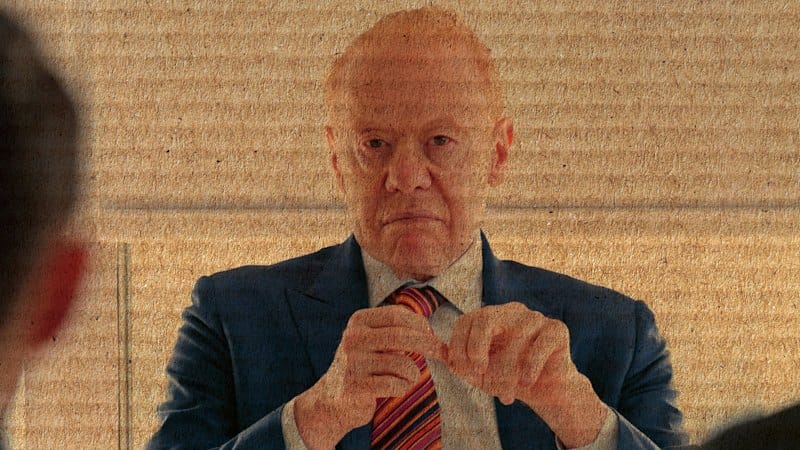
He keeps ex-PMs on retainer, parties with Trump and dines with King Charles: this is Anthony Pratt – The Age
He’s one of Australia’s richest men, but cardboard billionaire Anthony Pratt lived in a roadside hotel for two years while building his father’s American dream.
You have reached your maximum number of saved items.
Remove items from your saved list to add more.
Anthony Pratt will soon have to leave for the airport, where his private jet is waiting to whisk him back to the United States. For the moment, though, the billionaire industrialist is ensconced in a Melbourne hotel suite, having a mid-morning coffee and reminiscing about a thrilling evening in November last year. He was hosting a party at the glitzy Mar-a-Lago club in Palm Beach, Florida, and had hired country singer Keith Urban to entertain his 700 guests. But it was the arrival of the club’s owner that made Pratt’s night. “President Trump was kind enough to pop in,” he tells me, eyes lighting up at the memory.
Pratt may be Donald Trump’s greatest Australian supporter. He has taken out full-page advertisements in American newspapers to declare his admiration for the US president, poured millions of dollars into his political campaigns and pledged billions to his program to boost US manufacturing. When Trump turned up at the party, it was confirmation that those efforts were appreciated. “He ended up sitting at my table with me for an hour and a half while we watched Keith’s performance together,” says Pratt, still buzzing with delight at the honour bestowed on him. An hour and a half. “So I consider him a friend.”
The cardboard king, Pratt is sometimes called. With his two sisters, he owns Australia’s biggest packaging and recycling company, Visy, which has sales of $4 billion a year and employs more than 7000 people across the country. But it is in the US, where Pratt lives with his third wife, Claudine Revere, and their two teenage children, that he has made the bulk of his fortune. He is the sole owner of Visy’s US offshoot, Pratt Industries, which has more than 12,000 employees in 25 states. “Pratt Industries is now the largest individually owned manufacturing company in America,” he says.
Whichever way you look at it, building an enterprise of that size is quite an achievement. “This is probably the most successful US expansion by any Australian company, ever,” says Ashok Jacob, executive chairman of asset management firm Ellerston Capital. Because Visy and Pratt Industries are both private companies, with no obligation to publish detailed financial results, accurately assessing their value is difficult. But according to the Bloomberg Billionaires Index, the group has annual sales of about $US10 billion ($14 billion) and Pratt is, at the time of writing, the 296th wealthiest person in the world, with an estimated net worth of $US11.4 billion ($16 billion). When former Victorian premier Daniel Andrews visited Pratt’s Manhattan residence – a four-level apartment atop The Sherry-Netherland building overlooking Central Park – he was dazzled by the art on the walls. “It was as if I were visiting MoMA or The Met: Renoir, Picasso, Gauguin, Dali – all looking down on the luncheon table,” Andrews says.
Trump isn’t the only holder of high office to be drawn into the Prattosphere. At a party in March at Raheen, Pratt’s grand old family home in the Melbourne suburb of Kew, Prime Minister Anthony Albanese and Victorian Premier Jacinta Allan sat at his table. He is a major donor to both the Labor and Liberal parties, and helps cushion the retirement of party leaders by hiring them as consultants. Andrews, for instance, confirms to me that he is on Pratt’s payroll, as do Paul Keating, who was Labor prime minister from 1991 to 1996, and Tony Abbott, Liberal prime minister from 2013 to 2015.
When I ask Abbott what he does for his $8000 a month, he goes a bit vague. “Look, I have been asked occasionally for insight into how some particular issue might be best approached,” he says. “I’ve been asked occasionally if I might attend an event where my presence could be useful. That kind of thing.” Keating, who is paid $25,000 a month, has said previously: “My advice is limited to big-picture issues of the international kind.”
That puzzles me at first. How much advice on big-picture international matters does Pratt need? He isn’t an arms dealer. He makes cardboard boxes. It turns out, though, that Pratt is a box-maker with attitude. He likes to be at the centre of things. Wants to be in the know. By associating with movers and shakers, many of them beholden to him for one reason or another, he cements his place as a man of consequence. When he built a paper mill and adjacent box factory in Kentucky, giving a shot in the arm to the economy of one of the poorest states in the US, Democratic governor Andy Beshear showed his gratitude by making him a Kentucky colonel. That is an honorary title, obviously, but Pratt has adopted it for regular use. A recent Visy promotion refers to “our chairman Colonel Anthony Pratt”, as if the company were led by a swashbuckling military officer.
At the Raheen shindig, Pratt wore a diagonally striped tie. His name was printed on each stripe. As the sun set, fleets of waiters in black aprons circulated with trays of Mumm Cordon Rouge Brut champagne. “Anthony certainly knows how to throw a fantastic party,” Prime Minister Albanese told the crowd. The entertainer that night was Kylie Minogue, Australia’s seemingly ageless princess of pop, whose $3 million appearance fee may have partly explained the bright smile she wore when posing for photographs with Pratt.
Days after the party, still trying to get Can’t Get You Out of My Head out of my head, I study a picture of the diminutive singer standing beside her beaming benefactor. It occurs to me that, with enough money, you can collect not just paintings but people. Pratt himself has put it this way: “My superpower is that I am rich.”
Trump hasn’t always been kind to Pratt. “A red-haired weirdo from Australia,” the US president once called him on social media. Hurtful, you would think, but Pratt has let bygones be bygones and Tony Abbott understands his equanimity. “In the scale of Trumpian abuse, that’s pretty mild,” says Abbott, pointing out that Pratt wasn’t out of favour for long. “Cordial and constructive relations swiftly resumed.”
Pratt’s hair isn’t as red as it used to be, incidentally. As he has aged – he’s 66 – his curls have thinned, and faded to a muted ginger. His complexion is extremely pale. He wears running shoes all the time, even with suits, yet has the look of a person who goes outside only to cross the pavement to his limousine.
Caroline Kennedy, former US ambassador to Australia, mentions on the phone that she too was in sports shoes the first time she met Pratt. Before she took up her post in Canberra in 2022, Pratt invited her to a gathering at the Manhattan apartment. Kennedy had injured her foot. “I felt nervous about wearing my sneakers but I had to,” she says. “He obviously doesn’t feel nervous about wearing his sneakers. So we hit it off.”
That Pratt sought her out wasn’t surprising to Kennedy. “Obviously Anthony is a person that every ambassador meets at some point because he’s such a leading figure in the US-Australian alliance and relationship,” she says. As an example of his nurturing of the bond between the two countries, she cites his funding of a specialised unit focussing on Australia within the Centre for Strategic and International Studies, a Washington, D. C. think tank. “For Australia to have that raised profile is noticed and important,” she says.
Pratt’s main address is a large house about an hour’s drive north of Manhattan in Westchester County. Within a week of Trump’s re-election in November 2024, he announced that he had been granted permanent US residency. Years earlier, he had been filmed looking down the barrel of a camera and saying: “God bless America, the greatest country on Earth.” He retains Australian citizenship, though, and it is plain to former Labor prime minister Kevin Rudd – until recently, our ambassador to the US – that he is loyal to the land of his birth. “For Team Australia, he’s always been prepared to put his hand in his pocket to help with corporate sponsorship of major embassy events,” says Rudd, who estimates that during his three-year term in Washington, Pratt contributed several hundred thousand dollars. “That’s money the taxpayer doesn’t have to spend.”
While Caroline Kennedy was in Australia, she read up a little on Pratt and his relatives. The clan is known for its philanthropy and patronage of the arts but also for outbreaks of the kind of shenanigans that make headlines in gossip columns – “the family dramas”, as Kennedy calls them. Mistresses, lawsuits, inheritance disputes … When it comes to complicated dynastic dynamics, it’s probably hard to impress a Kennedy, but Caroline sounds genuinely intrigued by the Pratts. “Anthony seems to be the quietest one in the bunch,” she says.
I find myself wondering if Kennedy has seen the video clip of Pratt gyrating around a stage in a figure-hugging white jumpsuit, doing his Elvis at Las Vegas routine. Perhaps not.
Pratt isn’t keen to be profiled. “As you are probably aware, Anthony gives very few interviews that aren’t specifically about his business,” one of his senior advisers says in an email. Nevertheless, the adviser sends names of people willing to speak to me about Pratt – everyone from his rabbi to the widow of his late friend, boxer Muhammad Ali. (I find some other people, too.) I’m told I will be able to meet the man himself when he visits Melbourne, though everything Pratt says will be off the record. After the event, when Pratt and I have had a half-hour chat and he has returned to New York in his Bombardier Global 6000, that edict is reversed. I can quote Pratt after all. My request for a follow-up phone interview is declined.
In a way, Pratt’s wariness is understandable. Three years ago, he was caught on tape making wildly indiscreet observations about Trump, King Charles and others he has courted. Someone had secretly recorded his comments and leaked them to The Age, The Sydney Morning Herald and 60 Minutes. For Pratt, who has always tried to control what is written about him, that must have been a traumatic experience. For the rest of us, it was a fascinating glimpse into the way his mind works.
“I see him as an undervalued political stock,” Pratt said of Charles, who was still Prince of Wales when the words were recorded. “… He’s a laughing stock now. But when he’s king [they] won’t be laughing.” Musing about Trump, Pratt seemed torn between distaste for his crassness (“He just says whatever the f— he wants”) and admiration for his ruthlessness: “Can you imagine how yuck it would be to poke someone’s eyes out in a fight? So he does that but in life … He’s shameless and fearless. He’s got incredible balls.”
Pratt gave Trump credit for cunning: “He knows exactly what to say and what not to say, so that he avoids jail … He won’t go up to someone and say, ‘I want you to kill someone.’ … What he’ll say is he’ll send someone to tell someone to kill someone.”
In 2020, Pratt invited Trump adviser and former New York mayor Rudy Giuliani to his 60th birthday party in Melbourne. The celebration was cancelled because of the COVID-19 pandemic. “I paid him about a million bucks to come out as a celebrity guest,” Pratt said on the tape, “[but] it didn’t happen, so now he rings me once a week.” Pratt sounded content with that outcome: “Rudy is someone that I hope will be useful one day. Plus I just think he’s cool.”
What was clear was that Pratt knew to be cautious in his dealings with Trump and Giuliani. “All of these guys are like the mafia,” he said. “…You want to be a customer, not a competitor.”
Some say that to understand Pratt, you had to know his father. Richard Pratt was a dynamic and charismatic character who dominated every room he entered. “A very engaging, funny guy,” says Paul Keating. “If you met him, you’d never forget him.”
Richard was the son of Leon and Paula Przecicki, who changed the family surname after migrating to Australia from Poland in 1938. They settled on a rural block at Shepparton, in northern Victoria, where they started making cardboard boxes to replace the heavy wooden crates used by local fruit-growers. As a young man, Richard was athletic and good-looking, both a champion footballer and a talented actor. In the late 1950s, he appeared in London and New York productions of Ray Lawler’s hit play, Summer of the Seventeenth Doll. When he took over the family business after Leon’s death in 1969, Visy was a $5 million company with two box factories. Over the next 40 years, he turned it into a packaging and recycling empire.
Richard was a big wheel and a respected member of Melbourne society – even if everyone knew that, apart from his three children with his wife, Jeanne, he had a daughter with his longstanding mistress. (That daughter, Paula Hitchcock, now in her late 20s, is waging a legal battle for a larger share of his estate.) It was Richard who started the family tradition of political patronage: in the mid-1990s, he was reported to have paid consultancy fees to former prime ministers Bob Hawke and Gough Whitlam, former state premiers Rupert Hamer and Nick Greiner, and retired Victoria Police commissioner Mick Miller. He was president of Carlton Football Club, foundation chancellor of Swinburne University of Technology and head of the Victorian Arts Centre Trust.
But his reputation took a major hit in late 2005, when the Australian Competition and Consumer Commission prosecuted Visy for price-fixing and market-rigging. The Federal Court fined the company $36 million, which was the largest financial penalty imposed in Australian corporate history (though, as some commentators pointed out, a small fraction of the amount that box customers had lost as a result of artificially inflated prices). Richard faced four criminal charges for lying to the cartel investigation. He died of prostate cancer aged 74 in 2009, the day after the charges were withdrawn due to his ill-health. Despite his fall from grace, the Victorian Labor government held a state memorial service for him.
Anthony, Richard’s oldest child and only son, had joined Visy after graduating from Monash University with an economics degree and doing a stint at management consulting firm McKinsey & Co. At Richard’s funeral, he said his father was his hero. But several people interviewed for this story tell me the two had an extremely rocky relationship. “I think Richard had genuine love for his son,” says Ellerston Capital’s Ashok Jacob, who is a former managing director of Thorney Holdings, the investment arm of the Pratt Group. “But he was very, very tough on Anthony.”
For all his charm, Richard could be an unreasonably demanding boss, exploding with anger if his high expectations weren’t met. And no one felt his wrath more than Anthony. A journalist remembers witnessing Richard berate Anthony for some perceived failing. The brutality of the dressing-down took the journalist aback: “I thought, ‘I wonder what he’d say if I wasn’t here?’ ”
To expand the business to the US had long been Richard’s dream. Anthony says he learnt his part in the plan at the end of a family holiday in the US in 1991: as his parents prepared to board the plane home, his father said to him, “You’re staying.” That night, 31-year-old Anthony drove to Macon, Georgia, the site of an old paper mill Richard had bought. He checked into a hotel in the Howard Johnson’s chain – “where they bolt the TV remote to the side table so you don’t steal it. And I lived there for about two years. It was pretty lonely, I guess.”
After selling that first mill in 1992, Anthony moved to Georgia’s capital, Atlanta, where he established Pratt Industries’ headquarters. In 2000, he bought Villa Juanita, built in 1924 for a Coca-Cola heir and known to Atlantans as “the Great Gatsby house”. The three-hectare estate was next door to the state governor’s mansion, whose occupant from 2003 was Republican politician Sonny Perdue. “We were intrigued with his accent, obviously,” says Perdue, recalling his first impression of his neighbour. “And he had his distinctive red hair at that point in time. He didn’t melt into the crowd very easily.”
Six of the last eight paper mills built in the US belong to Pratt Industries. The company also has more than 65 box factories. “It’s one of the best manufacturing businesses that you will see anywhere in the world,” says Ashok Jacob. “It just relentlessly doubles in size every five to six years.” But Pratt makes the point that getting a foothold in the US was a long and gruelling process. “We had pretty tough sledding for the first 15 years,” he says. “America’s natural resource is entrepreneurial spirit, which is the propensity of someone to mortgage their house to start a business. So it’s very competitive.”
Pratt ran no risk of losing the roof over his head, of course. Richard provided the financial backing to get the US operation up and running, but with the funds came enormous pressure to succeed. And a lot of long-distance advice. “Ten thousand hours a day on the phone,” Pratt says with a faint smile. At Villa Juanita, he kept a to-do list on a whiteboard beside his bed.
During our meeting, Pratt is affable but reserved. “We tend to think of people who are very successful in business as being brash and domineering,” says Tony Abbott. “But that’s not Anthony’s style at all. He’s courteous, he’s polite, he listens at least as much as he talks.”
Richard Pratt had a big baritone voice and the ability to flick the switch to vaudeville. At parties for Visy customers and staff, he would commandeer the microphone and sing If I Were a Rich Man. Anthony? Very different, says Abbott. “He’s not flamboyant or ostentatious or showy or anything like that.”
I ask Abbott if he has seen photographs of Pratt at the Met Gala, the annual fundraiser for the Metropolitan Museum of Art’s Costume Institute in New York. In 2025, he wore a green and yellow suit plastered with his company logo (“Pratt 100% Recycled”), teamed with a green felt bowler hat. Abbott says he missed those pictures. I’m guessing he hasn’t seen the Elvis video, either.
Visy got into recycling early. Not out of concern for the environment, Pratt says, but for the same reason Richard always under-ordered when he bought Chinese takeaway for the family: “He hated waste.” Typically, 10 per cent of paper that gets turned into cardboard and made into boxes ends up as offcuts, Pratt explains. “We get $1000 a tonne for selling boxes but when you sell the offcuts to the garbage man, you only get $50 a tonne for that. So the idea my father had was to recycle the offcuts back into making his own paper.”
When the business launched in the US, that policy held them back. As Pratt recalls: “Our competitors would say, ‘Why would you buy a recycled box when you can have one made from trees?’” The turning point, he says, was the release of An Inconvenient Truth, the 2006 documentary that dramatically raised awareness of global warming. The message that recycling could help save the planet changed his company’s fortunes. “All of a sudden, we went from being schlock recyclers to being very cool.”
Pratt embraced the role of manufacturer-with-a-conscience, pledging to invest $US1 billion over a decade in recycling and waste-to-energy plants. He supported Hillary Clinton’s run for president in 2016, but when Trump confounded expectations by beating Clinton, he smoothly transitioned to being a Trump supporter. Because he wasn’t a US citizen, he was unable to contribute to Trump’s inauguration fund, but his American wife Claudine – whose hospitality company had the catering contract at the Central Park skating rink then operated by Trump – kicked in $US1 million. In 2017, after Trump cut the US corporate tax rate from 35 per cent to 21 per cent, Pratt joined Mar-a-Lago.
Journalist Joe Aston, founder of business news publication Rampart, was dining with Pratt at the club one night in 2019 when the band started playing Hail to the Chief. “In walks Trump with Melania,” Aston says. “He sees Pratt and makes a beeline for him. There are all these other powerful people in the restaurant. They’re only there so that Trump will notice them. And Trump goes over to Pratt. Is that because he loves Pratt more than anyone else?” Maybe. But Aston, who himself has a soft spot for Pratt, has a theory that his singular appearance gives him an advantage in a situation like that. In a sea of faces, he stands out. “It’s impossible not to remember him.”
Later that year, soon after Pratt attended a White House dinner for the then Australian prime minister Scott Morrison, Trump opened a Pratt Industries mill in Ohio. There was another invitation to the White House last year, after Pratt undertook to invest $US5 billion in American manufacturing. He was one of a number of deep-pocketed tycoons in the room, all of them Trump backers, but again the president singled him out. “During the press conference, he gave a shout-out to ‘my friend Anthony’,” Pratt tells me. “So that was nice of him.”
Nicer than the red-haired weirdo crack, that’s for sure. Trump hurled the insult in 2023, after the American ABC television network revealed that the president had told Pratt sensitive information about the tactical capabilities of US nuclear submarines during a tête-à-tête at Mar-a-Lago in April 2021. Pratt didn’t keep the potential security breach under his hat. According to the network’s sources, he reported the conversation to at least 45 people, including 11 members of his staff, 10 Australian officials, three former Australian prime ministers and six journalists.
In an interview on CNN, former Mar-a-Lago employee Brian Butler said the submarines snafu wasn’t the first time that Pratt’s relationship with Trump had concerned him: “Red flags went up in my mind years before that.” Butler said Pratt brought large groups of friends – say, 30 or 40 people – to New Year’s Eve parties and other celebrations at the club. He would pay much more than the asking price for tickets, Butler claimed: “It might cost $1000 or $1500 per person. He was giving a million dollars.”
When Trump stood for re-election in 2024, Pratt gave $US10 million to his political action committee, MAGA Inc. After the results came in, he bought space in The New York Times to congratulate the president. Pratt is certainly transactional, says Joe Aston, but at least he’s open about it: “He’s like, ‘We curry favour with the serving president or prime minister because it’s good for business. We want to be close to whoever’s the winner.’ He doesn’t even pretend that it’s about policy.”
I ask Caroline Kennedy, daughter of a legendary Democratic president, what she makes of her friend Pratt’s wooing of Trump. She says he is probably working on the assumption that proximity to power can be commercially useful: “I think it’s a business strategy.” Paul Keating agrees that Pratt is merely being a smart operator. “Anthony may have become Trump’s favourite groupie,” Keating says. “I mean, you would be a groupie, wouldn’t you, if you were getting the US president endorsing you.”
One of the bonds between Keating and Pratt is their shared belief that Australia’s $4.5 trillion superannuation system has the potential to be an important source of financing for Australian businesses. Keating says that when Pratt decided to sponsor an annual meeting on superannuation lending – which he co-hosts with The Australian Financial Review – “he asked me if I would join in, because he thought I was better at telling the story than he was”. (Pratt also co-hosts an annual “recycling roundtable” with The Sydney Morning Herald and The Age and a “global food forum” with The Australian.)
Keating says his work for Pratt is his only consultancy, and the $25,000 a month isn’t his motivation: “It’s pin money, in my terms. I’m just doing Anthony a favour, fundamentally.”
It’s certainly pin money to Pratt, I say. “Not even tip-of-the-pin money to Anthony,” Keating replies.
Billionaires aren’t super-popular at present. On the street outside the Raheen party, a group of protesters struck up a chant aimed at Pratt and his guests, who were guilty by association. “Eat your pheasants, drink your wine/Your days are numbered, bourgeois swine.” Game birds weren’t actually on the menu but we got the drift. At least, we did when we left the marquee. Inside, it was hard to hear anything over the strains of The Loco-Motion and other hits from the Kylie Minogue songbook. Before the dancing started, Premier Jacinta Allan thanked Pratt and his sisters, Heloise Pratt and Fiona Geminder, for their financial support of worthy causes and deserving Victorian institutions.
Last year, Heloise and her ex-husband, billionaire fund manager Alex Waislitz, concluded a highly publicised fight for control of Thorney Investment Group. In a settlement reached just before the case was due to go to court, Heloise got $325 million in cash and Thorney went to Waislitz, who has also been embroiled in a bitter legal stoush with his fiancée’s sister, Venus Behbahani, a former star of The Real Housewives of Melbourne. Allan’s speech steered clear of all that unpleasantness and concentrated on the Pratts’ good works. “It’s your relentless generosity that keeps this state ticking,” she said.
The family’s two main charitable foundations give away close to $11 million a year between them. “He doesn’t just sit on his pile,” Kevin Rudd says of Anthony Pratt. “He does things with it for the broader good.” To me, Pratt says it’s worth remembering that philanthropy can be good for business. He tells a story about visiting a $US250 million aquarium given to the city of Atlanta by Bernie Marcus, co-founder of Home Depot, the largest home improvement retailer in the US. After Marcus gave him a tour of the aquarium, Pratt left a donation. “And three months after that, as if by a miracle, Home Depot started buying boxes from us,” he says. “Now they’re our biggest customer.”
Pratt lets that sink in for a moment. “Einstein used to say coincidences are God’s way of remaining anonymous,” he says. “I do believe in a sort of mystical dimension to it.”
Here’s what financial analyst Jason Ward believes: the very rich should focus less on philanthropy and more on paying their fair share of taxes. Ward, the Australian-based principal analyst at the not-for-profit think tank, the Centre for International Corporate Tax Accountability and Research, has compiled Australian Taxation Office data on Pratt Consolidated Holdings Pty Ltd, the corporate umbrella for Pratt’s businesses, including Visy in Australia and Pratt Industries in the US. He says that in the 11 years for which figures are publicly available (2014 to 2024), the company had average annual revenue of $3 billion. “Yet there was zero tax paid in six out of the 11 years.”
How is that possible? “It looks like the business is structured in such a way so as not to make a lot of money on paper,” says Ward, who believes the smoking gun is a declared profit margin that averages just 2.64 per cent a year – far lower than would be expected of competently run enterprises. The sheer complexity of the corporate set-up also rings warning bells, he says. “I mean, it’s completely global. There are huge numbers of subsidiaries in lots of different jurisdictions, including lots of tax havens.”
Workers at Visy Packaging in Shepparton held a six-month campaign of rolling strikes in 2023, demanding a pay rise, which they eventually got. In Victorian parliament, Labor member Dylan Wight backed the strikers. “With corporate greed driving up the cost of living, these workers’ wages have gone backwards,” Wight said.
One night during the pandemic, police arrived at Raheen and found a table set for about a dozen people. A source later told The Age that Anthony Pratt and his mother had been hosting a Shabbat dinner – a festive meal held on Friday nights to welcome the Jewish day of rest – for their extended family, thereby allegedly flouting lockdown laws. Leaked video footage showed the guests going down a stairwell to hide from the police, then re-emerging after their departure. A Victoria Police spokesperson said no action was taken against the Pratts because no offence was detected, though police photographed the registration plates of several luxury cars parked outside the house.
The pandemic was pure gold for the packaging business, Pratt tells me, because suddenly everyone was shopping online. “Lo and behold, like manna from heaven, home delivery of boxes became a thing. It really doubled the size of the industry in many ways.”
Last year, Pratt went to a black-tie dinner in the US capital with John Hamre, chief executive of Washington’s Centre for Strategic and International Studies. Among the guests was Jeff Bezos, founder of Amazon, the world’s largest e-commerce company. Pratt, resplendent in an electric blue tuxedo, scooted straight up to Bezos and started talking business with him. “I think his inherent temperament is that he’s shy,” Hamre says of Pratt, “but he knows very precisely what he’s after.” Hamre laughs. “It’s why he’s a billionaire and I’m not.”
Before Minogue’s performance at the Raheen party, where many of the guests were executives of companies that buy Visy boxes, Pratt belted out a few bars of The Beatles’ Oh! Darling, gamely accompanied by the master of ceremonies, television presenter Karl Stefanovic. After that, Pratt showed a video of previous turns he’d done at Visy parties, from duets with singer-songwriters Paul Anka and Burt Bacharach to the Elvis routine. In the audience, I reflected that if Hamre was right about him being shy, he hid it well.
For the 70th birthday in 2018 of the future king Charles, Pratt commissioned a portrait of him by London-based Australian artist Ralph Heimans. “Apparently, it went down a treat with Charles,” says Paul Keating. “If you’re going to play both sides of the Atlantic, that’s the way to do it.” (When King Charles visited the US last month, Pratt attended the state dinner at the White House.) Heimans was subsequently commissioned to paint Pratt’s children, Leon and Lilly. Then he was given an unusual assignment: Pratt wanted a portrait of himself with his late father. He asked that the two men look about the same age and be talking to each other.
Heimans says that in the course of fulfilling that commission, he learnt quite a bit about the relationship between father and son. Pratt idealised Richard, he says. “He presented him to me as this sort of Renaissance man.” Rabbi Arthur Schneier of the Park East Synagogue in Manhattan gets the impression from talking to Pratt that he and Richard were extremely close. “He often quotes his father,” Schneier says.
Richard was famous for quips like, “I want all my people to be fired with enthusiasm. Otherwise they’ll be fired with enthusiasm.” What Pratt doesn’t often quote but says he remembers clearly are Richard’s last words. According to Pratt, his father used his final breath to instruct him never to publicly list the family companies on the stock exchange. “Don’t let the EBITDA drop below $40 million a month,” Richard said, using the business acronym for “earnings before interest, taxes, depreciation and amortisation” – a measure of a company’s core operating profitability. “Don’t let $30 million become the new normal … and stay private.” As Anthony tells it, he squeezed Richard’s hand, and Richard squeezed his. “Then he was gone.”
Holy moly. Perhaps Pratt has spent the 17 years since that conversation making the point that he can run his own show. “No one really thought he was capable of doing what he’s done,” says Joe Aston. Former Victorian premier Daniel Andrews tells me he met Richard a few times. “He struck me as a man not easily impressed,” Andrews says. “But I’m certain if he could see what Anthony has built in America, he’d be very pleased and more than a little proud.” Pratt says his EBITDA is now $180 million a month.
Get the best of Good Weekend delivered to your inbox every Saturday morning. Sign up for our newsletter.
Read more from Good Weekend:
Continue this edition
Founded 25 years ago, Wikipedia remains a rare internet presence with 65 million entries thanks to a global collective of geeks.
Librarians Melissa Jackson and Ronald Briggs are colleagues who have become friends.
You have reached your maximum number of saved items.
Remove items from your saved list to add more.
More: