
EU tries to draw Trump’s interest in Ukraine peace at G7 – Geneva Solutions
Subscribe to our free daily newsletter
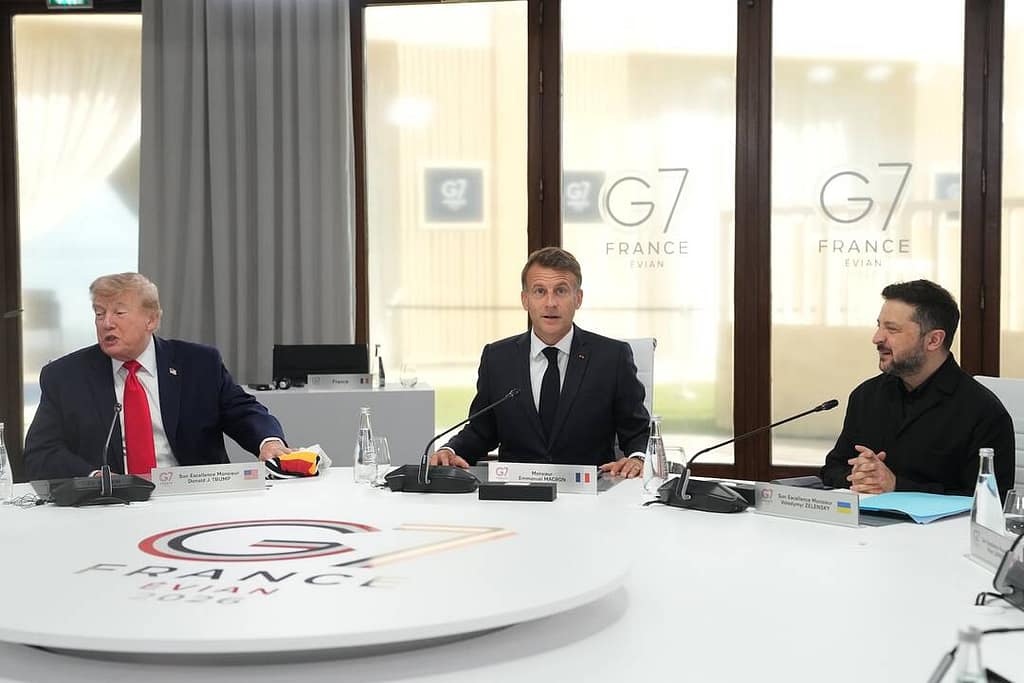
On Tuesday morning, the G7 summit focused on the war in Ukraine, with Zelensky meeting Trump for the first time in four months. But as the EU seeks to increase pressure on Moscow, the US president failed to reassure observers about his interest in ending the conflict.
Shortly before the start of a working session on Ukraine on Tuesday morning at the G7, Volodymyr Zelensky, Donald Trump and Emmanuel Macron met for 30 minutes on the sidelines of the Évian summit, according to Ukrainian outlet, The Kyiv Independent.
Although the US president has lost interest in the war Russia is waging in Ukraine since he began his own war against Iran, these talks were the first in four months between the US and Ukrainian leaders.
Zelensky is seeking to push the White House into setting up trilateral negotiations between the US, Ukraine and Russia. The request came alongside a push by the G7 to increase pressure on Russia to end the war, as it continues to pound Ukraine daily. Trump, who a few months ago had presented a plan that would have amounted to Kyiv's capitulation to Moscow, struck a somewhat less conciliatory tone toward Russia this time. He said he was ready to reinstate sanctions on Russian oil that he had partly lifted.
The reason for this reversal is the memorandum of understanding that US vice president JD Vance is set to sign in Bürgenstock on Friday. Trump said, somewhat prematurely in his own estimation, that this would now be possible because oil is flowing freely again, noting that sanctions had been suspended because the US obviously didn't want to penalise itself.
Meanwhile, Canadian prime minister Mark Carney announced new measures against Russia, unveiling a fresh round of sanctions targeting more than 160 entities linked to the "shadow fleet" used by Russia to transport energy and other goods under false flags. Quoted by AFP, Carney struck an optimistic note, pointing to the unity on display within the G7 and to its backing for Zelensky.
The United Kingdom was equally firm. In a statement released Tuesday, prime minister Keir Starmer said the UK would keep working with its G7 allies to increase pressure on Putin and his circle of associates until Russia's war machine is halted and peace returns to the continent.
But is that unity really so clear-cut? Trump appears to be committing to Ukraine, but given his many reversals, doubts remain. The US president promised to do everything he could to end the war in Ukraine, arguing that Russia should make a deal. What seems to have struck him is the human toll of the war: he said the only reason he's getting involved is that he doesn't like seeing 25,000 young people die every month.
The US has been marginalised in managing the Ukrainian conflict. According to François Heisbourg, an adviser at the Foundation for Strategic Research in Paris, funding for Ukrainian resistance is now anything but American, with the European Union, aided by Canada and Australia, covering 100 per cent of the financial support to Kyiv.
He believes Zelensky played his hand "rather skillfully" by proposing trilateral talks involving Washington and Moscow, since Putin now appears as the sole obstacle to peace.
The strategic research adviser also welcomed Brussels’ willingness to play a bigger role, noting that “initial talks began Monday between Kyiv and Brussels regarding eventual EU membership”. Whether such a goal is realistic and close, European Commission president Ursula von der Leyen, in Évian, recalled that the €90 billion package adopted by its 27 members would cover two-thirds of Kyiv's financing needs for 2026 and 2027. “We are anchoring Ukraine in Europe,” she stated, adding that the country has made remarkable progress on reform. Heisbourg, however, believes von der Leyen is getting ahead of herself. “I’m in favour of Ukraine's EU membership but anti-corruption efforts remain very insufficient,” he says.
Ukraine's main problem, Heisbourg continues, lies in its air defence against Russian Iskander ballistic missiles. “It’s primarily the Patriot defence systems, which the US stopped delivering, that are needed to counter them,” he said. “Ukraine, on the other hand, manages to intercept 100 per cent of cruise missiles,” he added.
In terms of weaponry, the EU has largely replaced the US with European states supplying large quantities of artillery pieces, armoured vehicles, 155mm shells and airborne missiles on Mirage 2000s or F-16s jets. According to the expert, Ukrainians are now manufacturing their own Flamingo cruise missiles, with help from the French and German defence industries.
Geneva Solutions content is licensed under Creative Commons BY 4.0.
Your morning update on International cooperation and development, seen from Geneva. Sent Monday to Fridays at 6 AM. We cover five core themes: Climate, Global Health, Peace & Humanitarian, Technology, and Sustainable Business & Finance, featuring opinion pieces as well as guest-edited newsletters.
Free |Monday to Friday | Archives
The GS Monthly Digest is sent every last Wednesday of the month. It features our top stories of the month for each of our five themes (Climate, Global Health, Peace & Humanitarian, Science & Technology, Sustainable Business & Finance) as well as the latest opinion pieces.
Free | Monthly | Archives
The news platform covering international Geneva.


