
Column: Obama's strong terms curbed Iran. Trump struggles to secure even a weak deal – Los Angeles Times
This is read by an automated voice. Please report any issues or inconsistencies here.
President Trump, it’s well known, is into gold. Every day brings new evidence that he’s thoroughly enjoying the “golden age” he pronounced in his inaugural address — as few other Americans are — with stock trades, crypto profiteering and much more, even a new taxpayer-financed slush fund to reward his allies.
As for me, I’ve gone into silver. That is, I constantly look for the silver linings in Trump’s heinous acts.
One silver lining, of course, is his cratering job-approval numbers in the polls, especially among the young and Latino voters who made his reelection possible. But here’s another: By his humiliating failure to bring Iran to heel, nearly three months after starting a war that he said would last weeks at most, Trump has brought new, more positive attention to what he again this week derided as “Barack Hussein Obama’s Iran nuclear deal.” (The emphasis on “Hussein” is Trump’s, always.)
The president, along with his Republican cheerleaders, counts his first-term abrogation of the 2015 Iran nuclear agreement, the Joint Comprehensive Plan of Action, as a signature achievement. This week, yet again, he falsely claimed that had he not done so, Iran would have a nuclear weapon. In fact, his action in 2018 taking the United States out of the multinational deal subsequently led to Iran’s rebuilding of its nuclear program, the emboldening of the Iranian hard-liners now in power and the Middle East morass in which the United States is now mired.
That quagmire has left Trump seeming desperate for a deal — almost certainly a worse deal than the one Obama struck. Call it JCPOA Lite.
If he were able to get Iran’s sign-off on the sort of detailed, restrictive agreement that Obama and other world leaders won 11 years ago, he’d be trumpeting himself as the world’s greatest dealmaker. (He does that anyway, but his record proves otherwise.) Instead, by his own failure to date, Trump has invited reconsideration of the very agreement he decried as the “worst deal ever” on his march to election and reelection.
No sooner was the 2015 deal signed than Trump and Republicans succeeded in defining it as a giveaway to Iran that assured, not hindered, its development of a nuclear weapon to threaten Israel and the world. Opponents condemned the agreement for not addressing Iran’s other threats, notably its support for militant proxies throughout the Mideast. Some Democrats, notably Senate Minority Leader Chuck Schumer of New York, were among the foes. Other Democrats, cowed by opposition to the agreement by Benjamin Netanyahu’s Israeli government and pro-Israel lobbyists, were all but mute in the pact’s defense.
Now some Democrats are belatedly finding their voice (and, post-Gaza, some willingness to defy Israel). Along with nonpartisan experts, those Democrats are drawing comparisons between the 2015 agreement, flawed yet successful, and Trump’s promised yet ever-elusive alternative. What’s ironic for Israel and Netanyahu, still implacably against negotiating with Tehran, is that they could end up, under Trump, with a nuclear deal that gives Iran more leeway than the hated JCPOA did.
As Americans are being reminded, the 2015 deal wasn’t just between Iran and Obama, as Trump has long suggested; other signatories were China, Russia, Britain, France, Germany and the 27-nation European Union. Reconstituting that group would be all but impossible today.
The pact’s 159 highly technical pages and five appendices — a far cry from the short-lived one-pager that Trump officials teased earlier this month — required Iran for 15 years to limit its nuclear program to civilian purposes, forfeit more than 97% of its enriched uranium and submit to intrusive monitoring by the International Atomic Energy Agency to ensure compliance. In return, Iran gradually got relief from some, but not all, international economic sanctions and access to Iranian funds that were frozen after the 1979 Islamic revolution. Presumably, after 15 years, the agreement would have been extended somehow.
By all accounts, including those of Trump’s first-term intelligence and national security officials, Iran was complying when he abandoned the deal. Its “breakout time” for building a nuclear weapon was about a year — time enough for the world to intervene — instead of two to three months. Now, though the president boasts he barred Iran from having that weapon by breaking the Iran nuclear deal, he incessantly tells Americans that he went to war against Iran on Feb. 28 because it was on the brink of a bomb — never mind that he also said he had “obliterated” Iran’s nuclear program last summer, a program that was in a well-monitored box until he first took office.
If you’re confused, you’re paying attention.
A month ago, Trump posted online that he was close to a deal “FAR BETTER” than the 2015 accord. “I am under no pressure whatsoever, although, it will all happen, relatively quickly!” To several reporters, he suggested he in fact had a deal and that Iran had agreed both to suspend its nuclear activities and to forfeit all of its enriched, near-weapons-grade uranium.
Preposterous claims, given Iran’s current government, and Tehran promptly denied them. It was a sign of Trump’s squandered credibility that few, if anyone, believed him in the first place. Nor have folks believed his more recent talk of imminent success; oil markets, too, have learned not to trust the president, as prices at the pumps attest.
On Tuesday at the White House, amid a noisy tour of the billion-dollar-ballroom construction site, Trump told reporters he’d been “an hour away” from striking Iran again that very day but Mideast leaders asked for more time for negotiations.
Don’t hold your breath.
But for the tragic consequences, Obama might be enjoying some justifiable schadenfreude about Trump’s travails.
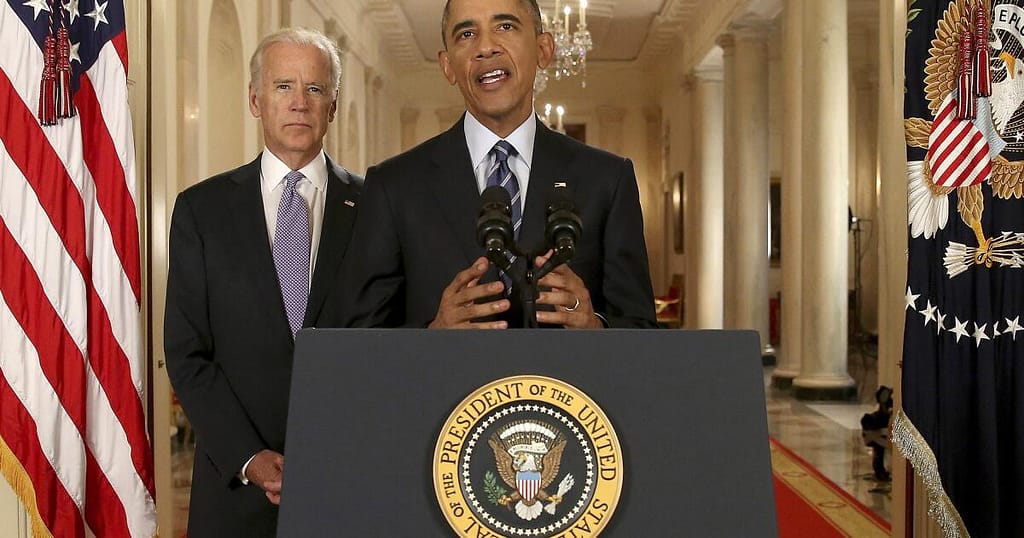
“We pulled it off without firing a missile. We got 97% of the enriched uranium out,” he told Stephen Colbert in an interview last week. Both U.S. and Israeli intelligence agreed that Iran was abiding by the nuclear limits, Obama added, “and we didn’t have to kill a whole bunch of people or shut down the Strait of Hormuz.”
That sure doesn’t sound like the “worst deal ever.” It wasn’t.
Bluesky: @jackiecalmes
Threads: @jkcalmes
X: @jackiekcalmes
L.A. Times Insights delivers AI-generated analysis on Voices content to offer all points of view. Insights does not appear on any news articles.
The following AI-generated content is powered by Perplexity. The Los Angeles Times editorial staff does not create or edit the content.
The column argues that Trump’s 2018 withdrawal from the 2015 Joint Comprehensive Plan of Action (JCPOA) — which the administration touted as a “signature achievement” — directly enabled Iran to rebuild and expand its nuclear program, empowered hard-liners in Tehran and contributed to the wider Middle East war the United States is now trapped in.[8][9]
In contrast, the piece contends that the JCPOA, negotiated by Obama with Europe, Russia and China, was “flawed yet successful”: it capped Iran’s nuclear activities for peaceful purposes, forced Tehran to ship out roughly 97% of its enriched uranium, sharply limited centrifuges and redesign the Arak reactor so it could not produce weapons-grade plutonium, and imposed intrusive International Atomic Energy Agency (IAEA) monitoring that extended Iran’s “breakout time” from a few months to about a year.[1][2][8][9]
The article stresses that, by all credible accounts at the time — including U.S. and Israeli intelligence and the IAEA — Iran was complying with the JCPOA when Trump walked away, and that the deal was effectively keeping Iran’s program “in a box” without the United States having to resort to military force or shut down the Strait of Hormuz.[1][2][8][9]
The column maintains that Trump’s claim he prevented an Iranian bomb by exiting the JCPOA is the opposite of reality: as independent arms-control analyses have noted, Iran’s enrichment and stockpile grew markedly after the U.S. withdrawal, its breakout time shrank to as little as a week, inspector access was curtailed, and the verification environment worsened.[8][9]
At the same time, the piece notes that Trump has repeatedly promised a “FAR BETTER” replacement, yet nearly three months into a war he said would last only weeks, he appears unable to secure even what critics would call “JCPOA Lite,” with Iran denying his boasts of a near-complete agreement and oil markets and foreign governments discounting his statements.[6][8][9]
The article argues that this contrast has revived appreciation among many Democrats and nonpartisan experts for the depth and rigor of the 159-page Obama-era accord and its appendices, especially when compared with the Trump team’s floated one-page framework and the administration’s shifting narratives about having “obliterated” Iran’s nuclear program while simultaneously warning that Tehran is on the brink of a bomb.[1][2][8][9]
The piece further suggests that Israeli Prime Minister Benjamin Netanyahu and hard-line supporters of maximum pressure may now face an ironic outcome: after having helped torpedo the JCPOA, they could end up with a Trump-brokered deal that offers Iran more leeway than the original agreement did, because reconstituting the original multilateral coalition and restoring its strict limits would be nearly impossible today.[2][8][9]
Finally, the column highlights Obama’s recent public defense of the JCPOA — emphasizing that it removed the vast majority of Iran’s enriched uranium and constrained the program without “firing a missile” — and uses those comments to underscore the argument that diplomacy, not war, had been working to keep Iran away from a nuclear weapon.[1][2][8]
Critics on the right, including many Republicans and pro-Israel advocates, have long contended that the JCPOA was dangerously weak, framing it not as a barrier but as a “pathway” to an Iranian bomb because key restrictions on enrichment, centrifuges and plutonium production sunset between 2026 and 2031, after which Iran would be permitted to build an industrial-scale program with international legitimacy.[7][9]
In that vein, the advocacy group United Against Nuclear Iran argues that the deal merely “rented” Iranian restraint, allowing Tehran to expand research on advanced centrifuges and, once the sunsets arrive, to stockpile large quantities of enriched uranium, operate more powerful machines and even reprocess plutonium — changes that could reduce breakout time to “mere weeks, if not days,” all within the JCPOA’s terms.[7]
The deal’s opponents further insist that the verification regime was inadequate, noting that the JCPOA did not provide true “anytime, anywhere” inspections; Iran could delay access to suspect sites for up to 24 days, while the IAEA’s closure of its inquiry into the program’s past “possible military dimensions” left unanswered questions about hidden weaponization work and made it difficult to establish a complete baseline for future monitoring.[7][9]
Many critics, including some members of Congress, also emphasize that the agreement failed to confront Iran’s ballistic missile development or its support for militant proxies and regional destabilization, arguing that sanctions relief and the unfreezing of assets gave Tehran billions of dollars it could redirect to the Revolutionary Guard and allied groups in Syria, Iraq, Lebanon and Yemen.[4][7][9]
A 2016 column from Republican Sen. John Boozman, for example, charged that the Obama administration was never serious about enforcing the deal, accusing Washington of excusing violations while Iran tested ballistic missiles, harassed U.S. naval vessels and flaunted its reintegration into global markets; the piece argued that lifting nuclear-related sanctions left Iran “flush with resources” to expand its arsenal and fund terrorism.[4]
From this perspective, Trump’s first-term decision to decertify and then withdraw from the JCPOA is defended as a necessary correction that revived U.S. leverage: supporters of the move say “maximum pressure” sanctions aimed to force Tehran into accepting a more comprehensive agreement that would eliminate enrichment on Iranian soil, impose longer timelines and address missiles and regional behavior together rather than focusing narrowly on the nuclear file.[3][6][9]
Policy analysts examining post-JCPOA diplomacy note that Trump and key advisers sought what they considered a tougher standard: a deal under which Iran would give up the right to enrich uranium at home, with any civilian fuel-cycle activity moved to a regional consortium in neighboring states under international supervision — a position consistent with recent U.S. proposals to prohibit enrichment in Iran and extend strict limits for 20 years or more.[5][6][8]
Some nonproliferation experts sympathetic to stricter terms argue that a revamped accord should not replicate the JCPOA but go further by banning high-level enrichment, sharply constraining centrifuge research and missile programs and tightening inspection authorities, contending that only such measures can credibly ensure Iran never reaches the threshold of nuclear weapons capability.[5][8][9]
Get thought-provoking perspectives with our weekly newsletter.
By continuing, you agree to our Terms of Service, which include arbitration and a class action waiver. You agree that we and our third-party vendors may collect and use your information, including through cookies, pixels and similar technologies, for the purposes set forth in our Privacy Policy such as personalizing your experience and ads.
Follow Us
Jackie Calmes is an opinion columnist for the Los Angeles Times in Washington, D.C.
Politics
Politics
World & Nation
World & Nation
Author and CBS News correspondent Jonathan Vigliotti attempts to answer some questions about rebuilding communities in his new book about the Palisades Fire — and names a motive for a quick rebuild: the Olympic games coming to Los Angeles in 2028.
Today we discuss one of the pivotal events of the 1960s: the assassination of Robert F. Kennedy. Though the gunman was caught at the scene, confessed at trial, and even bragged about the shooting, his motives have largely been forgotten.
Modern LA earned its first smoggy nickname 450 years ago, as the “bay of smokes.” At the La Brea tar pits, we take a short walk through a long history with curator Regan Dunn, who explains how and why the first Angelenos would have set fires that filled the broad bowl of LA and foretold the curse of smog.
Subscribe for unlimited access
Site Map
Follow Us
MORE FROM THE L.A. TIMES


