
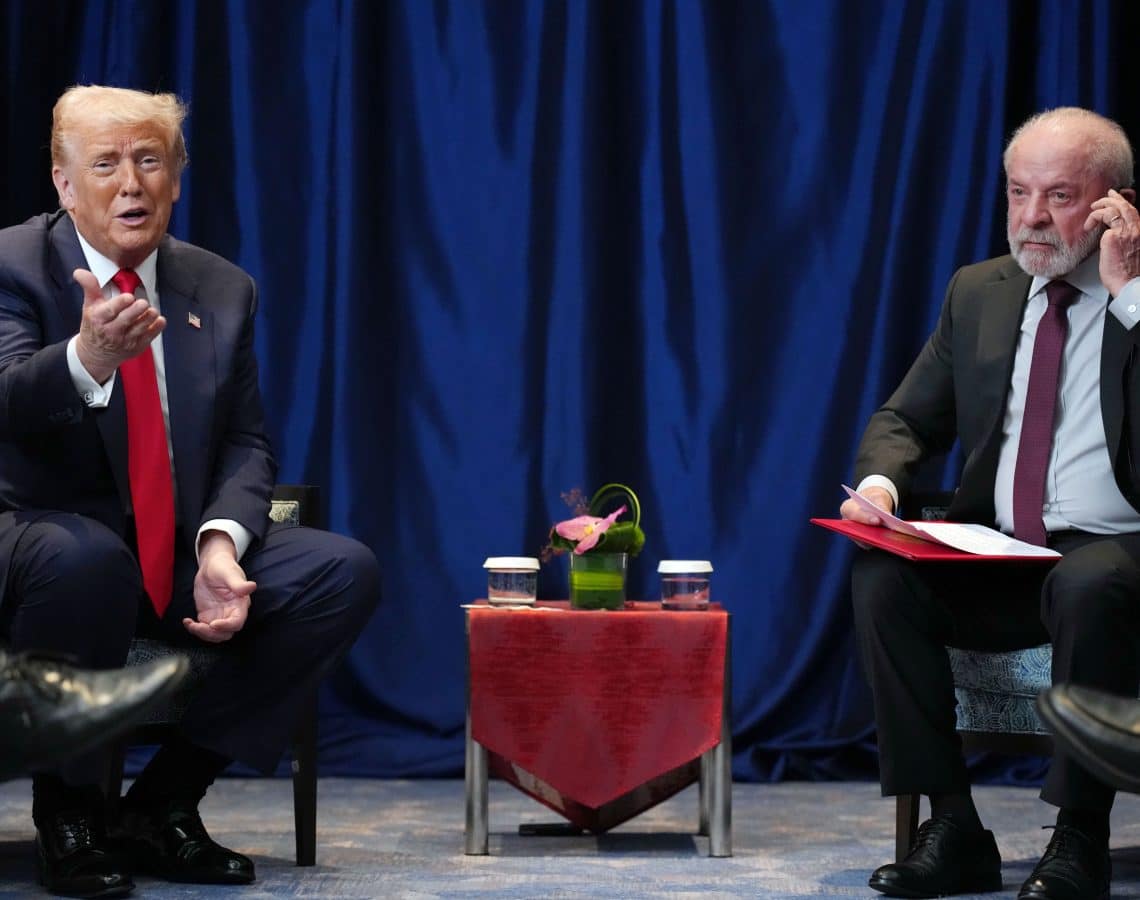
Coercive U.S. trade policy and Brazil’s strategic pivot – GIS Reports
Brazil, under President Lula, is strengthening ties with China and other partners to diversify trade and achieve strategic autonomy amid U.S. tariffs.
As American tariffs and trade tensions have increased following President Donald Trump’s return to office in January 2025, Brazil has accelerated its diversification strategy. This involves strengthening ties with Beijing, leveraging BRICS and south-south cooperation frameworks and reducing Brazil’s vulnerability to United States market volatility and political conditions.
In line with diplomatic tradition, the government of Luiz Inacio “Lula” da Silva has carefully framed this strategy not as a rejection of Washington, but rather as a pragmatic effort to maintain autonomy in an increasingly polarized international system.
The Trump administration’s reimposition and expansion of tariffs in April 2025 marked a turning point in Brazil-U.S. economic relations. Although Brazil was not the primary target of U.S. protectionism, it still faced the impact of broad tariffs on steel, aluminum, agricultural products and select manufactured goods. The overall unpredictability of U.S. trade policies affected investment and supply chains in Brazil. For policymakers in Brasilia, the issue was not simply the direct economic cost of tariffs, but the signal they sent about Washington’s willingness to weaponize market access in pursuit of domestic political goals.
On April 2, 2025, President Trump’s “Liberation Day” tariffs imposed a baseline 10 percent levy on Brazilian exports – a rate that initially seemed modest compared to the crushing tariffs applied to Asian economies. Brazil’s commodity-focused export profile and limited dependence on U.S. markets suggested the country could weather the storm relatively well. After all, exports to the U.S. constitute only about 11 percent of Brazil’s total trade.
This calculus changed, however, in July 2025, when President Trump announced a 50 percent tariff on Brazilian goods, among the highest rates imposed globally. The White House justified this escalation not on traditional trade grounds – the U.S. maintained a trade surplus with Brazil of approximately $415 billion over the preceding 15 years – but on explicitly political criteria. The White House’s executive order cited Brazil’s “politically motivated persecution” of former President Jair Bolsonaro, President Trump’s erstwhile ideological ally who was then on trial for orchestrating a coup attempt following his 2022 electoral defeat. Additional justifications in the executive order included alleged threats to free speech through social media regulation and Brazil’s role in the BRICS coalition exploring alternatives to dollar-denominated trade.
A comprehensive 40 percent tariff under the International Emergency Economic Powers Act (IEEPA) was imposed on non-exempt Brazilian products, including beef, coffee and manufactured goods. While 694 product categories, such as crude oil, aircraft and orange juice, received exemptions, the tariffs significantly disrupted supply chains. An executive order issued on November 20 provided limited relief by exempting 238 additional agricultural products following bilateral negotiations; however, the underlying political tensions remained unresolved. The tariff situation continued to evolve, with announcements in January 2026 threatening an additional 25 percent levy on countries doing business with Iran – a category that could ensnare Brazil, which has modest but growing trade ties with Tehran.
Taken together, these measures strengthened Brazilian policymakers’ long-standing concern about Brazil’s disproportionate exposure to U.S. policy cycles. Even during periods of relative political alignment, such as the Bolsonaro-Trump years, Brazil learned that personal rapport between leaders did not shield it from U.S. unilateralism. Under President Lula, this lesson has led to a renewed focus on strategic autonomy through diversifying trade partners.
The friction between the U.S. and Brazil has accelerated the established trend of closer cooperation between Beijing and Brasilia. Since 2009, China has been Brazil’s largest trading partner, but the Lula government’s agenda for 2025-2026 has focused on qualitatively upgrading that relationship. While soybeans, iron ore and oil still dominate Brazil’s exports, Brasilia is seeking to expand access for value-added agricultural products, food processing and select manufactured goods.
This reflects domestic political needs to reduce vulnerability to fluctuations in commodity prices and to create jobs in politically sensitive regions. In response to U.S. tariffs on Brazil, Beijing has announced its intention to increase imports of Brazilian coffee, meat and grain. This signals China’s readiness to absorb commodities displaced from U.S. markets.
Beyond trade flows, China has deepened its footprint across various strategic sectors. Chinese involvement in Brazilian infrastructure, such as ports, logistics corridors, energy transmission and digital infrastructure, has grown cautiously yet steadily. Unlike previous waves of Chinese overseas investment, current projects are designed to minimize political backlash. This often involves joint ventures, local content requirements and adherence to Brazilian regulatory standards. For Brasilia, Chinese financing provides long-term capital at a time when Western development finance has become more conditional and, in some sectors, limited.
This economic integration has established structural dependencies that go beyond ideology. Brazil’s influential agribusiness constituencies, which have historically been conservative and once aligned with Mr. Bolsonaro, are increasingly recognizing China as a more stable and pragmatic long-term partner than the U.S., which is now seen by many as governed by unpredictable tariff policies.
It would be incorrect to assert that Brazil is replacing the U.S. with China. Successive Brazilian governments have avoided framing the country’s foreign policy as a binary choice between Washington and Beijing. This posture is rooted in Brazil’s diplomatic tradition of maintaining autonomy through diversification and its self-image as a middle power with global, rather than merely hemispheric, interests. President Lula’s third term has explicitly revived this tradition, rejecting both domestic and external pressures to align Brazil firmly with one side or another in the escalating rivalry between the U.S. and China.
While strengthening commercial ties with China, Brazil has also expanded trade and cooperation agreements with India and Indonesia, as well as with partners in the Middle East and Southeast Asia. With this “portfolio strategy,” Brasilia aims to broaden its export markets for agriculture, energy and certain manufactured goods, while simultaneously building a range of financial and diplomatic partnerships to avoid becoming overly dependent on any single great power.
The approach has proven successful. Between August and December 2025, following the full implementation of tariffs, Brazilian exports to the U.S. declined by $3.7 billion from the previous year. However, Brazil concluded 2025 with record total exports by quickly redirecting its trade flows to alternative markets. China accounted for 37 percent of Brazil’s redirected exports during this period, consolidating its status as Brazil’s largest trading partner. Additionally, Brazil experienced significant increases in trade with other countries, including a 62 percent rise in bilateral trade with Morocco and a 52.9 percent increase in exports to India.
Brazil’s engagement with BRICS and the New Development Bank (formerly known as the BRICS Development Bank) has taken on renewed importance. The Lula government views BRICS less as an anti-Western bloc than as an institutional hedge to expand policy space, access alternative financing and shape global governance debates from within. These efforts, along with initiatives to advance the European Union-Mercosur agreement, illustrate a clear strategy to expand Brazil’s economic ties across regions.
In practice, Washington’s tariff campaign appears to have produced several unintended strategic effects in Brazil. First, the belief that economic pressure would weaken President Lula domestically proved questionable. Instead, this external pressure has reinforced nationalist narratives, bolstered President Lula’s political standing among key constituencies and created cross-ideological backing around themes of sovereignty and economic autonomy.
Second, the perceived connection between U.S. trade pressure and the legal challenges facing former President Bolsonaro alienated parts of Brazil’s conservative establishment that might otherwise support closer ties with Washington, as many elites saw it as threatening judicial independence.
Third, these dynamics created additional political and commercial space for China to expand its presence precisely in key sectors – technology, infrastructure and critical minerals – where the U.S. has sought to limit Beijing’s global reach.
The effectiveness of this tariff strategy at the regional level remains uncertain. Coercive economic diplomacy has historically had a greater effect in countries with a high structural dependence on U.S. market access, such as Mexico. Its influence appears to be more limited in larger, more diversified economies such as Brazil and much of South America. Due to existing commercial ties with China, the EU and Middle Eastern markets, governments in the region have found it easier to resist pressure by adjusting trade and investment flows rather than conceding.
At the same time, U.S. protectionism has occurred alongside a broader global trend where many major economies, including the EU, China and several middle powers, continue to advocate for trade liberalization. In the past decade, countries in Latin America have increasingly adopted multi-vector trade strategies instead of focusing on a single integration path. They have been broadening trade agreements with partners in the Asia-Pacific region, strengthening intra-regional trade frameworks and advancing long-awaited initiatives such as the EU-Mercosur agreement.
The result is not a wholesale realignment away from the U.S., but a gradual erosion of Washington’s structural leverage: As alternative markets, financing and institutional partners proliferate, the costs of distancing from the U.S. decline. In this environment, efforts to compel alignment through economic pressure are more likely to accelerate diversification than reverse it.
Given policy changes since January 2025, the most likely outcome for U.S.-Brazil relations is that they settle into a new equilibrium marked by ongoing friction but functional cooperation in certain sectors. The Trump administration continues to exempt key Brazilian agricultural exports (coffee, beef, soybeans) to control U.S. consumer prices while maintaining symbolic tariffs on manufactured goods and politically sensitive categories. Brazil accelerates economic integration with China in technology, infrastructure and mining, while remaining diplomatically flexible by avoiding the formation of a clear anti-U.S. bloc.
Regional dynamics see other Latin American countries emulating Brazil’s diversification strategy, leading to increased Chinese trade and investment across the hemisphere without wholesale abandonment of U.S. ties. The hemisphere becomes genuinely multipolar, with countries maintaining commercial relationships with both powers while asserting greater autonomy in foreign policy. This outcome represents a managed decline in U.S. hegemony rather than a catastrophic collapse, with Washington retaining significant influence through security cooperation, cultural ties and selective economic engagement.
Another possible scenario is that mounting domestic political pressure from U.S. consumers, agricultural lobbies and business groups forces President Trump to change course. The administration describes tariff reversals as a “successful negotiation” in which Brazil made unspecified concessions on issues like digital trade and access to rare earth minerals, allowing President Trump to claim victory. Brazil, in response, moderates its public criticism of U.S. policy but does not reverse its growing relationship with China or the diversification of its supply chains and trade ties.
This outcome resembles India’s strategic playbook: maintaining cordial relations with Washington on security issues while deepening commercial ties with Beijing. Brazil’s foreign policy successfully balances competing pressures without sacrificing core interests.
The least likely scenario is that the U.S.-Brazil confrontation escalates beyond tariffs into comprehensive economic warfare. Washington imposes sanctions on Brazil’s financial system under the IEEPA, targeting major banks alleged to facilitate money laundering for criminal organizations or to engage in trade with Iran. The Trump administration classifies Brazilian organized crime groups as terrorist organizations, imposing secondary sanctions on companies doing business with Brazilian entities. Brasilia retaliates by nationalizing or expropriating U.S. digital platforms operating in its market, citing national security and sovereignty concerns.
This scenario requires sustained political will on both sides to absorb high economic costs for symbolic political victories. Given that both Presidents Lula and Trump face electoral pressures (Mr. Lula in 2026, the U.S. Republican Party in 2026 midterms and the 2028 presidential race), the mutual incentives to avoid catastrophic escalation make this outcome unlikely, though not impossible.
The views expressed in this review are solely those of the author and do not represent the views of or endorsement by the United States Naval Academy, the Department of the Navy, the Department of Defense or the United States government.
Contact us today for tailored geopolitical insights and industry-specific advisory services.
Receive insights from our experts every week in your inbox.
Information about what personal data we collect about you and how we process it (including information about how we personalize our website for you and deliver content tailored to you) can be found in our privacy policy.
Show all reports