
Appeals court clears Trump to remake slavery exhibit – E&E News by POLITICO
 Full access to essential energy & environment news for professionals.
EXPLORE COVERAGE
GET ACCESS
EXPLORE COVERAGE
By Heather Richards | 06/18/2026 03:07 PM EDT
Judges rejected a bid by the city of Philadelphia to stop the National Park Service’s efforts to recast unsavory elements of American history.
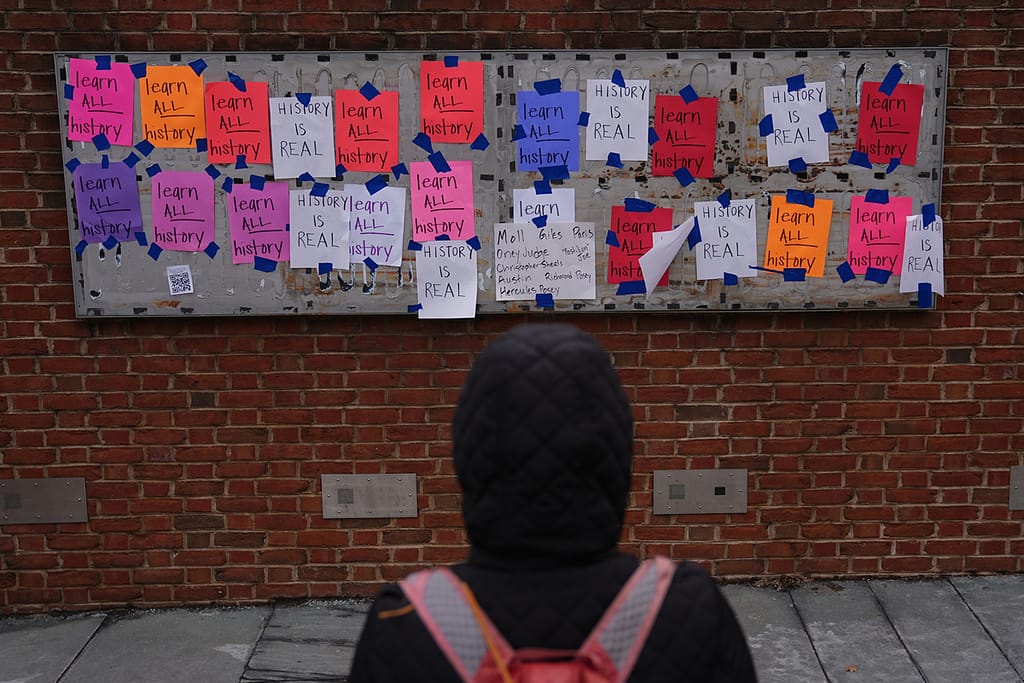
A person views posted signs on the locations of the removed explanatory panels that were part of an exhibit on slavery at President’s House Site in Philadelphia on Jan. 23. Matt Rourke/AP
An appeals panel ruled Thursday that the Trump administration can take down an exhibit on the enslaved servants of George Washington at a Philadelphia national park, a win for the White House as it tries to reframe the nation’s sins into uplifting stories of progress across national park sites.
The 3rd U.S. Circuit Court of Appeals unanimously concluded that a lower court lacked authority when earlier this year it ordered the National Park Service to mostly restore the slavery exhibit removed from Independence National Historical Park and blocked efforts to install a revised installation.
The Trump administration in January removed the outdoor exhibit dedicated to nine enslaved African Americans that Washington brought to the executive residence in Philadelphia when he served as president. The move was the most public display of Trump’s order for national parks to eliminate exhibits and education material that “inappropriately disparages Americans past or living.”
Following a lawsuit from the city of Philadelphia, District Judge Cynthia Rufe forced the park service to mostly reinstate the panels — while the case was being heard — and blocked an effort by the Trump administration to put up a new installation that replaced much of the material about the individual enslaved people at Washington’s house with general education about slavery and abolition.
In a decision written by Circuit Judge Thomas Hardiman, a George W. Bush nominee, the three-judge panel ruled that Philadelphia failed to prove that it suffered “concrete injury” when NPS took down the exhibit without consulting the city.
Hardiman argued that Philadelphia’s rights were limited within the national park site and did not include the President’s House site. He argued that a 2006 cooperative agreement between the park service and Philadelphia had expired, noting that the federal agency now owns the property.
“The City attempts to leverage language in the Cooperative Agreement that obligates NPS to ‘maintain’ the President’s House after it is finished,” Hardiman wrote. “The duty to ‘maintain’ is better understood as a general management obligation that accompanies ownership, not a promise that the exhibits will forever remain in place regardless of the owner’s wishes.”
Hardiman, who was tapped in 2018 by the Trump administration as a potential Supreme Court nominee, also praised the replacement panels provided by the Trump administration, arguing that they include context about slavery while acknowledging the first president’s personal ambivalence.
“These new panels are full of historical context,” the judge wrote. “They acknowledge the evil of slavery, including its injustices and hypocrisies, and, by telling the story of the nine slaves that Washington kept in the President’s House, remind us of their essential humanity.”
The appeals court ruling comes on the heels of a district court ruling in Massachusetts ordering the Trump administration to restore any park historical education it removed across the country.
The Trump administration asked for a stay on the ruling while it appealed, arguing that the order would be an enormous task. The court denied that request Thursday.
The transformation of the energy sector.
Policy. Science. Business.
Congress. Legislation. Politics.
The leader in energy and environment news.
Late-breaking news.
© POLITICO, LLC


