
About half of Americans continue to say Trump administration is doing ‘too much’ on deportations – Pew Research Center
Numbers, Facts and Trends Shaping Your World
Read our research on:
Full Topic List
Read Our Research On:
|
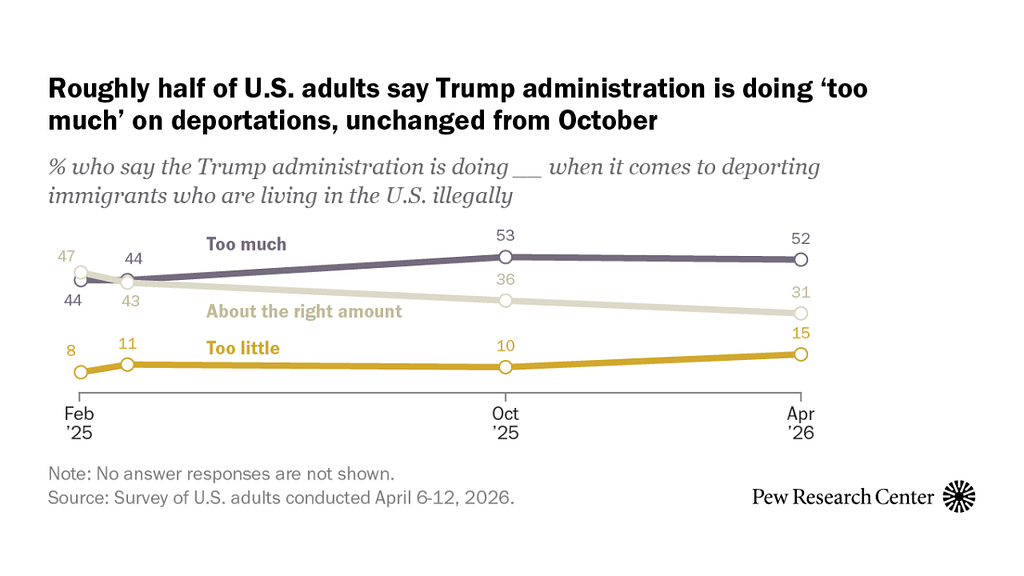
About half of U.S. adults (52%) say the Trump administration is doing too much to deport immigrants who are living in the country illegally, according to a Pew Research Center survey of 3,592 U.S. adults conducted April 6-12, 2026. This share is little changed from when we last asked this question in October 2025.
However, slightly more Americans now say the administration is doing too little to deport immigrants who are living in the country illegally (15% now vs. 10% in October). This is primarily driven by Republicans and Republican-leaning independents, as 28% now say the administration is doing too little. That’s the highest share since we first asked this question in February 2025, early in Donald Trump’s second term as president.
Meanwhile, the share of U.S. adults who say the administration is doing about the right amount when it comes to deportations has fallen steadily, from 47% in February 2025 to 31% today.
Pew Research Center surveyed Americans to see how they view the Trump administration’s efforts to arrest and deport immigrants who are living in the country illegally.
Pew Research Center does research to help the public, media and decision-makers understand important topics. This project builds on our long-standing research about immigration attitudes.
Learn more about Pew Research Center.
This analysis includes findings from a survey of 3,592 U.S. adults who are part of the Center’s American Trends Panel (ATP). The survey was conducted April 6-12, 2026, and has an overall margin of error of plus or minus 1.9 percentage points.
Here are the questions used for this analysis, the detailed responses and the survey methodology.
Immigrants are U.S. residents born in foreign countries to parents who aren’t U.S. citizens. People who are U.S. born are those born in the U.S. or its territories or born in foreign countries to U.S. citizen parents.
Second generation refers to people who are U.S. born with at least one immigrant parent.
Third or higher generation refers to people who are U.S. born with both parents who are U.S. born.
References to White, Black and Asian adults include those who are not Hispanic and identify as only one race. Views of Asian adults are representative of English speakers only. Hispanics are of any race.
Some groups of Americans are more likely than others to say the Trump administration is doing too much to deport immigrants who are living in the U.S. illegally:
There are also differences by nativity and immigrant generation. Third- or higher-generation adults (48%) are less likely than second-generation adults (62%) or immigrants (65%) to say the administration is doing too much. (Second-generation adults are U.S. born to at least one immigrant parent. Third- or higher-generation adults are U.S. born to U.S.-born parents.)
For most of these groups, views on this question are similar today to what they were in October 2025. However, Hispanic adults have become slightly less likely to say to the Trump administration is doing too much (65% now vs. 71% then).
Americans have mixed views about where law enforcement officers should be allowed to arrest immigrants who are living in the U.S. illegally.
Two-thirds of Americans or more say arrests should not be allowed in:
Roughly half or more of Americans say arrests should be allowed at:
This pattern is similar to when we last asked this question in early March 2025.
Note: Here are the questions used for this analysis, the detailed responses and the survey methodology.
Topics
Joseph Copeland is a research analyst at Pew Research Center.
Alexandra Cahn is a research assistant at Pew Research Center.
901 E St. NW, Suite 300
Washington, DC 20004
USA
(+1) 202-419-4300 | Main
(+1) 202-857-8562 | Fax
(+1) 202-419-4372 | Media Inquiries
ABOUT PEW RESEARCH CENTER Pew Research Center is a nonpartisan, nonadvocacy fact tank that informs the public about the issues, attitudes and trends shaping the world. It does not take policy positions. The Center conducts public opinion polling, demographic research, computational social science research and other data-driven research. Pew Research Center is a subsidiary of The Pew Charitable Trusts, its primary funder.
© 2026 Pew Research Center
We use cookies and other technologies to help improve your experience; some are necessary for the site to work, and some are optional. Learn more in our privacy policy.
These cookies are required for the website to function and cannot be switched off.
These cookies are used to collect information about how you use our website.
These cookies are used to track your activity and show you personalized content.
These cookies allow the website to remember choices you make.
Notifications