
View from Brazil: Economy teeters over Trump tariffs – New Internationalist
Subscribe Now!
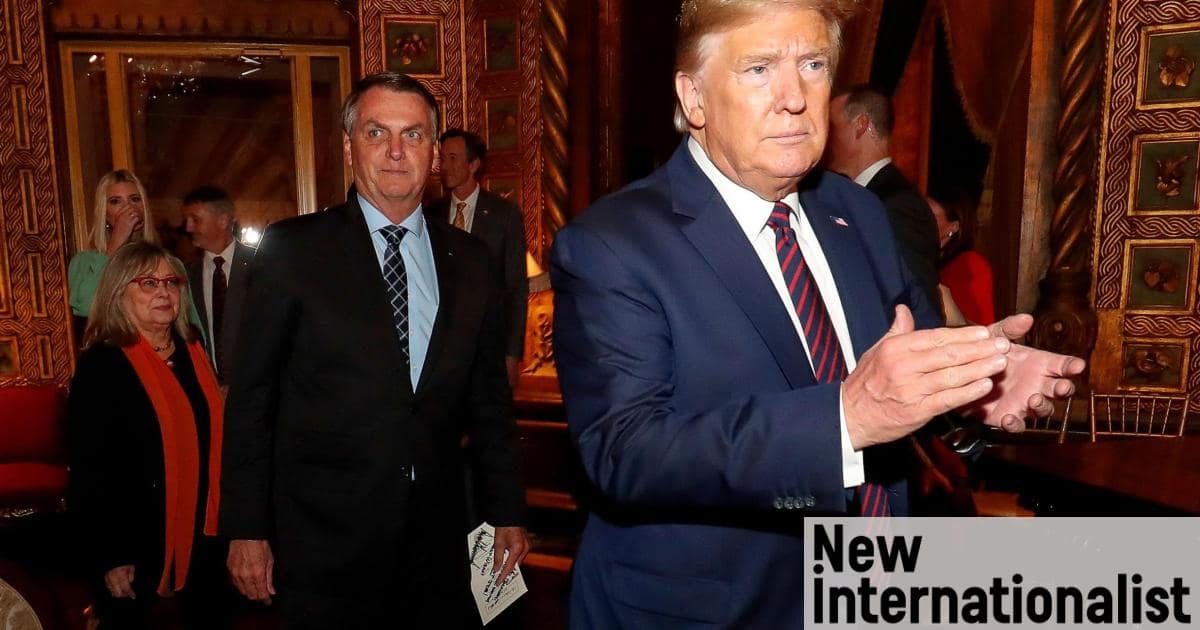
Trump's imposition of tariffs on Brazil are in part to object to the conviction of his friend former Brazilian president Jair Bolsonaro – here, the two are pictured in Mar a Lago, Florida, in March 2020. ALAMY..
Trump’s tariffs are pushing Brazil closer to China in an effort to open up new markets, writes Leonardo Sakamoto.
When United States President Donald Trump imposed 50 per cent import duties on Brazilian products in early August, it meant job losses and company closures here, and inflation in the US, since Brazil is one of the world’s largest food suppliers. Whatever Trump’s intention, the decision pushes Brazil closer to China.
The three reasons Trump cited for his new tariffs on Brazil were: 1) the trial of former president Jair Bolsonaro in Brazil’s Supreme Court for attempting a coup d’état; 2) trade relations with Brazil, which he calls unfair, despite the fact the US has consistently run a multi-billion dollar trade surplus with the country; 3) judicial rulings that force US big tech companies to comply with Brazilian law.
Trump, just like Bolsonaro, was accused of leading an invasion of Congress after being defeated in the presidential election; he perhaps sees a reflection of himself in the beleaguered politician and has repeatedly used his power to demand the trial be halted.
Advert
Jair’s son, federal deputy Eduardo Bolsonaro, moved to the United States to push for sanctions against both Brazil and Justice Alexandre de Moraes, the judge on his father’s trial. Beyond tariffs and other punishments, the US used the Magnitsky Act – originally designed to punish dictators by enabling blocking of accounts and assets – against Moraes.
Meanwhile, the founders of the BRICS economic bloc – China, Brazil, India and South Africa – have been among those hit by the highest tariffs, as Trump takes aim at fledgling efforts to move away from the US dollar’s hegemony. The other founder, Russia, already has a range of Western sanctions against it.
In search of collective solutions, BRICS have been holding talks among themselves. Chinese premier Xi Jinping declared his country would work with Brazil to set an example of unity and self-sufficiency among the leading countries of the Global South. China, Brazil’s largest trading partner, has already increased its soya purchases from the Latin American nation, and plans to buy more beef and coffee. Lula has also held discussions with Indian Prime Minister Narendra Modi, and is opening up new markets, including beef exports to Indonesia.
Advert
Yet the situation remains delicate. The US has slapped extra tariffs on India because of its purchase of Russian oil and weapons. Brazil is dependent on Russian diesel and fertilizers, and there is concern the US could use these imports as a justification for further tariff hikes.
Affected Brazilian sectors experienced a drop in exports of almost a quarter in August. Lula’s government announced almost $6 billion in support for affected companies, on the condition they protect jobs; privately, officials say some job losses are inevitable. Meanwhile Trump’s efforts have led to the European Union and South American trade bloc Mercosur accelerating efforts on their own trade agreement.
Trump does not want to hear talk of the BRICS reducing their reliance on the dollar as a trading currency. But instead of drawing Brazil and India closer – by encouraging bilateral trade, continuing international aid for social programmes and building on its cultural influence the – United States is pushing former partners into China’s arms by proving itself no longer trustworthy.
Bolsonaro’s desperate pledges to Trumpism have not paid off, argues Leonardo Sakamoto.
Bolsonaro’s desperate pledges to Trumpism have not paid off, argues Leonardo Sakamoto.
Subscribe Today
This article is from the November-December 2025 issue
Gaza: Genocide and Resistance
Subscribe today
Our free, weekly newsletter with the best of our journalism.
Advert
The Beirut-based journalist provides his analysis on why Israel is able to impose a one-way ‘ceasefire’, its broader war aims in South Lebanon, and the people caught in the middle
The activist and campaigner on the treaty to end fossil fuel extraction, and why a free Palestine is inextricably linked with climate justice
A wave of femicides prompts questions about government failings and potential strategies of resistance, writes Leonardo Sakamoto.
Rosebell Kagumire reflects on the politics, hope and scrutiny surrounding the Africa Cup of Nations.
More stories »
Subscribe Today
New Internationalist is a multi-stakeholder co-operative owned by its workers and approximately 4,600 co-owners
 Member of
Co-operatives UK
Follow us


