
What’s Going On in Donald Trump’s Brain as He’s Turning 80? He’s Given Us Some Clues. – Slate Magazine
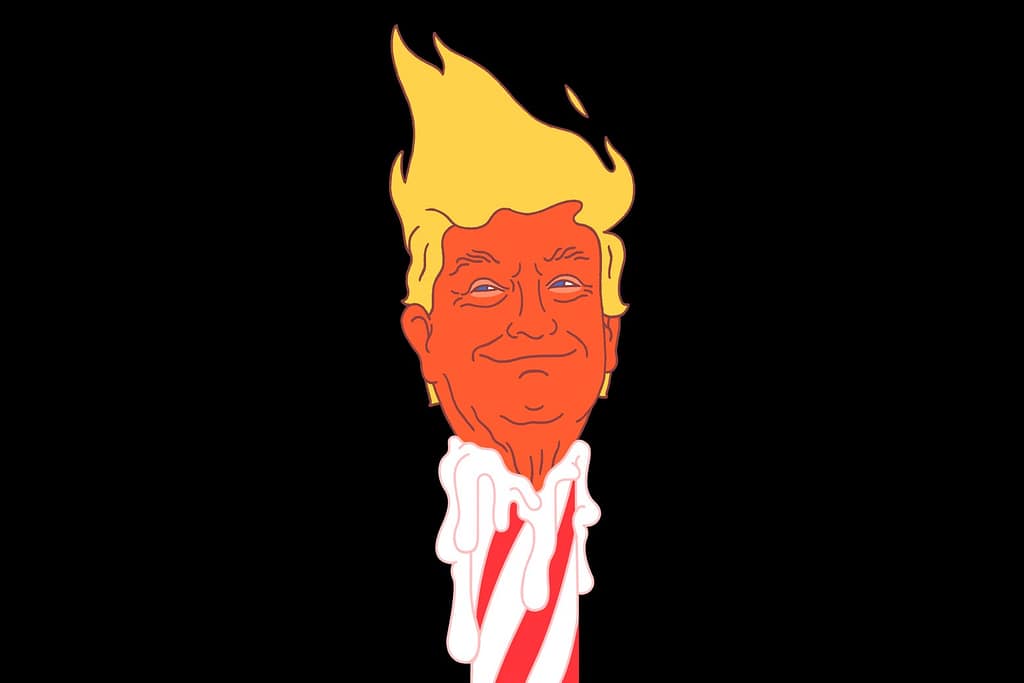
Trump Brain is a series about what’s really going on in the president’s head, on his 80th birthday.
The president of the United States is about to turn 80. We’ve been here once before. It did not go particularly well.
The question of just how cognitively sharp Donald Trump is these days is more complicated, however, than it was for Joe Biden after his notorious 2024 debate, at 81, against the current president. (His performance was so bad that Jill Biden recently claimed she thought he’d been having a stroke.) There are signs of trouble with Trump, persistent and notable: He continues to fall asleep in meetings (and at Knicks games) while behaving in ways no one understands. Yet he still sounds like himself much of the time. And while it might not be totally clear what’s going on in Trump’s head, every day he seemingly gives us some clues.
It’s not for nothing that, even as his war with Iran persists, Trump spends his days posting about “taking out” late-night hosts like Bill Maher. When he talks naval strategy and lays out his bloodthirsty international agenda, he also tends to launch into repetitive, rambling tangents about Victory at Sea, the docuseries of the World War II battleship fleet that became one of TV’s first big hits—helping usher in the broadcast era that would, eventually, make the man himself a celebrity. After setting the Venezuela invasion in motion, Trump celebrated on Truth Social by posting a video montage of fighter planes bafflingly soundtracked by the classic anti-war anthem “Fortunate Son.” Just weeks afterward, he invited dignitaries like Waka Flocka Flame and Jordan Belfort to the Trump–Kennedy Center (whose renaming was recently struck down by a federal judge) for the release of Melania, the $40 million, Amazon-distributed documentary about our first lady that was helmed by Brett Ratner. The once disgraced filmmaker has remained a weirdly consistent presence throughout the year, even accompanying Trump in May on a state visit to China, where the People’s Liberation Army band greeted the motley crew at dinner by covering one of the president’s longtime favorites, “Y.M.C.A.”
More than ever before, the state of Trump’s mind, already TV-addled since childhood, is a mass of gray matter slowly congealing into a mush of reactionary-boomer grievances and pop-culture references from bygone eras. Consider his nonmusical plans for observing the country’s 250th birthday: with a UFC fight on the White House lawn and a sculpture garden of national icons who would certainly have appealed to any child of midcentury America (e.g., Elvis, Sinatra, Disney, Gens. Patton and MacArthur, John Wayne, Davy Crockett). Or, going beyond that, his enduring obsession with Time magazine covers and with The Phantom of the Opera. How much does he love Phantom in particular? In a 2023 interview with Steve Bannon, Trump became so enraptured talking about the musical that he wouldn’t stop, even as Bannon tried to get him to focus on crime in New York City. He continues to blare cast recordings at the White House to this day.
Many times, Trump’s cultural preoccupations have seemed to directly shape policy. There was plenty of confusion around his repeated campaign-trail invocations of Hannibal Lecter and asylums; they make more sense when you realize that he confused immigrant asylum-seekers with institutionalized patients. Last spring, Trump suddenly declared that he was going to reopen Alcatraz; curiously, as the Hollywood Reporter noted, a local PBS affiliate that serves the South Florida region encompassing Mar-a-Lago had aired the 1979 classic Escape From Alcatraz twice in the preceding days.
Of course, watching PBS did not additionally inspire Trump to preserve the broadcaster’s federal funding. Trump is not only driven by culture but obsessed with bringing the entities that produce it to heel. In one alarming example, his administration has succeeded in reshaping Paramount from the top down, suing CBS News into a hefty settlement and celebrating the abrupt cancellation of Stephen Colbert’s show. The administration approved the Skydance merger only after certain ideological commitments were met (eventually spurring the gutting shake-up at 60 Minutes), then openly vied to have the merged entity also take over Warner Bros. Discovery—all but granting Trump pal Larry Ellison a whole media empire of his own, sans the CNN anchors he and Trump want gone. Yet, as we now know, one of Trump’s keenest desires, beyond the First Amendment desecrations, is for Ellison and son to produce Rush Hour 4, directed by none other than … Brett Ratner.
At a political moment that’s simultaneously more horrific, erratic, and plain befuddling than anything this country has seen in ages, we wanted to understand Trump’s potential decline and his obsessions by looking sideways at his second administration—specifically, by analyzing those cultural artifacts that the president perennially brings up at the strangest occasions, explaining what they say about his worldview and what he’s trying to do to America. This brought us to our new compendium, Trump Brain.
One thing we realized, the more we dug into Trump’s cultural obsessions, is how often he seems to fundamentally misunderstand the works he treasures most deeply. But there are insights about his perception of—and plans for—America to be gained from examining those misunderstandings. Every so often, his chat with Errol Morris about Citizen Kane makes the rounds, in which his surprisingly incisive musings on the movie’s themes (“Wealth does isolate you from other people—it’s a protective mechanism”) give way to repellent misogyny (“Get yourself another woman”). For someone who’s worked so hard to vanquish LGBTQ+ Americans’ civil rights, his taste in music has always leaned toward the orchestral and campy—musicals, yes, but also jazzy old-school standards, flamboyant rockers, and the opera house. It’s a fitting palette for a man who himself became a pop-culture titan in the midst of the Reagan ’80s, his tacky gold Trump logos embossed upon the New York City skyline at a moment when financial speculation ran rampant, Warholian excess defined the art world, unapologetic wealth displays were a social ticket, de facto segregation kept wealthy white people fenced off from the inner city, and the mob still had a handle on things.
Remember, too, that while all this pop culture guides him, it does so per his most superficial interpretations. Let’s take a look back at how he likes to watch 1988’s Bloodsport, as recounted by the New Yorker’s Mark Singer:
By assigning to his son the task of fast-forwarding through all the plot exposition—Trump’s goal being “to get this two-hour movie down to forty-five minutes”—he eliminated any lulls between the nose hammering, kidney tenderizing, and shin whacking. When a beefy bad guy who was about to squish a normal-sized good guy received a crippling blow to the scrotum, I laughed. “Admit it, you’re laughing!” Trump shouted. “You want to write that Donald Trump was loving this ridiculous Jean Claude Van Damme movie, but are you willing to put in there that you were loving it, too?”
That really resembles those high-octane battle clips and pop-culture montages that define the White House’s current social media strategy, doesn’t it? It’s also, at its base, the Trump id, the sharpest remnants of an 80-year-old brain still marinating in the brutish, tacky, loud, glossy, screen-saturated cultural touchstones that raised him—and that still guide his presidential tenure, however confusingly. There may be no better way to understand what’s happening in Trump’s head than his 25 biggest cultural fixations, explained and decoded by Slate’s best writers and reluctant Trump scholars. Read Trump Brain here.
Slate is published by The Slate Group, a Graham Holdings Company.
All contents © 2026 The Slate Group LLC. All rights reserved.
Slate relies on advertising to support our journalism. If you value our work, please disable your ad blocker. If you want to block ads but still support Slate, consider subscribing.
Already a member? Sign in here