Trump’s designation of Brazilian criminal groups as terrorists concerns clergy – Crux | Taking the Catholic Pulse
Today's top stories delivered straight into your inbox.
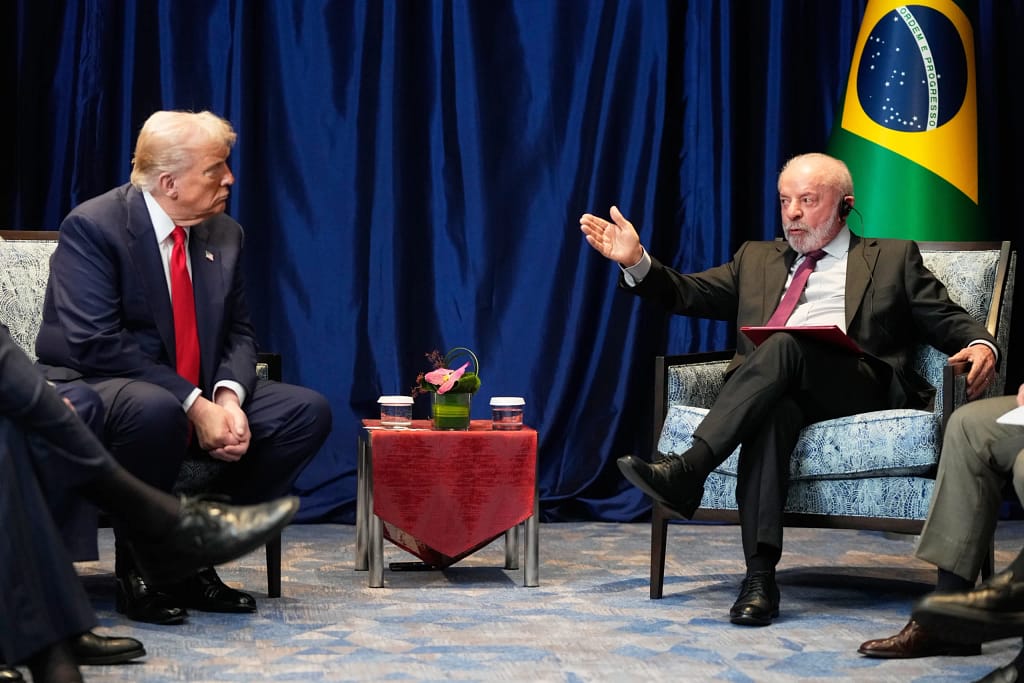
U.S. President Donald Trump meets with Brazil President Luiz Inácio Lula da Silva on the sidelines of the ASEAN meeting in Kuala Lumpur, Malaysia on Oct. 26, 2025. (Credit: Mark Schiefelbein/AP.)
SÃO PAULO – President Donald Trump’s administration announced on May 28 that it had decided to designate two Brazilian mafia-like criminal organizations, Primeiro Comando da Capital (First Capital Command, also known by the Portuguese acronym PCC) and Comando Vermelho (Red Command, or CV), as terrorist groups.
The news drew criticism from President Luiz Inácio Lula da Silva’s administration, which had been working hard to dissuade the U.S. government from pursuing that idea over the previous several months.
Church leaders and activists in Brazil have also expressed opposition to the U.S. decision, voicing concern over its possible consequences for the country and for particular segments of Brazilian society.
The announcement came only two days after Senator Flávio Bolsonaro, the eldest son of former President Jair Bolsonaro, and his brother Eduardo Bolsonaro (a former congressman who now lives in the U.S.), visited Trump at the White House.
Flávio, who is expected to run against Lula in this year’s presidential election, saw his support decline after Intercept Brasil revealed that he had solicited money from Daniel Vorcaro, a once-prominent banker who has since fallen from grace and is now imprisoned on charges related to numerous financial crimes.
According to Intercept, Flávio negotiated an arrangement under which Vorcaro would provide him with $24 million to fund a biopic about Jair Bolsonaro titled Dark Horse. Between February and May 2025, Vorcaro transferred at least US$ 10.6 million. The money was sent to a U.S.-based fund owned by an ally of Eduardo Bolsonaro.
Text messages between Flávio and Vorcaro indicate they maintained a close relationship. On Oct. 22, Flávio invited Vorcaro to a dinner in São Paulo with Dark Horse director Cyrus Nowrasteh and actor Jim Caviezel, who portrays Jair Bolsonaro in the film. The discussion ultimately led to an agreement for Vorcaro to host the dinner at his residence.
According to a recent poll, the leak of those messages caused Flávio’s support to drop from 36 percent to 31.5 percent. Lula’s support also declined, from 40 percent to 38.5 percent. In that scenario, Flávio would lose to Lula in both the first and second rounds of the election scheduled for October.
Most analysts in Brazil viewed Flávio’s May 26 visit with Trump as an attempt to create a new narrative and divert attention from the Vorcaro controversy. After the White House meeting, he told reporters that he had asked the U.S. government to classify the PCC and the CV as terrorist organizations, and that classification ultimately occurred two days later.
While Bolsonaro’s supporters hailed Trump’s decision as a fundamental step toward intensifying the fight against organized crime in Brazil, Lula’s administration perceived it as an attempt to undermine Brazilian sovereignty.
Public security experts likewise criticized the measure. São Paulo prosecutor Lincoln Gakiya, for instance, told Folha de S. Paulo that the new classification could complicate cooperation between U.S. and Brazilian authorities in investigations into the activities of such groups.
According to Gakiya, who has been fighting the PCC for more than 20 years and has been targeted for assassination by the organization, the measure would shift efforts against the PCC and the CV from the sphere of law enforcement – where he frequently meets with the Federal Bureau of Investigation and the Drug Enforcement Administration – to the Central Intelligence Agency (CIA) and national defense agencies.
Such a change would likely result in intelligence gathered in the United States being classified, reducing the exchange of information with Brazilian authorities.
Gakiya and other experts have also pointed out that U.S. anti-terrorism legislation allows military operations to be conducted outside American territory without prior authorization from the country where the target is located. They argue that such a possibility would undermine Brazil’s sovereignty.
Both groups control prisons throughout Brazil and are major narcotics distributors in the country. The CV exerts influence over vast urban areas in Rio de Janeiro and other regions, dominating numerous favelas. The PCC has a different structure and operates as a network, controlling drug smuggling and distribution in Brazil and neighboring countries, especially Paraguay.
Part of the Brazilian clergy is also concerned about these issues. This is true of Archbishop Zanoni Demettino Castro of Feira de Santana in the state of Bahia.
“Such criminal organizations have caused immense harm in our region. They dominate cities, recruit young people, and kill many individuals. They must be fought with strength and intelligence,” Castro told Crux Now.
But “specialists do not believe that designating them as terrorist organizations is the best alternative – and the justification for such a measure appears to lack substance,” he added.
Castro, who heads the Afro-Brazilian Pastoral Commission, said that foreign intervention in such matters is unhelpful and that those who advocate it are “hypocritical.”
“Terrorism carries an ideological dimension, and that is not the case here. These groups must be fought, but this is not the best way to do it,” he argued.
Political scientist and lay Catholic Daniel Seidel, who heads the Justice and Peace Network in Latin America, also rejects the idea that Brazilian criminal organizations can be classified as terrorist groups.
“Terrorist organizations seek to challenge or seize political power over cities, states, or nations. Drug cartels in Brazil seek to gain influence within power structures, but only in order to secure impunity and ensure their own reproduction,” he told Crux Now.
Seidel argued that extremist actions carried out by terrorist organizations are intended to mobilize public opinion in pursuit of the capture of the State.
In 2006, the PCC launched a wave of attacks against police stations and other public and private buildings in retaliation for the transfer of hundreds of inmates – including several of its leaders – to a maximum-security prison. But, again, Seidel argued, those attacks were linked only to the group’s pursuit of impunity.
“It is pushing the definition too far to characterize them as terrorists,” he said.
He said he believes that Brazil’s domestic mechanisms for combating organized crime, although insufficient, are more effective than any action a foreign country could undertake.
The measure adopted by Trump has encouraged the opposition in Brazil, which now seeks to pass legislation that would also designate the PCC and the CV as terrorist organizations. Seidel fears that such a move could lead to the militarization of efforts to combat drug trafficking in Brazil.
“For some people, violence can only be fought with more violence. Under that logic, massacres of young Black men have become commonplace in Rio de Janeiro. And those massacres have solved nothing,” he said.
Seidel argues that only by addressing the structural causes of inequality in Brazil will the State be able to successfully combat crime.
Concerns about the potential consequences of such a decision for marginalized social groups in Brazil have also been expressed by Franciscan Father David Santos, a longtime activist for the rights of Black Brazilians.
“My main concern is that initiatives of this nature may reinforce a public security approach based on the expanded use of force without the necessary safeguards,” he told Crux Now.
The Brazilian experience shows that, all too often, the most vulnerable populations – especially Black youth and residents of poor urban neighborhoods – bear the highest costs of anti-crime policies when such policies are not accompanied by robust human rights protections, he said.
“The risk is that this could further stigmatize poor communities and favelas, where the most disadvantaged social groups live, despite having no connection whatsoever to the criminal organizations in question,” Santos said.
He argued that organized crime must be combated in accordance with Brazilian law and that all international cooperation must be conducted within the parameters set by Brazilian law.
“Combating organized crime is an unquestionable necessity, but it must not be instrumentalized for ideological disputes,” Santos said.
In his view, the National Conference of Bishops of Brazil (CNBB) “will not remain silent and will take a stand.”
“We will send a letter to the CNBB requesting that it issue a public statement on the matter. Our courageous Pope Leo XIV has given strong indications that he opposes nations intervening in the affairs of other countries without going through the international body responsible for maintaining peace and cooperation among nations, namely the United Nations,” Santos said.
Father Marcelo Toyansk Guimarães, who heads the National Housing and Favelas Pastoral Ministry, also fears the possibility of political interference by the United States in Brazil.
“The United States has increasingly designated criminal organizations in other countries as terrorist groups. As many analysts have noted, such designations are often viewed as a pretext for interference in the domestic affairs of other nations, particularly those whose policies or actions affect U.S. geopolitical interests,” he told Crux Now.
In Guimarães’s opinion, however, the measure appears to be politically motivated.
“It seems to be a move aimed at fueling criticism of President Lula’s administration and bolstering the opposition, which has recently been weakened by allegations involving Flávio Bolsonaro,” he said.
Today's top stories delivered straight into your inbox.