Trump signs executive order reclassifying 8,000 senior federal roles to ‘at will’ positions – Jurist.org
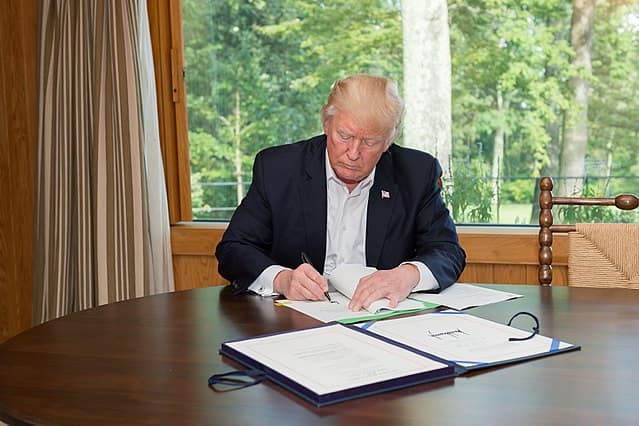
President Donald Trump signed an executive order (EO) on Wednesday reclassifying approximately 8,000 senior policy-influencing federal roles into the Schedule Policy / Career category, which effectively enables the “at will” removal of federal workers in these roles.
According to the Trump Administration, the present personnel rules present significant hurdles to removing federal employees for “any” reason. Reminding that all executive branch employees report to the president, the Trump Administration cited a poll according to which, senior federal employees admitted ignoring lawful orders from the president that in their view constituted bad policy.
Underperforming employees, employees engaged in misconduct, and employees “unwilling to advance Presidential policy across administrations” stay in their jobs for years, making federal agencies less capable of “delivering for the American people.” The Trump Administration states that this order will the eliminate the lengthy procedural hurdles that prevent accountability, and enable removal of senior federal workers for poor performance, misconduct, corruption, or “subversion of Presidential directives.”
Stating that officials in confidential “policy-determining, policy-making, and policy-advocating roles” serve an important function in helping the president fulfill his constitutional duties, the Trump Administration submits that the ability to remove such federal workers for the stated reasons is vital to “protecting democratic self-government by an elected President.”
Essentially, the order amends Civil Service Rules III, VI and XI, and further amends the reinstated EO 13957, issued during Trump’s first term and revoked by former President Joe Biden. EO 13957 was similar in many respects to the present order and reclassified many federal roles into “at will” positions. The amendments to EO 13957 further empowers the director of the Office of Personnel Management to recommend additional positions to be reclassified as Schedule Policy / Career (i.e. at will positions).
While Director of the Office of Personnel Management Scott Kupor has defended the order as necessary to ensure accountability of federal workers, critics have pointed that this is another move in a series of efforts by the president to discipline and terminate federal workers who are not aligned with his political goals. Nevertheless, the order impacts far fewer workers than was anticipated—50,000 roles were expected to be reclassified, but only 8,000 positions are covered by this order. Despite the far fewer impacted roles, Democrats and many nonprofit organizations have already pledged to challenge the order.
Egypt dispatch: historic overhaul of personal status laws sparks fierce debate over family stability
India dispatch: Supreme Court weighs anti-terror law as activist enters sixth year jailed without trial
Beyond Sovereignty: The Legal and Moral Case for Treating Hormuz as a Global Trust
‘This is Canada’s moment’ — Former Canadian justice minister, UN prosecutor call on Ottawa to lead on Ukraine war crimes accountability
The Legal Architecture of Reparations: A Conversation with Kwesi Pratt Jnr.
Beaten, Starved, Unbroken: An Interview with Ben Marmarelli, Lawyer to Marwan Barghouti, Palestine’s Nelson Mandela
Treaty of Trianon concludes WWI between Allies and Hungary
On June 4, 1920, the Allies and Hungary signed the Treaty of Trianon, which concluded peace between the two sides after World War I. The treaty cost Hungary 72% of its territory, which went primarily to Romania, Czechoslovakia, and the Kingdom of Serbs, Croats and Slovenes.
US Supreme Court ruled wiretapping legal to secure evidence in police investigations
On June 4, 1928, in Olmstead v. United States, the US Supreme Court decided that wiretapping private telephone conversations to secure evidence was permissible.
Learn more about the history surrounding the case and view the text of the decision.