
Opinion | Why Trump's cratering poll numbers are so remarkable – MS NOW
Opinion
Morning Joe
RacheL Maddow
Deadline: White House
The weekend
NEWSLETTERS
Share this –
Opinion
His approval rating is lower than it has been since immediately after leaving office — but you need to look beneath the hood for the real story.
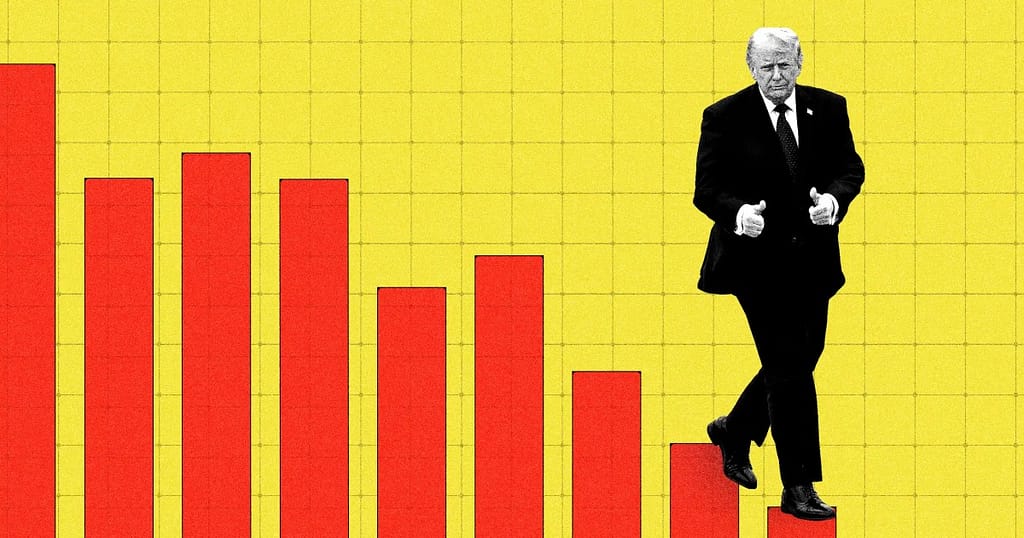
President Donald Trump’s approval numbers have been in a prolonged slump in a way that we haven’t seen in his second term. According to The New York Times’ national polling average on Monday, 38% of Americans approve and 58% disapprove of his performance. He hasn’t broken a 40% average approval since late April. The overall figures are bad, clearly, and though Trump has had runs of horrific polling before and bounced back, there are reasons to believe he’ll have a harder time recovering this time.
Trump’s cratering poll numbers are remarkable in part because they challenge a consensus about how low any politician’s numbers can rise or fall in this political climate.
Trump has been able to shrug off bad polling in the past because the supposed floor his MAGA base represents keeps him from dipping below a certain point. But approval numbers this far underwater suggest Trump’s floor is collapsing. The Washington Post noted last week that a growing number of white voters without college degrees disapprove of Trump’s performance. Meanwhile, young and nonwhite voters who swung right in the 2024 election have jumped back to the left. And independents’ support has only crawled downward compared to when Trump’s term began.
GOP voters shifting away from Trump is bad enough for Republicans hoping to win in November. But the collapse of the coalition that sent Trump to office makes things all the worse.
Trump’s cratering poll numbers are remarkable in part because they challenge a consensus about how low any politician’s numbers can rise or fall in this political climate. As Brandon Rottinghaus, a professor of political science at the University of Houston, told the Los Angeles Times for its Sunday story about Trump’s plummeting poll numbers, “Polarization has raised the floor and lowered the ceiling for approval ratings.”
“Dramatic swings are less common because approval ratings are now fixed to partisanship,” Rottinghaus said. “Approval ratings today are increasingly a measure of who the president is rather than what the president does.”
Similarly, the answer to another classic polling question — “Is the country moving in the right direction or wrong direction?” — has become linked to whether one supports the person in the Oval Office. It is not a reliable barometer for the mood of the country.
Must reads from Today's list
Wednesday’s YouGov/Economist poll highlights how intertwined the two concepts have become. A chart representing Trump’s net approval rating over his two terms shows Republicans’ allegiance to Trump growing after the 2018 midterm elections. Before then, Republicans had been more wary of Trump’s chaos but they seemed to lock in once Democrats won the House and Trump used the party’s investigations into him and his administration as a rallying cry.
Wednesday’s YouGov/Economist poll clocked Trump’s overall approval rating at a shockingly low 34%. At the same time, Trump’s 80% approval rating among self-identified Republicans, with only 19% disapproving, reflects that he still has a lot of control over the GOP as his overall support dwindles. But it’s not as much control as he’s used to. YouGov’s analysis finds that Trump’s +61 net approval rating among Republicans is the lowest of his second term.
It will be difficult for Trump to bounce back from those kinds of numbers when he’s so out of touch on the most important issue to most Americans.
While the isolated approval number has become unreliable in judging whether the public truly agrees with a president’s agenda, the stories about a softening of support among white voters who didn’t graduate college and the apparent regret of those young and nonwhite voters he got in 2024 give us reasons to believe Trump’s low approval number may be more predictive. Even more tellingly, according to the most recent New York Times/Siena survey, Republicans were asked whether the next GOP presidential candidate should follow Trump’s lead or follow a new direction. Only 65% thought that following Trump into the future was best for the party.
It will be difficult for Trump to bounce back from those kinds of numbers when he’s so out of touch on the most important issue to most Americans. In response to a YouGov question about the economy, asking whether it’s getting better or worse, 31% of Republicans answered “worse.” Likewise, 61% of GOP respondents said the economy is either “fair” or “poor,” with only 37% calling it “excellent” or “good.” But Trump refuses to admit that any of his policies have made life worse for Americans feeling the crunch.
As MS NOW contributor Paul Waldman rightly noted, Trump’s self-indulgent priorities are certainly taking a toll on his polling numbers with his own party. Given Trump’s fixation on almost anything but what Americans want, it seems unlikely that he’ll pull out of his current spiral anytime soon. And with Democrats and a growing number of independents depressing the overall total, any further erosion of his standing among his base could send him tumbling into territory we have never seen this early in a president’s second term.
Hayes Brown
Hayes Brown is a writer and editor for MS NOW. He focuses on policymaking at the federal level, including Congress and the White House.
© 2026 Versant Media, LLC