I Watched the Worst of Trump’s Attempt to Destroy the Government. I Have One Requirement for All 2028 Democrats. – Slate Magazine
Sign up for the Slatest to get the most insightful analysis, criticism, and advice out there, delivered to your inbox daily.
The dismantling of the U.S. Agency for International Development has taken a devastating toll, with more than 750,000 lives already lost—most of them children—due to the cuts, and far worse yet to come. The reckless destruction of USAID stands out as one of the most costly decisions of the Trump administration to date. That decision, however, does not have to be a permanent one.
I was the top global health official at USAID, and my new book, Into the Wood Chipper, takes readers inside the mayhem to expose the jaw-dropping ignorance, indifference, and cruelty of DOGE and Donald Trump’s appointees as they eviscerated one of America’s best ideas in a few short weeks. But it wasn’t solely Elon Musk’s chain saw that killed a congressionally mandated federal agency that had enjoyed broad bipartisan support for more than six decades. Congress abdicated its constitutional authority. Lawmakers merely watched as the administration ignored and violated the laws it had passed to establish and fund USAID. Too many stood silent for too long.
As the midterm elections approach, Americans cannot allow their representatives to make the same mistake again. Now is the time for candidates seeking election to pledge to enter office with an actionable plan to rapidly and immediately rebuild USAID. This is especially important—and it should be a prerequisite for any candidate who wants to be the Democratic nominee for president in 2028. (For what it’s worth, it should be a prerequisite for any presidential candidate from either party, but in the current political environment, that seems unlikely.)
This should be an easy promise for anyone seeking office. The case for USAID is both unequivocal and overwhelmingly popular. The agency was one of the best investments across the entire government. On less than 1 percent of the federal budget, USAID saved 92 million lives around the world in the past two decades alone. And it made Americans safer too. The agency helped countries develop early warning systems to ensure that infectious disease outbreaks were rapidly detected and contained before they risked spreading to our borders. It projected American generosity and soft power in ways that built lasting alliances far more efficiently than could ever be achieved militarily.
But don’t take my word for it. Secretary of State Marco Rubio made a strong case for USAID as a bulwark of American national security. In 2022 he described the agency as a key tool to “counter the Chinese Communist Party’s expanding global influence.” Regarding USAID’s global health programs, Rubio said: “Travel to the African continent, and you will meet people who are alive today because of the American-taxpayer-funded antiviral HIV medications that kept them alive. It will not be easy to radicalize people who are alive because the American taxpayer saved their lives and the lives of their children.”
USAID was dismantled not because there was something wrong with the agency. In fact, as I describe in my book, DOGE and the political appointees tasked with destroying USAID were shockingly clueless about what it even did. One official matter-of-factly stated that he had assumed that the only thing the agency did in global health were abortions. Another ordered me to make “Barney-style” slides (referring to the purple dinosaur of children’s television) to explain the dangers of drug-resistant tuberculosis.
The flimsy lies Trump and Musk spouted to justify dismantling USAID were quickly debunked. The president claimed, for example, that “we identified and stopped $50 million being sent to Gaza to buy condoms for Hamas. They’ve used them as a method of making bombs.” But it turned out that the project in question had nothing to do with Hamas, or even Gaza. It was a family-planning initiative in Gaza Province, in Mozambique.
Again, don’t take it from me. Trump’s own chief of staff, Susie Wiles, admitted that there was no justification for dismantling the agency: “I was initially aghast,” Wiles said, “because I think anybody that pays attention to government and has ever paid attention to USAID believed, as I did, that they do very good work.”
With USAID shuttered, the shredded remnants of American foreign aid were last summer folded into the State Department, where, Rubio claims, he’ll administer a more effective form of international development assistance. Yet we’ve already started to see why burying development assistance in the bureaucratic tangle of the State Department is not likely to succeed. For the same reason that we have separate departments of state and defense (or war?)—they focus on different pillars of foreign policy, diplomacy and defense—so too do we need an independent agency for the third pillar of foreign policy: development.
Diplomacy and development are two separate ways of engaging with other countries, and they require different approaches, different operational capacities, and different expertise. Over the past several months, the State Department has attempted to shoehorn development into its existing transactional diplomacy approach, for example through its America First Global Health Strategy, which conflicts with and undermines the goals of development. Lifesaving health aid is now being conditioned on quid pro quo deals that grant access to sensitive data and natural resources, including in Zambia, where HIV treatment for over 1 million people is being conditioned on American access to the country’s critical minerals. The new approach jettisons everything we’ve learned over 60 years: that international development is successful when lasting partnerships are built upon a foundation of goodwill.
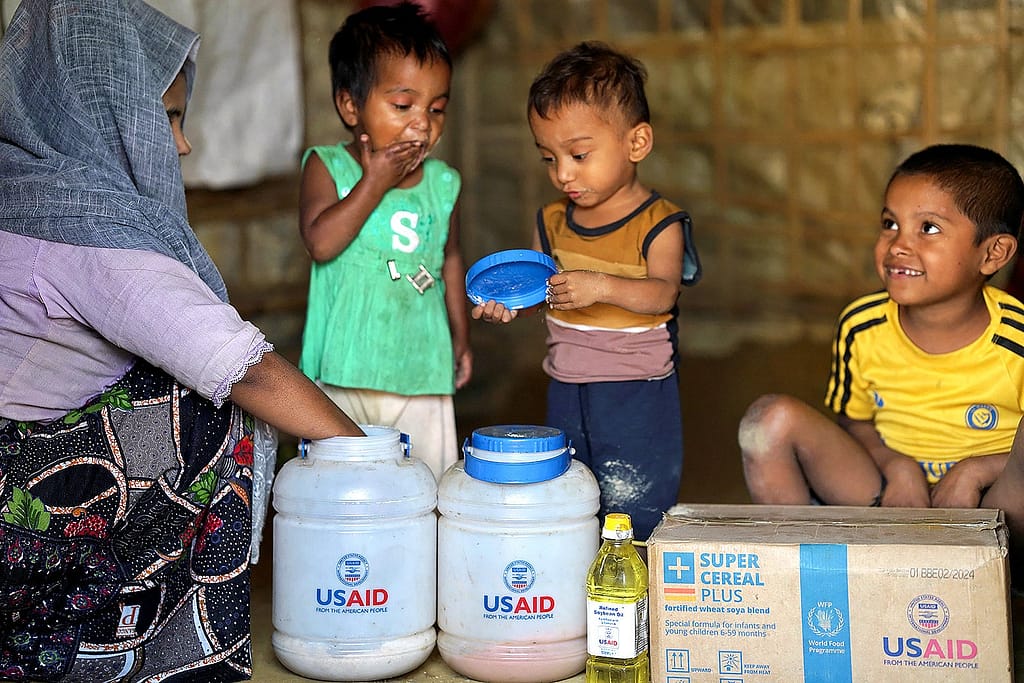
The symbolic significance of an independent agency for foreign aid is powerful too. As President Barack Obama said: “To many people around the world, USAID is the United States.” The agency’s logo—a handshake over the words From the American People—was a ubiquitous reminder that the U.S. was committed to making the world a healthier and safer place. That is why Congress created USAID as an independent agency in the first place, and now Congress must insist that it be reestablished.
Some will say that it’s unrealistic to resurrect USAID, that it is never coming back, and that we need to adjust to the new reality. I disagree. USAID worked well. It was dismantled to satisfy the ego of a billionaire at a cost of the suffering of millions. It is not enough to decry the damage done by DOGE’s destruction. USAID can be rebuilt, and it must be.
Unfortunately, rebuilding the agency will not be nearly as easy as it was for Musk and his minions to tear it down. Its expertise has been scattered, its contracts terminated, and the trust built with countries, local organizations, and multilateral institutions destroyed. Fully restoring USAID will require a renewed congressional mandate to codify its authorities, procurement systems, and operating structures across the world.
Though it will be a challenge, restoring USAID is certainly not unprecedented. The federal government has redesigned and rebuilt agencies before, including the Consumer Financial Protection Bureau and the Department of Homeland Security. It is not a question of whether USAID can be rebuilt; it is a question of whether lawmakers will demonstrate the political will to make it happen.
As with those other new agencies, reestablishing USAID presents substantial opportunities. USAID wasn’t perfect, and there are ways it can be improved in reincarnation to ensure it leads us toward a world where the need for aid no longer exists. A few ideas include setting end dates for aid funding to transition ownership to host governments; flexibility from congressional earmarks so that funds can address crosscutting developmental issues rather than only specific diseases; reformed procurement processes to better tie contractor performance to results; and reconstructing the network of local partner organizations that was decimated by last year’s cuts.
But USAID must be restored. Somewhere, the early version of Project 2029 is no doubt being written, and I implore the drafters to include the reestablishment of USAID as a Day 1 pledge. So too must candidates running for Congress pledge their commitment to immediately begin rebuilding what was lost.
Slate is published by The Slate Group, a Graham Holdings Company.
All contents © 2026 The Slate Group LLC. All rights reserved.
Slate relies on advertising to support our journalism. If you value our work, please disable your ad blocker. If you want to block ads but still support Slate, consider subscribing.
Already a member? Sign in here