
Donald Trump Faces Rebellion From Republicans in Congress: List of Issues – Newsweek
Published
Jun 02, 2026 at 03:12 PM EDT
updated
Jun 02, 2026 at 03:13 PM EDT
Politics and Culture Reporter
President Donald Trump has long enjoyed strong support within the Republican Party, with few GOP lawmakers publicly challenging him. However, a growing number of Republicans are pushing back on some of the president’s recent priorities, creating potential hurdles for his agenda despite GOP control of both chambers of Congress.
The tensions come as Trump faces weakening public approval. Silver Bulletin’s polling average showed Trump’s disapproval rating at 57.6 percent on Tuesday, leaving him with a net approval rating of minus 19.1 points. By comparison, former President Joe Biden’s net approval rating was minus 13 at a similar point in his presidency, while Trump stood at minus 10.6 points at this point during his first term, according to the polling aggregator.
Although there are some signs of policy disagreement and resistance within the party, Trump’s endorsement remains extremely influential within the GOP as candidates head into this year’s midterm elections, where Republicans are seeking to defend their narrow House and Senate majorities and Democrats are hoping to make up ground.
Trump has shown over the past few months that he will directly target Republican dissenters, raising the stakes for pushback. In recent weeks, his endorsed candidates ousted Representative Thomas Massie of Kentucky, Senator Bill Cassidy of Louisiana and Senator John Cornyn of Texas in GOP primaries, reinforcing the political risks of breaking with the president. Many of the Republicans who have most openly challenged Trump are retiring or are not seeking reelection.
Despite the disputes, most of Trump’s priorities continue to enjoy broad support within the Republican conference. While lawmakers have objected to specific proposals, few have mounted direct challenges to the president, and Republicans have largely continued backing his broader agenda on immigration, taxes and foreign policy.
Newsweek has reached out to the White House and Senate and House leadership for comment via email on Tuesday.
Trump’s proposed $400 million White House ballroom has sparked political and legal battles, with much of the debate centered on funding and authority. The president and his aides have argued that the 90,000-square-foot ballroom would provide a more secure venue for large events, citing the April shooting at the White House Correspondents’ Dinner as an example of the dangers posed by off-site gatherings.
Trump has repeatedly said the ballroom itself would be privately funded, although related additional security funding requests have drawn scrutiny on Capitol Hill.
Critics argue that the project raises concerns about historic preservation, transparency and whether the administration has sufficient legal authority to proceed without explicit congressional approval.
While GOP members have echoed the White House argument that the ballroom is necessary for security reasons, some have balked at a proposed $1 billion taxpayer-funded security package tied to the development.
In May, Senator Thom Tillis, a North Carolina Republican who is not seeking reelection, said adding the security detail to the larger reconciliation package was a “bad idea” that he believes lacks backing among party members.
The proposal has drawn resistance from some Republicans, who have moved to remove the provision from the reconciliation bill, arguing that the administration has not adequately explained the need for the funding and question the optics of spending billions on White House security upgrades while voters remain focused on inflation, energy prices and the war with Iran.
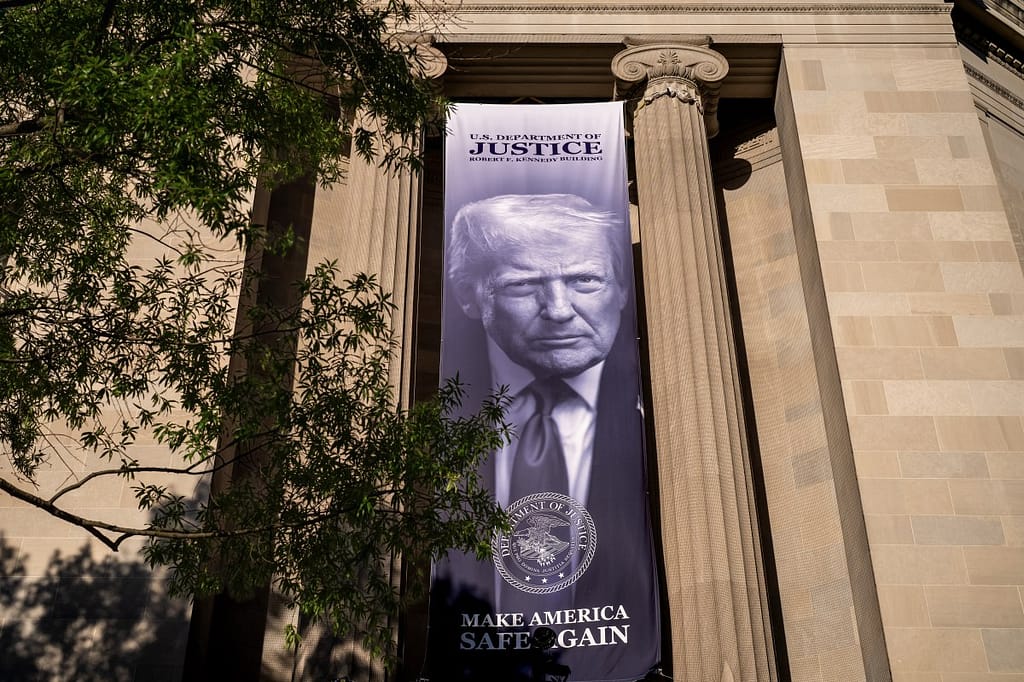
The “anti-weaponization” fund was established as part of a Department of Justice (DOJ) settlement of Trump’s $10 billion lawsuit against the IRS over leaked tax returns. In exchange for dropping the case, the DOJ established the fund, which would allow individuals who claim they were victims of government “weaponization” to apply for compensation or formal apologies through a commission reviewing claims through 2028.
Many lawmakers have objected to the $1.8 billion in federal money tied to the settlement, citing concerns about executive authority, the use of taxpayer funds and potential eligibility for individuals convicted in connection with the January 6, 2021, riot at the U.S. Capitol when Trump supporters sought to overturn the 2020 presidential election results.
Democrats denounced the fund as a “slush fund,” while some Republicans voiced concerns about its cost, oversight and legal basis.
The DOJ described the fund as a “systematic process to hear and redress claims of others who suffered weaponization and lawfare.” Trump and his allies have argued that Biden-era law enforcement unfairly targeted conservatives, including through cases involving Trump and some people charged over January 6.
Kentucky’s Mitch McConnell, a former Senate Republican leader, said in a May statement: “So the nation’s top law enforcement official is asking for a slush fund to pay people who assault cops? Utterly stupid, morally wrong – Take your pick.”
Other Republicans have spoken out against it, too, such as Cassidy, who recently lost his Louisiana primary to a Trump-backed challenger, writing in a May post on X: “People are concerned about paying their mortgage or rent, affording groceries and paying for gas, not about putting together a $1.8 billion fund for the president and his allies to pay whomever they wish with no legal precedent or accountability.”
Senator Roger Wicker, a Mississippi Republican, described the weaponization fund as “a nonstarter from the get-go.”
Ahead of meeting with acting U.S. Attorney General Todd Blanche about the fund in May, Tillis told reporters: “Imagine that, a fund that is set up to compensate people who assaulted Capitol Police officers and other responding agencies. People that had pled guilty to physical acts against the president may actually be able to get compensated. How absurd does that sound coming out of my mouth?”
Senator Ted Cruz, a Texas Republican, said in late May that nearly half of the Republican conference was ready to vote with Democrats against it.
“My guess is there’re probably 45 senators in the room, at least half of them were blasting the attorney general [Todd Blanche], and they were pissed,” Cruz said on his Verdict podcast. “There were multiple senators yelling at the attorney general, saying this feels like self-dealing.”
Blanche is expected to speak to the House Appropriations Committee on Tuesday about the matter.
Former Vice President Mike Pence on Sunday became the latest prominent Republican to break with the administration over the fund, calling the proposal “deeply offensive” and urging that it be scrapped.
Amid mounting backlash from Republicans over the issue, the DOJ said Monday that it will comply with a federal court order temporarily blocking its proposed fund despite strongly disagreeing with the ruling. The move represents a rare concession by the administration after vocal pushback from congressional Republicans.
Responding to Monday’s legal update and if Republicans would support a bill shutting down the fund, Senate Majority Leader John Thune, a South Dakota Republican, said: “I don’t know, but I do think that the best way to handle it is if the administration decides to shut it down themselves.”
The reconciliation bill is a Republican-led effort to provide roughly $72 billion in new funding for immigration enforcement agencies, including Immigration and Customs Enforcement (ICE) and Customs and Border Protection (CBP).
But the bill is tied up in the administration’s other priorities, as well, and faces delays amid Republican disagreements over unrelated provisions, including the proposed anti-weaponization fund and $1 billion funding tied to White House security upgrades.
“The only thing that’s going to solve this problem—to get immigration funded and law enforced—is for the president to do away with the weaponization fund,” Senate Judiciary Committee Chair Chuck Grassley, an Iowa Republican, told PunchBowl News.
In late May, the vote was pulled as Republicans didn’t have enough votes, pushing it to this month.
“The reconciliation bill looks like a broken arm with the bones sticking out,” said Senator John Kennedy, a Louisiana Republican. “It won’t move this week, in my opinion, unless we have some resolution on the weaponization fund.”
Even as several policy fights have exposed divisions between Trump and some congressional Republicans, the White House maintains that the president is the dominant force in the party.
A White house official told Semafor in May: “No one should be doubting the political will that [Trump] has, the amount of support that he has—he’s shown that he can wield it in many different ways. No one should be doubting how he’s able to bend everything to his will.”
While most Republicans have backed Trump’s handling of the war with Iran, a small but growing group of GOP lawmakers has pushed back. Senators Rand Paul of Kentucky, Susan Collins of Maine, Lisa Murkowski of Alaska and later Cassidy joined efforts by Democrats to advance a war powers resolution that would require congressional authorization for continued military action against Iran.
When he cast his vote, Cassidy was fresh off a primary loss to Trump-backed Representative Julia Letlow and state Treasurer John Fleming, who will clash in a runoff election.
The 1973 War Powers Resolution allows Congress to direct the president to withdraw U.S. forces from hostilities not authorized by lawmakers. Presidents of both parties have challenged limits on executive war powers, but the law remains one of Congress’ primary checks on unilateral military action.
It also requires the president to notify Congress within 48 hours of introducing U.S. forces into hostilities and limits unauthorized military action to 60 days.
Trump did not seek congressional authorization before launching military strikes against Iran in February, and many Democrats argued that the action was unconstitutional. The resolution prohibits unauthorized conflict to continue past 60 days, with a 30-day withdrawal period. Trump initiated the strikes on Iran on February 28, and informed Congress on March 2. There is currently a ceasefire in place amid talks, but the U.S. struck targets in Iran in May.
The White House has reiterated its position on the war powers resolution, telling Newsweek in a statement last week: “The President can act consistent with the will of Congress as expressed in the War Powers Resolution (or any other statute for that matter) without thereby conceding the WPR is constitutional.”
The House is expected to hold another vote on the Iran War Powers resolution on Wednesday after Republican leaders postponed a vote last month amid uncertainty over whether enough GOP lawmakers would oppose the measure, Politico reported.
Representative Ashley Hinson, an Iowa Republican who is running for Senate, said about the war with Iran last week: “If it drags on beyond that, it’s a political liability for us, too, because we’ve lost Iowa soldiers. I’ve been to four funerals since December, it’s awful,” according to audio obtained by Politico. Hinson, a close Trump ally who has backed the president’s military actions in Iran and broader foreign policy agenda, is on the ballot Tuesday in the Republican primary for Iowa’s open U.S. Senate seat.
Polling has consistently shown that more Americans oppose the war with Iran than support it, although Republican voters remain more supportive than Democrats and independents.
One of the earliest and most visible rifts between Trump and some of his Republican allies during his second term emerged over the release of files related to convicted sex offender Jeffrey Epstein.
Massie led an effort with Representative Ro Khanna, a California Democrat, to force a House vote requiring the Justice Department to release the documents, drawing support from Republicans including then-Representative Marjorie Taylor Greene of Georgia, Representative Nancy Mace of South Carolina and Representative Lauren Boebert of Colorado. Their push put them at odds with Trump and House Republican leadership, which initially opposed efforts to force the documents’ release.
The dispute evolved into a broader test of Trump’s influence within the GOP. Greene, once one of the president’s closest allies, publicly criticized the administration’s handling of the files and later blamed the issue for deepening divisions within the party. She resigned from Congress, leaving office in January.
Trump eventually backed efforts to release the documents, but only after months of pressure from lawmakers and growing public scrutiny.
He fired Attorney General Pam Bondi on April 2, cutting short her tenure after roughly 15 months in office. Trump had reportedly grown increasingly frustrated with Bondi’s inability to deliver swift federal prosecutions against his prominent political adversaries.
Her standing within the West Wing was further crippled by the compounding political fallout from the slow rollout of the Epstein files, leaving the administration exposed to bipartisan congressional scrutiny.
Republicans’ narrow congressional majorities leave little room for dissent, allowing even a handful of lawmakers to slow or block parts of Trump’s agenda. Additionally, each election holds high stakes as both parties fight for every seat in the midterms in an effort to secure control in each chamber.
Democrats are hoping to turn Trump’s lower approval ratings into electoral gains in the midterms, with control of Congress hanging in the balance. The party in the White House historically loses seats in the midterms, and Democrats have overperformed in special and state elections the past year, helping fuel optimism among some in the party for November.
However, neither party is particularly popular with voters. A recent Pew Research Center survey found that unfavorable views of the Republican and Democratic parties stood at 58 percent and 59 percent, respectively. The poll of 5,103 U.S. adults was conducted April 20-26 and had a margin of error of plus or minus 1.6 percentage points.
© 2026 Newsweek Digital LLC