
As Trump turns 80, who are the oldest – and youngest – current world leaders? – Pew Research Center
Numbers, Facts and Trends Shaping Your World
Read our research on:
Full Topic List
Read Our Research On:
|
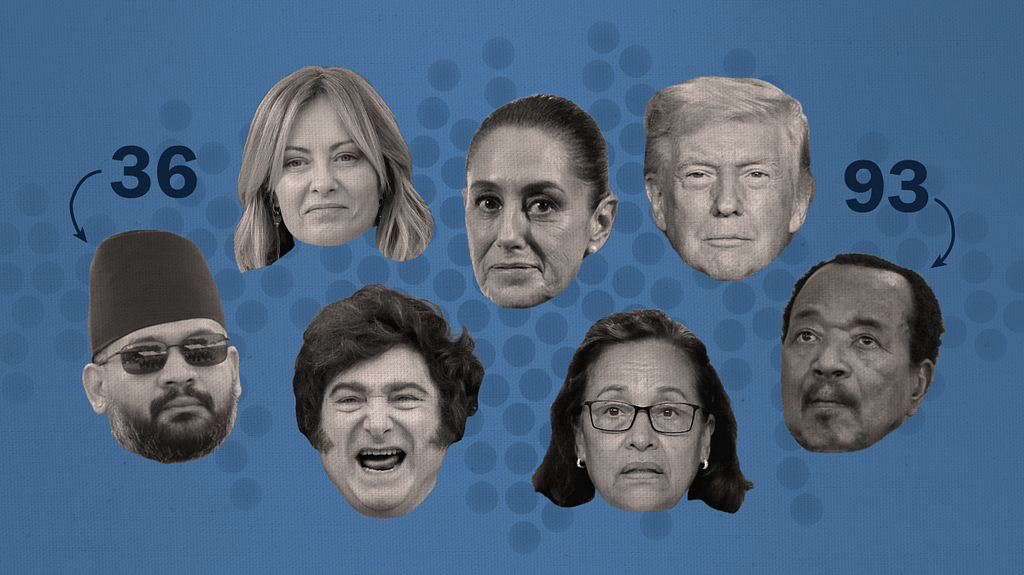
As U.S. President Donald Trump approaches his 80th birthday on June 14, he is among the oldest national leaders in the world, according to a Pew Research Center analysis of current leaders in 186 United Nations member states.
Just 16 of the 186 current national leaders are older than Trump. The oldest leaders are Cameroon President Paul Biya, who is 93, and Saudi Arabia King Salman bin Abdulaziz Al Saud, who is 90. Biya has held the presidency for nearly 44 years – longer than 13 current national leaders have been alive – and Al Saud has been king since 2015.
Many of the world’s oldest leaders are in African countries. In addition to Biya, the leaders of Malawi, Ivory Coast, Equatorial Guinea, Zimbabwe, the Republic of the Congo and Uganda are all among the 10 oldest leaders.
Pew Research Center analyzed the ages of national leaders around the world ahead of U.S. President Donald Trump’s 80th birthday on June 14.
Pew Research Center does research to help the public, media and decision-makers understand important topics. This research builds on our previous work about political leadership around the world, including a look at the oldest and youngest national leaders ahead of the 2024 U.S. presidential election.
We identified the birthdates of the current heads of government in 186 countries that are member states of the United Nations using government biographies and regional news articles. This analysis is based on their ages as of June 14, 2026.
This analysis focuses mostly on heads of government as defined by a country’s political system or constitution. In some cases, we determined the national leader based on which executive has the power to appoint or dismiss the nominal head of government.
We included acting or interim leaders in a few cases, but not leaders-elect who have yet to take office as of June 14. We excluded six UN member states because their leader’s exact birth date could not be determined: Afghanistan, Guinea-Bissau, Madagascar, Niger, Sao Tome and Principe, and Somalia. We also excluded San Marino, which is led by two captains regent who share power equally. For Nicaragua, which has been led by two co-presidents since 2025, we included the birthdate for Rosario Murillo since she was installed most recently.
Seven of the world’s 10 oldest leaders are also in countries that Freedom House categorizes as “not free,” based on the political rights and civil liberties people have there.
On the other end of the spectrum, the youngest national leader is 36-year-old Balen Shah, who became prime minister of Nepal in March after youth-led protests helped oust the previous government. Shah, who is also a rap artist, counts TikTok and YouTube among his primary income sources, and he released a song on social media about national unity the day before he was sworn in.
Shah and 38-year-old Iceland Prime Minister Kristrún Frostadóttir are both younger than Burkina Faso President Ibrahim Traoré, who was the youngest national leader when we last did this analysis in May 2024. (Traoré, also 38, is two months older than Frostadóttir.)
The median age of all national leaders in our analysis is 63. About two-thirds are in their 40s, 50s or 60s. (Read “About this research” to learn how we defined the leader of each country.)
In a 2023 Pew Research Center survey, the largest share of Americans (49%) said the ideal age for a U.S. president is in their 50s. Another 24% prefer someone in their 60s, and just 3% said it’s best for a president to be in their 70s or older.
In addition, a large majority of Americans (79%) support age limits for elected officials in Washington, D.C., according to another 2023 Center survey. Currently, there is no maximum age for these officials, and changing this would likely require amending the Constitution.
Topics
Jenn Hatfield is a writer/editor at Pew Research Center.
Sofia Hernandez Ramones is a research assistant focusing on global attitudes at Pew Research Center.
Laura Silver is an associate director focusing on global attitudes at Pew Research Center.
Anna Jackson is an editorial specialist at Pew Research Center.
901 E St. NW, Suite 300
Washington, DC 20004
USA
(+1) 202-419-4300 | Main
(+1) 202-419-4372 | Media Inquiries
ABOUT PEW RESEARCH CENTER Pew Research Center is a nonpartisan, nonadvocacy fact tank that informs the public about the issues, attitudes and trends shaping the world. It does not take policy positions. The Center conducts public opinion polling, demographic research, computational social science research and other data-driven research. Pew Research Center is a subsidiary of The Pew Charitable Trusts, its primary funder.
© 2026 Pew Research Center
We use cookies and other technologies to help improve your experience; some are necessary for the site to work, and some are optional. Learn more in our privacy policy.
These cookies are required for the website to function and cannot be switched off.
These cookies are used to collect information about how you use our website.
These cookies are used to track your activity and show you personalized content.
These cookies allow the website to remember choices you make.
Notifications