
AP FACT CHECK: Trump's impeachment defense team glosses over his Jan. 6 tirade – PBS
Calvin Woodward, Associated Press Calvin Woodward, Associated Press
WASHINGTON (AP) — Donald Trump’s legal team thoroughly distorted his remarks from the rally that prefaced the storming of the Capitol last month, seizing on the one instance when Trump spoke of peaceful protest in his “fight like hell” tirade of anger and grievance.
Trump attorney Michael van der Veen accused House Democratic impeachment managers of showing selectively edited scenes of the violence and Trump’s words Jan. 6.
WATCH: Trump’s second impeachment trial | Day 4
Yet he ignored the incendiary substance and tenor of that staging speech as well as the president’s words of affection for the attackers later, while they were still hunting for lawmakers and sacking their offices. He ignored the fact, too, that all of Trump’s provocations that day and for weeks beforehand had the lie of a stolen election at their core.
Another Trump lawyer, Bruce Castor, denied that the siege was an insurrection, saying that’s a “term of art” not merited by the events of that day. Actually it’s a term of dictionaries and legal texts, and what happened Jan. 6 was an insurrection.
A look at rhetoric from the Senate impeachment trial, where Trump is charged with inciting the siege of the Capitol before Congress affirmed his defeat to Joe Biden in the presidential election:
“No thinking person could seriously believe that the president’s Jan. 6 speech on the Ellipse was in any way an incitement to violence or insurrection. … Nothing in the text could ever be construed as encouraging, condoning or enticing unlawful activity of any kind. Far from promoting insurrection against the United States, the president’s remarks explicitly encouraged those in attendance to exercise their rights peacefully and patriotically.”
This characterization does not resemble Trump’s speech. For more than an hour, Trump made the case that he and his supporters at the rally had been “cheated” and “defrauded” in the “rigged” election by a “criminal enterprise” made up of some of the “weak” legislators the insurrectionists were about to confront.
As for Trump “explicitly” encouraging non-violence, as the lawyer put it, the president’s sole gesture in the speech was this passing remark, lost in the winds of that day’s rage: “I know that everyone here will soon be marching over to the Capitol building to peacefully and patriotically make your voices heard.”
There were no other approximate appeals for calm, order or respect for the institutions that Trump assailed in the speech as a “swamp.”
“That was the one time, the only time, President Trump used the word ‘peaceful’ or any suggestion of non-violence,” Rep. Madeleine Dean of Pennsylvania, one of the Democratic impeachment managers, said during the trial. “President Trump used the word ‘fight’ or ‘fighting’ 20 times.”
Her count is correct. In addition, Trump thanked supporters when they chanted: “Fight for Trump! Fight for Trump! Fight for Trump!”
To be sure, not all of Trump’s “fighting” words were about the march to the Capitol. Some were about the political struggle to reverse a fair and certified election that he lost or about his other struggles in Washington.
But he sent his followers off to the Capitol with these words: “If you don’t fight like hell, you’re not going to have a country anymore.”
This, after his lawyer Rudy Giuliani had told the crowd: “Let’s have trial by combat.”
This, after Trump had summoned his followers to Washington in the first place with the promise: “Be there, will be wild!”
At the rally, Trump roused his followers with words such as these:
For all of that, his attorney Friday contended that Trump had “devoted nearly his entire speech to an extended discussion” of the voting process.
During the melee that ensued, Trump made a video telling the attackers it was time to “go home.” Only when the violence was underway did he stress the need for “law and order” and “peace.” But he added: “We love you. You’re very special people.” Others are “so bad and evil.”
He followed later with a tweet that expressed no concern with the deadly consequences of the siege. He appeared to see justice in what had transpired.
“These are the things and events that happen when a sacred landslide election victory is so unceremoniously & viciously stripped away from great patriots who have been badly & unfairly treated for so long,” he wrote. “Go home with love & in peace. Remember this day forever!”
“Clearly, there was no insurrection. Insurrection is a term of art, defined in the law, involves taking over a country … a shadow government taking the TV stations over and having some plan on what you’re going to do when you finally take power.”
It was a textbook insurrection.
As “defined in the law,” an insurrection is “the act or an instance of revolting esp. violently against civil or political authority or against an established government,” according to Merriam-Webster’s Dictionary of Law.
Under the U.S. Code, the crime of insurrection is committed by “Whoever incites, sets on foot, assists, or engages in any rebellion or insurrection against the authority of the United States or the laws thereof, or gives aid or comfort thereto.”
Apart from the law and legal texts, insurrection is defined by Webster’s New World College Dictionary, which is used by The Associated Press, as “a rising up against established authority; rebellion; revolt.”
On Jan. 6, attackers rose up physically and violently against the established authorities — Congress, as it was carrying out its constitutional duties surrounded and protected by U.S. government staff and police. Many in the siege were intent on stopping Congress from affirming Trump’s defeat.
An insurrection is commonly understood to mean a short-lived revolt that fails, as this one did. Castor may have been conflating an insurrection with a coup d’etat, which suggests a more organized and advanced effort to seize power, perhaps involving a shadow government ready to take over. Jan. 6 was not that.
Support trusted journalism and civil dialogue.
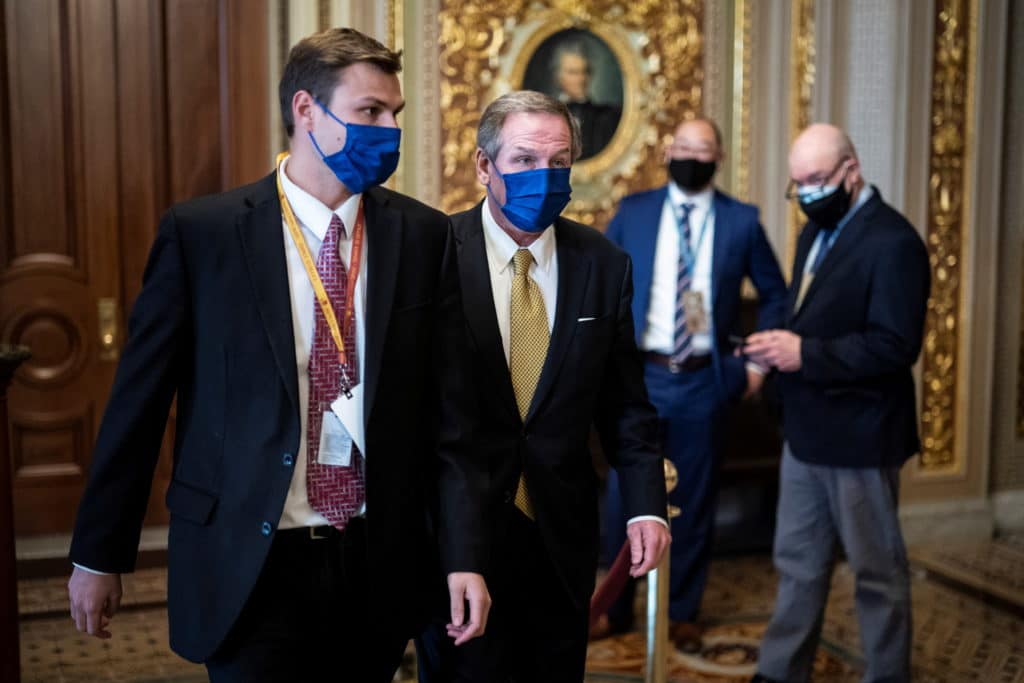
Left: Michael van der Veen, lawyer for former President Donald Trump, walks to the Senate floor through the Senate Reception room on the fourth day of the Senate Impeachment trials for former President Donald Trump on Capitol Hill in Washington, DC, U.S. February 12, 2021. Photo by Jabin Botsford/Pool via REUTERS
By Associated Press
By Associated Press
By Associated Press
Calvin Woodward, Associated Press Calvin Woodward, Associated Press
Support Provided By: Learn more
Subscribe to Here’s the Deal, our politics newsletter for analysis you won’t find anywhere else.
Thank you. Please check your inbox to confirm.
Politics Feb 11
© 1996 – 2026 NewsHour Productions LLC. All Rights Reserved.
PBS is a 501(c)(3) not-for-profit organization.
Sections
About
Stay Connected
Subscribe to Here’s the Deal with Lisa Desjardins
Thank you. Please check your inbox to confirm.
Support for News Hour Provided By