
Bell calls for Trump's removal over 'disgusting' Iran social media threat – Spectrum News
Get the best experience and stay connected to your community with our Spectrum News app. Learn More
Continue in Browser
Get hyperlocal forecasts, radar and weather alerts.
Please enter a valid zipcode.
Save
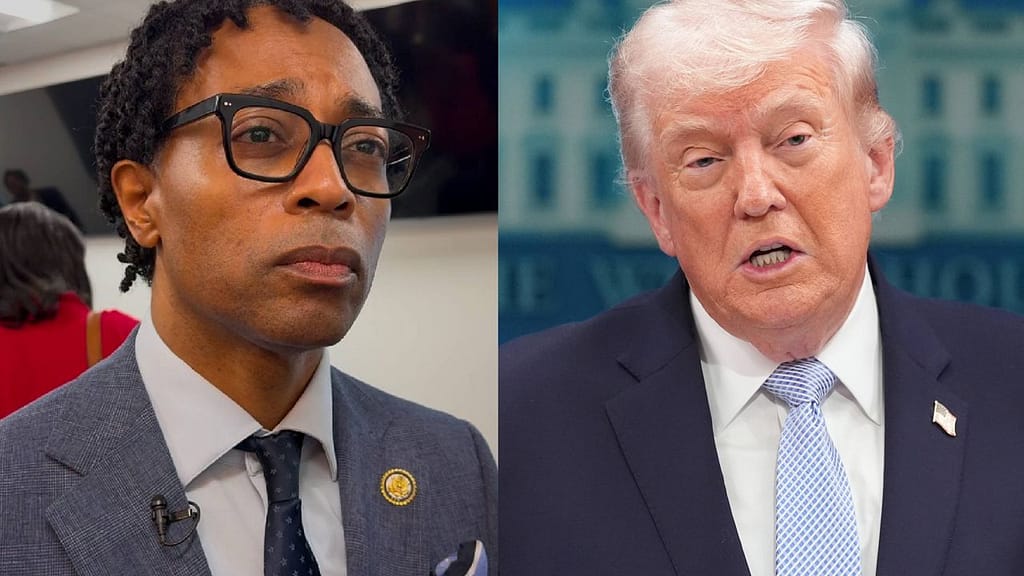
ST. LOUIS—One day after an announcement of a ceasefire deal in the Iran war staved off a threat by President Donald Trump that “a whole civilization will die”, Congressman Wesley Bell, D-St. Louis, reiterated his call for Trump’s impeachment or for the cabinet to invoke the 25th Amendment to remove him from power over the social media post.
“For the president, who everyone listens to, who has the nuclear codes to say that he is going to destroy an entire civilization is despicable. It is unhinged,” Bell told reporters Wednesday in north St. Louis County. To make that threat is truly disturbing, disgusting, and not befitting of the President of the United States.”
Bell, a member of the House Armed Services Committee criticized the Trump administration’s planning for the incursion, the lack of clear objectives and an exit strategy. While dozens of Democrats in recent days have come out with similar support for impeachment or invoking the 25th Amendment, the party is not in control of the House or the Senate, meaning impeachment articles are unlikely to pass the House or gain a conviction in the Senate.
Negotiations to turn the ceasefire into a lasting peace agreement are slated for this weekend but comes as all sides have presented vastly different versions of the terms. Iran said the deal would allow it to formalize its new practice of charging ships passing through the Strait of Hormuz. Trump said the U.S. would work with Iran to remove buried enriched uranium, though Iran did not confirm that.
Pakistan and others said fighting would pause in Lebanon, which Israel has invaded to fight Iran-backed Hezbollah militant group, but Israeli Prime Minister Benjamin Netanyahu said early Wednesday that the deal doesn’t cover fighting against Hezbollah. Israeli strikes hit several dense commercial and residential areas in central Beirut Wednesday afternoon without warning, killing dozens and wounding hundreds of people.
Iran closed the Strait of Hormuz again Wednesday in response to Israeli attacks against the Hezbollah militant group in Lebanon.
The ceasefire may formalize a system of charging fees in the Strait of Hormuz that Iran instituted — and give it a new source of revenue. Iranian attacks and threats deterred many commercial ships from passing through the waterway, through which 20% of all traded oil and natural gas passes in peacetime.
"Our enemies, our sworn enemies, who who consistently chant “death to America” are going to be able to make millions, possibly billions of dollars, according to what we’re seeing in this agreement, as basically a toll for the strait, which is essentially one of the most resource-rich areas as far as transportation for our world fuel economy,” Bell said.
The ceasefire requires a “free” reopening of the Strait of Hormuz, which includes no tolls imposed by Iran, said White House Press Secretary Karoline Leavitt, describing Trump’s thinking.
A regional official had said on condition of anonymity to discuss internal deliberations that the ceasefire plans included allowing both Iran and Oman to charge new fees to ships transiting through the strait.
Leavitt referenced Trump’s Truth Social post from Tuesday in which he said the agreement was conditional on the “COMPLETE, IMMEDIATE, and SAFE OPENING” of the strait. She added that “that’s very plain language and it should be taken at face value.”
Iran’s Parliament Speaker Mohammad Bagher Ghalibaf said Wednesday that a ceasefire and negotiations with the U.S. on ending the war is “unreasonable” as he accused the U.S. violating three of Tehran’s 10 conditions for an end to the fighting.
Ghalibaf, a key figure in the Pakistan-brokered negotiations to end the conflict, objected in a social media post to the continuation of Israeli attacks on Hezbollah in Lebanon, an alleged drone incursion into Iranian airspace after the ceasefire was in effect and the Trump administration’s assertion that it won’t accept any Iranian enrichment capabilities as part of an agreement to end the conflict.
It comes as the not yet day old ceasefire appears at risk of fraying over significant disagreements between the parties who each are claiming victory in the conflict. Ghalibaf’s comments come an hour after the White House announced that US Vice President JD Vance would lead the U.S. delegation to talks in Islamabad starting Saturday on bringing about an end to the war.
Speaking to reporters before leaving Hungary, the vice president said Iran questioning the workability of a ceasefire because it disagrees with the U.S. on three key points “must mean there’s a lot of points of agreement.”
Frustration on three issues “actually means that there’s a lot of agreements,” Vance said.
The vice president, who is set to participate in negotiations in Pakistan this weekend, said “ceasefires are always messy” and often feature “a little bit of choppiness.”