
Trump and Elon Musk Crushed USAID. Hunger and Violence Followed. – Mother Jones
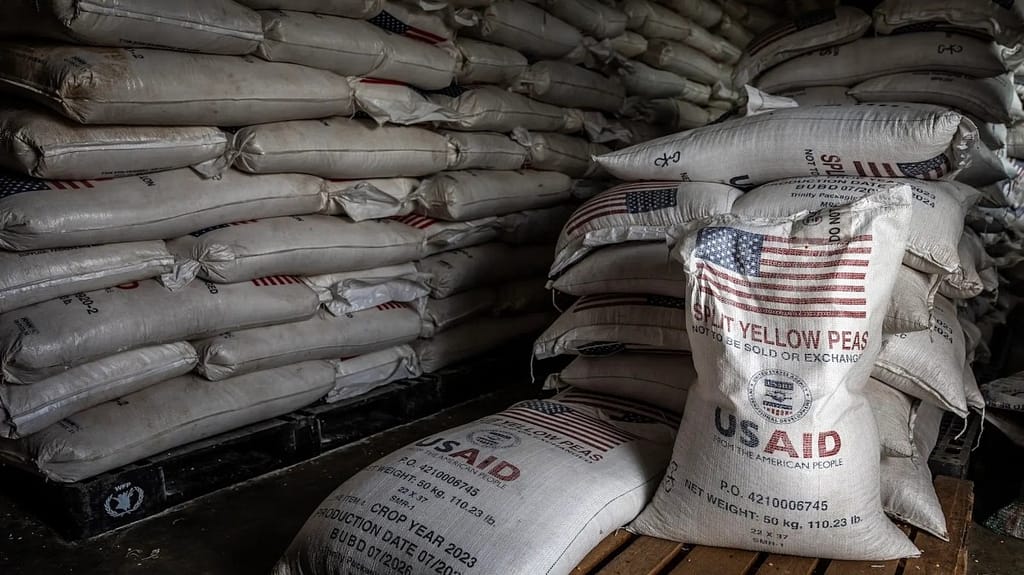
A study published in Science suggests the sudden USAID shutdown may be linked to an uptick in violent conflict across much of Africa.Luis Tato/AFP via Getty via Grist
This story was originally published by Grist and is reproduced here as part of the Climate Desk collaboration.
For decades, the US Agency for International Development (USAID), worked across many of the world’s most food-insecure and climate-besieged regions, funding thousands of humanitarian, healthcare, food, and disaster relief programs. That all changed last year when, days after President Donald Trump’s inauguration, his administration issued a stop-work order that suspended nearly all of USAID’s overseas programs. Then, last July, the administration informally dissolved the agency—leading to the largest withdrawal of American international development aid in more than 60 years.
A new study published May 14 in the journal Science suggests the sudden USAID shutdown could have been linked to an uptick in violent conflict across much of Africa, with some of the most politically fragile regions seeing the largest spikes. Outside experts, however, caution that the findings are preliminary and may not capture the bigger picture.
“Who in their right mind would retract healthcare and food so abruptly?”
Farming and agricultural markets are easily disrupted by conflict, and when conflict occurs, food security worsens because fighting can limit communities’ access to food. At the same time, deepening food insecurity in fragile political states contributes to social unrest. Climate impacts then layer onto this fragility. Extreme weather is second only to conflict in having the greatest effect on global hunger, food insecurity, and malnutrition, according to a UN report. That’s in part because it causes people to migrate as they flee places destroyed by rising seas and cataclysmic storms, which, in turn, can fuel conflict.
“It is undeniable that USAID programming around food aid, including emergency food kitchens, therapeutic foods, and health and water programming on which basic food and nutritional security is built, provided a critical lifeline to millions of women, children, and families in severe nutritional deficits,” said Zia Mehrabi, a food security and climate change researcher at the University of Colorado Boulder. “Who in their right mind would retract healthcare and food so abruptly, in so many places, when the direct result is people suffering and dying?”
In analyzing the impact of funding cuts on conflict across 870 subnational African regions that had been receiving different levels of USAID services, the Science paper’s authors found that in the roughly 10 months that followed the administration’s immediate withdrawal of aid, areas that had previously received more USAID support may have experienced more or different types of conflict.
Using two global datasets that track funding disbursements and violent conflict, the study suggests that, in areas with high historical USAID funding, there was a 12.3 percent increase in conflict overall and a 7.3 percent surge in armed battles; protests and riots in these areas rose by 6.8 percent and battle-related fatalities by 9.3 percent after the shutdown.
The end of USAID has buckled our ability to measure the very outcomes of the end of USAID.
According to Austin Wright, a University of Chicago researcher who studies the political economy of conflict, and a co-author of the paper, the effects have been swift and destabilizing. “There is nothing that we’re aware of in recorded human history of the magnitude of that shutdown, in terms of ending a country’s commitment at a global scale,” said Wright.
Established in 1961, USAID was created to encourage economic and social development in emerging nations while countering the Cold War influence of the Soviet Union. Building resilience in foreign political systems has, in recent decades, been “one of the main goals of the work of USAID,” said Chelsea Marcho, a senior director for research and policy at the Food Security Leadership Council and former USAID official under former President Joe Biden, who was not involved in the Science paper.
The study showing that violence may have been less severe in places where USAID had helped build stronger institutions, she said, only underscores the value of those aid investments. One example is the largely discontinued work to develop more resilient food systems across sub-Saharan African nations facing higher rates of poverty, hunger, and malnutrition.
But what many tend to forget, said Marcho, is that USAID also funded the bulk of pivotal data collection efforts across much of the world’s most food-insecure and climate-vulnerable regions. The dissolution of the agency has prompted widespread disruptions in everything from localized weather monitoring to one of the primary global famine early-warning systems. Although some of these systems have since been restored, the gaps in monitoring coupled with the decreased capacity across aid organizations means it is all the more difficult to understand what is happening on the ground.
Indeed, the end of USAID has buckled our ability to measure the very outcomes of the end of USAID. “The visibility that we have around food security is potentially in decline at the same time that the risks to the system are increasing,” said Marcho. “How do we actually get the data we need?”
More equitable benefit-sharing of resource extraction from critical mineral supply chains would “far outweigh any benefits from foreign aid.”
Mehrabi finds the new paper creates “more questions than answers.” He argues the mechanisms of measurement are unclear, the analysis period is too short, and the authors don’t adequately disentangle USAID’s specific effects from Trump’s simultaneous cuts to other US international funding sources, such as the State Department. “The results are clearly early and tentative,” he said. “I think it is a leap to say this is all attributable to USAID.”
Wright, for his part, acknowledged the study has limitations, including a short post-shock observation window of just 10 months, a disbursement baseline drawn from the first Trump administration rather than the period immediately before the cuts, and a geographic scope confined to Africa—leaving much open to future research. He says the team ran extensive robustness checks addressing these concerns, detailed in the paper’s appendix.
After running his own reanalysis of their data, Mehrabi, however, remains unconvinced. What’s more, he warns against the possible takeaway that the presence of American developmental intervention equates to stability. The US, he argues, could more effectively help deter widespread conflict and hunger in nations like the Democratic Republic of the Congo, for example, through more equitable benefit-sharing of natural resource extraction from critical mineral supply chains. This would “far outweigh any benefits from foreign aid,” proposed Mehrabi.
Nevertheless, with an annual budget of tens of billions and an institutional history spanning 64 years, USAID’s developmental footprint throughout the African continent was no small thing. “One cannot simply create USAID all over again, or give it a mandate and give it funding and assume that we have waved a wand and we can reverse the damage done,” said Wright.
Subscribe to the Mother Jones Daily to have our top stories delivered directly to your inbox.
By signing up, you agree to our privacy policy and terms of use, and to receive messages from Mother Jones and our partners.
For 50 years, Mother Jones has offered honest, investigative reporting you can rely on:
• Relentless in the pursuit of truth, unafraid to hold the powerful to account
• Independent from influence or agenda from oligarchs and corporations
• Freely accessible to every reader, never behind a paywall
But we can’t do any of this without you. Reader support powers our newsroom to stay nimble and fearless, ready for whatever story comes next. If you can, make a donation today.
For 50 years, Mother Jones has offered honest, investigative reporting you can rely on:
• Relentless in the pursuit of truth, unafraid to hold the powerful to account
• Independent from influence or agenda from oligarchs and corporations
• Freely accessible to every reader, never behind a paywall
But we can’t do any of this without you. Reader support powers our newsroom to stay nimble and fearless, ready for whatever story comes next. If you can, make a donation today.
Reveal
Anna Maria Barry-Jester and Brett Murphy
Michael Mechanic
Serena Lin
Nate Halverson
Julian Spector
Mother Jones
Sponsored Post
Moms Clean Air Force
Isaac Fitzgerald
Alex Nguyen
Sophie Hurwitz
Julia Métraux
Subscribe to the Mother Jones Daily to have our top stories delivered directly to your inbox.
By signing up, you agree to our privacy policy and terms of use, and to receive messages from Mother Jones and our partners.
Save big on a full year of investigations, ideas, and insights.
Mother Jones has no billionaires calling the shots—just readers like you making fearless reporting possible
Inexpensive, too! Subscribe today and get a full year of Mother Jones for just $19.95.
Award-winning photojournalism.
Stunning video. Fearless conversations.
Subscribe to the Mother Jones Daily to have our top stories delivered directly to your inbox.
By signing up, you agree to our privacy policy and terms of use, and to receive messages from Mother Jones and our partners.
This site is protected by reCAPTCHA and the Google Privacy Policy and Terms of Service apply.
Copyright © 2026 Mother Jones and the Center for Investigative Reporting. All Rights Reserved.
And we respect that! But maybe you’re of a mind to support our work directly instead? We’re working hard to deliver fierce, independent journalism you can’t find elsewhere. But we can’t do that without reader support—your support. Please chip in today.
We noticed you have an ad blocker on. Can you pitch in a few bucks to help fund Mother Jones’ investigative journalism?
Mother Jones is an independent newsroom—not owned by billionaires who want to control the narrative or tell us what to publish. The only people we answer to are our readers: YOU.
Because we’re funded by readers, our need for your support continues past the fundraising drives. So don’t just read the investigations. Fund the investigations. If you can, make a donation today. Your contribution helps our newsroom keep telling the truth, exposing the lies, and standing strong.
Mother Jones is an independent newsroom—not owned by billionaires who want to control the narrative or tell us what to publish. The only people we answer to are our readers: YOU.
Because we’re funded by readers, our need for your support continues past the fundraising drives. So don’t just read the investigations. Fund the investigations. If you can, make a donation today. Your contribution helps our newsroom keep telling the truth, exposing the lies, and standing strong.
Sign up for the free Mother Jones Daily newsletter and follow the news that matters.


