LSE United States Politics and Policy – The London School of Economics and Political Science
Latest commentary and analysis on the United States from academic experts
Latest commentary and analysis on the United States from academic experts
0 comments
Estimated reading time: 5 minutes
Latest commentary and analysis on the United States from academic experts
0 comments
Estimated reading time: 5 minutes
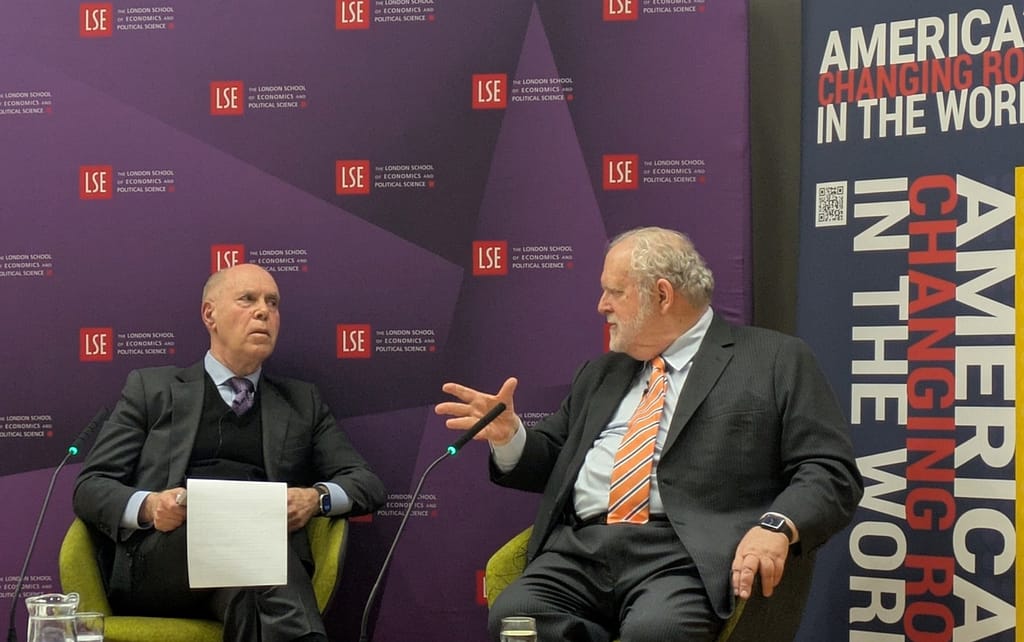
In February 2026, the Phelan US Centre hosted the event “American foreign policy in the age of Trump” with Professor Walter Russell Mead as part of the Centre’s America’s Changing Role in the World lecture series. Marc Devictor gives an overview of the event.
On Thursday, 19 February 2026, the Phelan US Centre hosted Professor Walter Russell Mead for the event “American Foreign Policy in the Age of Trump,” the latest instalment in the Centre’s America’s Changing Role in the World lecture series. Chaired by the Phelan US Centre Director, Professor Peter Trubowitz, the lecture addressed the following question: what should we do to better understand and respond to President Trump’s foreign policy?
Walter Russell Mead is a Distinguished Fellow at the Hudson Institute, the “Global View” columnist at the Wall Street Journal, and a professor at the University of Florida. He is best known for his taxonomy of four traditions in American foreign policy – Hamiltonian, Wilsonian, Jeffersonian, and Jacksonian – developed in his 2001 book, Special Providence, and his work on Jacksonianism has attracted renewed attention since Trump’s rise.
Mead opened his remarks by framing Trump’s presidency within its context. He argued that Trump is the first truly “post-modern president,” a leader operating amid an Information Revolution whose effects on political, social, and economic relations are, in his assessment, likely to surpass those of the Industrial Revolution. The post-war assumption that international life has reached a stable plateau – what Mead termed the idea of a “mature industrial society” – is no longer applicable. Instead, the rules governing institutions and traditional alliances are in flux, and the pace of that change is intensifying.
Paradoxically, Mead noted, the effect of this upheaval has been a shift toward less international cooperation at precisely the moment when more is needed. The idea that history has reached its endpoint, that the post-war liberal order represented a final destination, has, in his view, proven false. The world is instead moving in a different direction.
Importantly, Mead argued that Trump does not view the conservation of this older stability as “the natural and obvious goal of statecraft,” which distinguishes his foreign policy from that of his predecessors. He described the current moment as “an uncharted world with a man who doesn’t believe in charts,” and cautioned that the assumption of a return to normality after Trump misreads both the president and the changing international environment in which we live.
From this foundation, Mead proposed five analytical premises – ideas, he noted, that have helped him better understand and respond to Trump’s foreign policy.
First, he cautioned against taking Trump’s speeches at face value. They are designed not to convey information but to provoke reactions, based on a business-like logic of gauging the response and acting accordingly. Second, Trump is not pursuing a singular grand strategy. His foreign policy consists of multiple simultaneous negotiations, some pursued and others abandoned – his interest in annexing Greenland, for instance, was dropped at the January 2026 World Economic Forum meeting at Davos after generating a strong reaction. Trump’s approach is opportunistic and recognisably pragmatic. Third, the source of Trump’s power is not policy achievement but drama. He has weaponised public attention, commanding “the mental bandwidth of the human species.” His cabinet was “cast,” not staffed, to maximise media spectacle, and Mead described him as a “Napoleonic figure” with an exceptional talent for converting “eyeball power” into political power. Fourth, Trump is a skilled coalition manager. Foreign policy decisions that appear irrational become more legible when understood through the lens of managing MAGA’s internal factions. Fifth, Trump’s worldview, discernible through actions rather than rhetoric, centres on the belief that America’s key alliances have “fallen into disrepair.” His “tough love” aims to compel allies to reinvest in their own defence and is producing tangible results with the EU’s recent substantial increase in defence spending.
Beneath this lies a deeper strategic logic centred on the US’s balance of power with China. Mead suggested that to President Trump, a strong Russia serves as a better counterweight to China than a weak one, and that the aim of peace negotiations over Ukraine is not primarily territorial sovereignty but the economic reintegration of Russia.
In a follow-up discussion, Professor Trubowitz raised the issues of big tech, nuclear weapons, and the post-Trump landscape. Mead characterised Trump not as a catalyst of the shifting international order but as an “accelerant,” and predicted that key elements of his foreign policy will prove difficult – or even not worth – reversing.
During the Q&A, audience members raised concerns about European planning for an unpredictable United States, the profit motive in Trump’s foreign policy, and how to distinguish serious policy signals from provocations. Mead consistently responded to these through his central argument, that the distinction between a pre- and post-Trump world is misleading. The international order is undergoing a fundamental transformation, where Trump is a manifestation of that change rather than its author. On Iran, he suggested Trump’s goal is primarily a deal he can present as a victory. On the future of the drivers of American foreign policy, Mead predicted today’s pragmatism may give way to a renewed emphasis on morality and ideas, as during the Carter and Reagan eras.
Mead concluded by reflecting on the relationship between power and morality. He maintained that “we have to get the fundamentals of power right first” in order to pursue a more just international order. He compared this to an iron fist in a velvet glove: a velvet glove by itself is empty, but an iron fist on its own still functions. Our moral duty, he suggested, is to attend to pragmatism as the necessary foundation of power to be in a position to do good.
Marc Devictor is an MSc candidate in International Relations at the LSE. He holds a First Class BA in History from University College London.
Your email address will not be published.
© 2026 London School of Economics and Political Science (LSE). LSE Blogs.