Trump warns Iran that 'clock is ticking' as talks stall. Live updates – USA Today

Oil prices rose on Monday as President Donald Trump warned Iran that the “clock is ticking” following a drone strike on a nuclear power plant in the United Arab Emirates that raised fears of renewed conflict as talks between Washington and Tehran stall.
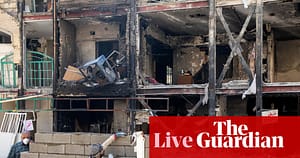
Emirati officials said a drone hit an electrical generator outside the Barakah Nuclear Power Plant’s inner perimeter on Sunday. No injuries were reported and regulators confirmed the facility remained safe. Officials said they were investigating the source of the drone and noted that the UAE has the full right to respond to such “terrorist attacks.”
The incident occurred after Iranian and U.S. officials rejected each other’s negotiating positions on Saturday. In a Truth Social post on Sunday, President Donald Trump threatened Iran to “get moving” or face consequences. “For Iran, the Clock is Ticking, and they better get moving, FAST, or there won’t be anything left of them. TIME IS OF THE ESSENCE!” Trump wrote.
Brent crude futures, the international benchmark, traded at $110.21 a barrel early Monday after briefly touching $112, the highest level since May 5. U.S. gas prices remain elevated at $4.51 per gallon.
Christopher Cann
President Donald Trump on Monday renewed his criticisms of media coverage critical of the Iran war.
“The Dumacrats and Media have totally lost their way. They have gone absolutely CRAZY!!!” he wrote on Truth Social.
Trump and his top Cabinet officials have increasingly criticized media outlets for their coverage of the war, even accusing journalists of treason.
“When the fake news says that the Iranian enemy is doing well, militarily, against us, it’s virtual treason in that it is such a false, and even preposterous, statement,” Trump posted on May 12.
Andrea Riquier
Oil ticked lower on Monday morning, relieving some of the pressure on bonds, and allowing U.S. stocks to open flat.
Brent crude traded around $108 a barrel, still much higher than before the Iran war began, but down about 1% from weekend highs.
The U.S. 10-year Treasury note, which had topped 4.63% overnight, hovered near 4.588% as trading opened on Wall Street. In February, before the war, the 10-year traded near 4%.
Investors all over the world are selling bonds because of the inflation that the war has caused. When prices rise, bonds’ fixed streams of income become less valuable. And when such a sell-off begins, it can develop its own momentum by making it harder for businesses, governments, and households to borrow money.
“Friday’s global bond market selloff and renewed oil-price gains at the start of the week spilled over into fresh selling at the outset of trading in Asia last night,” said John Canavan, an Oxford Economics analyst in a Monday morning note. “Japanese yields jumped 2 (basis points) to 18 (basis points) higher. The rise in Japanese yields was exacerbated by a Reuters report that Japan is likely to issue additional debt as part of a fiscal support package ‘to cushion the economic blow from the Middle East war.’”
Joey Garrison
A spokesman for the Iranian Foreign Ministry said Monday the country’s right to enrich uranium is non-negotiable as talks with the United States to end the U.S. war in Iran remain at a stalemate.
His remarks comes as President Donald Trump says he won’t sign off on a deal that does not include assurances from Iran to end its nuclear weapons program including uranium enrichment.
Iranian Foreign Ministry spokesman Esmaeil Baqaei, speaking at a news conference, said Iran’s nuclear enrichment rights are protected by the Nuclear Non-Proliferation Treaty, insisting that it’s not something Iran will “negotiate or compromise over.:”
“There is no need for another party to recognize this right for Iran. This right already exists,” he said, according to translations from Al Jazeera and theInternational Business Times.
Negotiations are being conducted through Pakistani mediators. Trump rejected Iran’s most recent offer to reopen the Strait of Hormuz, calling it a “piece of garbage” proposal.
Trump renewed his threats on Iran in a social media post Sunday, warning “the clock is ticking” and that if Iran doesn’t act quickly then “there won’t be anything left of them.”
Baqaei said Tehran won’t be “intimidated” by threats, NBC News reported, and stressed the ongoing negotiations.
Christopher Cann
House Speaker Mike Johnson in an interview on Sunday said “gas prices are too high” as a result of stalled traffic along the Strait of Hormuz.
Johnson said Republicans are “anxious” for the critical waterway to reopen and oil prices to come down, especially as the midterm elections approach. His comments come as polls show Americans are increasingly frustrated with the Trump administration’s handling of the economy and the Iran war, which has surged energy prices in the U.S. and abroad.
“All points lead back to that,” Johnson told Fox News Sunday, speaking about the waterway that carries one-fifth of the world’s oil and natural gas. “Gas prices are too high because of that, and that has an effect on how goods are transported to the grocery store and all the rest.”
“As soon as we get that straightened out we will get back to the kitchen table issues,” he said, adding: “We’re really excited, anxious for that to be resolved.”
Joey Garrison
Nearly two-thirds of Americans believe President Donald Trump made the wrong decision to go to war with Iran, a poll conducted by the New York Times and Siena University found.
Sixty-four percent of the poll’s respondents said it was the wrong decision to go to war with Iran, while 30% said it was the right decision.
The poll, taken May 11 to 15, also found Trump’s approval rating has dropped to 37%, with 59% of Americans disapproving of his job performance. The poll has a margin of error of 2.8 percentage points.
Trump has argued military action on Iran was necessary to prevent the Iranian regime from building a nuclear weapon. Yet his administration has been unable to secure a deal with Iran that achieves that aim. Meanwhile, the war has taken a toll politically on Trump as gas prices in the United States soar as a result of the conflict.
Christopher Cann
Pakistan’s Prime Minister Shehbaz Sharif on Monday condemned the drone attack near the UAE’s Barakah Nuclear Energy Plant and called for all countries to exercise “maximum restraint.”
“We stand in full solidarity with the leadership and the brotherly people of the United Arab Emirates,” said Sharif, whose country has played a central role in negotiations between Washington and Tehran since the start of the war in February.
“We urge all parties to exercise maximum restraint and fulfil their obligations under international law,” he added. “Dialogue and diplomacy remain the only viable path toward lasting regional peace, stability and de-escalation.”
James Powel
Nearly 70% of Americans said they are not getting a clear understanding of the situation in the Strait of Hormuz, according to a CBS/YouGov poll released on Sunday.
Pollsters found 69% of Americans said they did not clearly understand what is going on in the key oil shipping waterway. When asked which side had the upper hand in the conflict, 41% said neither the United States or Iran had an advantage.
Meanwhile, 59 % of Americans said that gas prices were a financial hardship, while 26% said that they are an inconvenience.
The poll came days after the Bureau of Labor Statistics’ consumer price index revealed that a 5.4% rise in gas prices in April drove inflation to its highest point since 2023. Gas prices are up 28.4% for the year, and AAA pegged the national average at $4.51 per gallon on Sunday.
Florence Tan, Reuters
Oil prices extended gains on Monday as efforts to end the U.S.-Israeli war on Iran appeared to have stalled, after a nuclear power plant in the United Arab Emirates came under attack.
Brent crude futures, the international benchmark, climbed $2.03, or 1.86%, to $111.29 a barrel after touching $112 earlier, the highest since May 5. U.S. West Texas Intermediate crude was at $107.73 a barrel, up $2.31, or 2.19%, following a rise to $108.70, its highest level since April 30.
Both contracts gained more than 7% last week as hopes of a peace deal that would end ship attacks and seizures around the Strait of Hormuz dimmed. Last week’s talks between President Donald Trump and Chinese President Xi Jinping ended without an indication from the world’s top oil importer that it would help resolve the conflict.