
Trump in China: Follow live updates as US president meets Xi – BBC
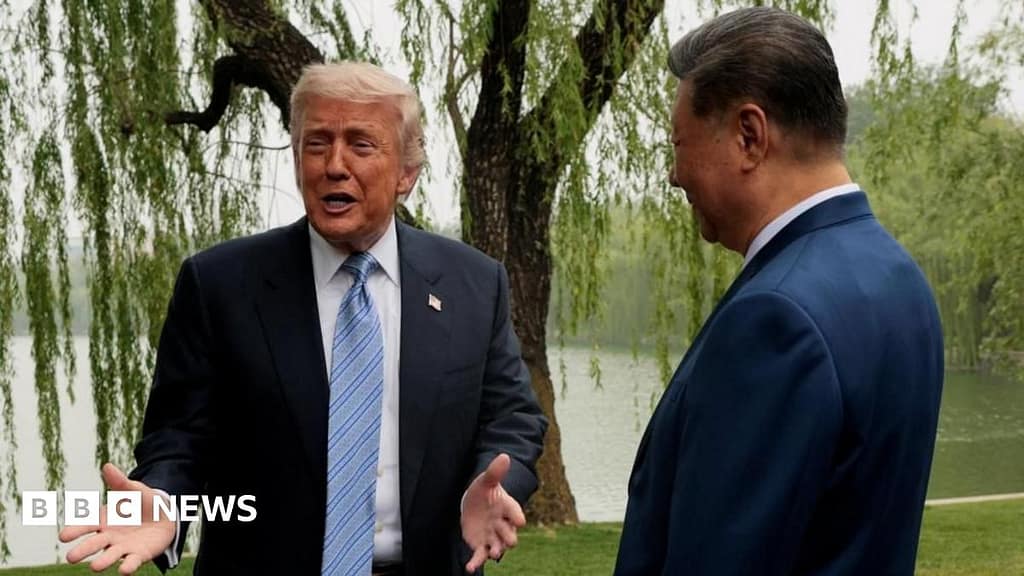
Donald Trump is meeting Xi Jinping for a final round of talks as the US president wraps up his state visit to Beijing
Earlier Trump said Xi had committed to withholding military equipment from Iran, in an interview with Fox News
The US president also said China wants the Strait of Hormuz open again and that Beijing has agreed to buy oil from the US
While Trump talked a lot about what he got from China, he refused to elaborate on what China wants in return, writes our senior international reporter
On Thursday Xi had hailed US-China relations, calling them the world's "most important", while Trump said talks were "extremely positive"
The White House earlier said trade, oil and Iran were among the topics discussed during a high-stakes meeting that lasted nearly two hours
But deep differences remain on tariffs and export controls, our business correspondent writes
Edited by Tessa Wong and Gavin Butler, with reporting from Laura Bicker, Stephen McDonell and Tom Bateman in Beijing
Trump's motorcade is leaving Zhongnanhai and is bound for the airport, marking an end to the US president's visit to Beijing.
Stay with us as we bring you more updates and analysis from the Trump-Xi meeting. Laura Bicker
China correspondent, reporting from Beijing
Xi Jinping has been rolling out the red carpet for world leaders eager to do a trade deal with China – including key US allies like Britain, Canada and Germany.
The Chinese leader has been eager to portray himself as a stable, global leader in contrast to the unpredictable US president.
"We are witnessing an historical change," says John Delury, a senior fellow from the Asia Society's Center on US-China Relations.
"I hesitate to put too much on this specific summit, but the inexorable rise of China to a place where it is legitimately rivalling the US. That is now happening before our eyes. Beijing is now the second world capital."
China has welcomed a parade of high-profile foreign leaders in recent months including France's Emmanuel Macron, South Korea's Lee Jae Myung, Canada's Mark Carney and Germany's Friedrich Merz.
In January, Keir Starmer became the first British prime minister to visit China in nearly a decade.
US President Donald Trump's sweeping tariffs and unpredictable threats – from acquiring Greenland to pulling troops from Europe – have cast uncertainty over America's longstanding alliances.
This has pushed US allies closer to China, the world's second-largest economy. And Beijing is happy to project an image of stability in contrast to the US.
During Carney's visit to Beijing in January, in which he signed a series of trade deals with China, he told reporters that the global order was at a "point of rupture".
The re-calibration of ties with China has set Canada up "well for the new world order", he said.
Here's another presidential conversation that was heard during Trump and Xi's walk around Zhongnanhai, captured on video:
"Can I ask the President: with other dignitaries from other countries, presidents or prime ministers, does he bring them here?" Trump asked, as he and Xi stood with their translators in a garden.
"Very few," Xi replied. "We usually don’t hold diplomatic events here. Even after we started having some, it’s still extremely rare."
"For example, Putin," Xi added. The Russian president has visited Zhongnanhai several times during previous visits to China."
"Good. I like it," Trump said.
On Thursday, as the two presidents met for bilateral talks, Russia announced that Putin would pay another visit to China very soon.
Stock image of kung pao chicken
Trump and Xi are now having a working lunch. Here's what's on the menu, according to the White House:
Meanwhile, reporters in the White House travelling pool are having McDonald's delivered to their vans. Suranjana Tewari
Asia Business Correspondent
One of the clearest shifts emerging from the Trump-Xi summit is how directly Beijing is now linking Taiwan to the broader economic relationship with the United States.
Over the past year of trade talks, Taiwan was largely treated as one of several areas of friction – particularly around semiconductors, US-Taiwan trade ties and American arms sales to Taipei.
But the messaging from Beijing yesterday suggests that how the US approaches Taiwan is becoming more of a pre-condition to long-term economic stability between the two sides.
According to Chinese state media, Xi Jinping said the US and China had agreed to a “new positioning” for relations built around “constructive strategic stability”.
But he then warned that Taiwan remained the “most important issue” in US-China relations, adding that mishandling it could push ties into a “highly perilous situation”.
Taiwan has always been a red line for Beijing, but it seems to be becoming more of a bargaining tool that could shape trade, technology and relations.
As we mentioned earlier, one of the things to look out for in this final round of talks is whether Xi pressures Trump on the issue of Taiwan.
Yesterday Xi had called Taiwan the "most important issue in China-US relations" and warned of potential "conflict" with the US over the self-ruled island.
He added that Taiwan independence is "fundamentally incompatible" with peace in the Taiwan Strait.
Later on Thursday Taiwan's foreign ministry responded saying that "Beijing is the sole risk to regional peace and stability".
The ministry added that it would continue to cooperate with the US and other countries to ensure regional security and prosperity.
Neither Trump nor the US have said anything publicly during the trip so far about what they have discussed about Taiwan.
Now we bring you more quotes from Trump, from the White House pool of reporters.
During their walk around Zhongnanhai, Trump said at one point that "these are the most beautiful roses anyone has ever seen".
Trump was later heard saying, on his way to the tea room, that Xi would give him roses for the White House Rose Garden.
Trump also mentioned Xi's potential visit to the US on 24 September.
"Like reciprocal trade the visit will be reciprocal," Trump said. "So we’re gonna lay it on the line and we’re gonna have and you’re gonna walk away hopefully very impressed, like I’m very impressed with China."
This video can not be played
Xi and Trump tour Zhongnanhai garden
President Xi has taken President Trump on a tour of Zhongnanhai, the heavily guarded compound where top Chinese leaders live and work. This is the main event of Trump's last day in Beijing, before he's set to fly back to the White House.
Stay with us as we continue to bring you the latest updates on Trump's visit to Beijing.
Trump tells reporters, after his tour of Zhongnanhai, that he and Xi had discussed Iran and "don't want them to have nuclear weapons".
This video can not be played
Trump: US and China 'feel very similar' about Iran
While we are still waiting to hear details of the meeting that is underway, here are some pictures showing what the two leaders did this morning.
The two leaders walked around in Zhongnanhai, the compound where Chinese central leadership resides, before their talks this morning
Xi showed Trump a garden at the compound
Trump and Xi then moved to a room where they spoke to press
In Xi's address, he describes the Zhongnanhai compound, where he hosted Trump this morning, as the place "central government leaders of China work and live, including myself"
"This place used to be part of the imperial garden, there is a lot of history in this compound," Xi said, adding that one of the trees they admired during their walk was 490 years old.
Xi said he would send the seeds of the Chinese roses they saw in the garden to Trump as a gift.
"I love that, it's great," Trump said.
Later on in the joint address, Xi said the two leaders had reached a "new bilateral relationship" that was "constructive". He called this a "milestone".
As his English translator was translating this, however, reporters were ushered out of the room and the livestream ended.
We'll bring you more details from their meeting once we have them.
The two leaders are speaking in front of press now, in a room in Zhongnanhai.
Trump begins, saying they talked about trade, Iran, and "a lot of other things".
He says they "settled a lot of different problems that other people woudn't have been able to solve".
On Iran, he says "we don't want them to have nuclear weapons", and "we want the strait open".
He then thanks Xi, saying it's an honour to be in Beijing. He says they will meet again on 24 September, when Xi visits the US, and adds he hopes Xi will be impressed with the US as how Trump is with China this time.
This video can not be played
Xi Jinping greets US officials
While the two presidents are having tea in Zhongnanhai, here's a quick catch-up of what happened during their first round of meetings yesterday:Laura Bicker
China correspondent, reporting from Beijing
The Chinese government says it has been "working tirelessly" to strive for an end to the conflict in the Middle East and hopes to provide "greater support for peace talks and play a constructive role in ultimately achieving lasting peace.”
The statement from Chinese state media comes after Donald Trump told Fox News that he’s “not going to be much more patient” on a possible peace deal with Iran.
The US president also claimed Xi Jinping offered China’s help in reaching some kind of settlement with Iran.
Beijing is a close ally of Tehran. China is the largest buyer of Iranian oil and is the country’s biggest trade partner. The Trump administration had hoped Xi would use this economic and political leverage to nudge Tehran towards the negotiating table.
The Chinese statement said today that the conflict "should never have happened” and "has no reason to continue” while notably avoiding directly criticising the U.S.
Economically this war is causing China’s factories pain as they are forced to pay more for oil products, but diplomatically and politically it is a win for Xi who will feel he is now facing a war-weakened Donald Trump.
In contrast, Xi can appear to play the role of peacemaker – a reminder that China is no longer just at the centre of the global economy, but also increasingly at the centre of global power.
Ian Tang
BBC Monitoring
People’s Daily, the Chinese Communist Party's official newspaper, today devoted its entire front page to reports on Xi and Trump’s interactions in Beijing yesterday.
Key stories, such as the leaders’ summit, Xi’s welcome ceremony and state banquet honouring Trump and their visit to the Temple of Heaven received front-page treatment accompanied by pictures of them.
Page two of the newspaper was largely filled with commentaries of Trump’s visit, with one report noting that the two countries’ agreement to work toward building a relationship of “constructive strategic stability” will inject new momentum to the development of bilateral ties.
Notably, the paper also included interviews with two American scholars. Columbia University professor Jeffrey Sachs said co-operation between China and the United States would bring tangible and mutually beneficial results.
Quincy Institute’s East Asia program senior research fellow Denis Simon was quoted as saying a stable US-China relations would help to mitigate the risks of global economic shocks, enhance supply chain resilience, and drive progress on transnational issues such as climate change.Suranjana Tewari
Asia Business Correspondent
Asia’s export-led economies will be watching the Trump-Xi meetings with what Reema Bhattacharya of Verisk Maplecroft calls a mix of “anxiety, caution and fatigue”.
Most economies in the region are part of key US-China supply chains, so any shift in relations feeds directly into trade, investment and manufacturing decisions. A renewed escalation could ripple across global markets.
At the same time, any agreement for lower US tariffs on Chinese goods, for example, could increase competition for countries like Vietnam, Malaysia and Thailand, which have benefited from supply chain shifts away from China in recent years.
China’s export controls on rare earths have already hit automakers and electronics producers across the region in Japan, South Korea and India.
Energy is another pressure point, with South East Asia heavily reliant on oil flows through the Strait of Hormuz and vulnerable to price swings.
For many governments, especially in South East Asia, the challenge is balancing ties with both Washington and Beijing as trading partners.
Expectations for major breakthroughs are low. The most likely outcome is a limited stabilisation in relations.
The key concern for businesses and economies across the region is continued uncertainty.
Trump and Xi are meeting at Zhongnanhai, the secretive Chinese leadership compound.
Only a small number of reporters have been allowed into the complex, according to a White House pool report.
It also says roads were cleared for the presidential motorcade, which rolled by as passersby filmed on their phones.
During their meeting on Thursday, Trump and Xi "exchanged in-depth views on major issues concerning both countries and the world, and reached a series of new consensuses", a foreign ministry spokesperson said in response to press queries, according to Chinese state media.
The spokesperson did not elaborate on specific topics, but added that the two presidents have "reached important consensus on properly handling each other's concerns" and agreed to boost coordination on global and regional issues.
We've now received a statement from China's foreign ministry responding to media queries.
On Iran, a foreign ministry spokesperson said that the conflict "should never have happened" and "has no reason to continue".
"Finding a solution sooner is beneficial to both the US and Iran, as well as to countries in the region and the world as a whole," the spokesperson said.
We'll bring you more updates from the ministry as we get them – as well as newslines from Trump's meeting with Xi at Zhongnanhai.
Copyright © 2026 BBC. The BBC is not responsible for the content of external sites. Read about our approach to external linking.


