
Lula and Trump failed to reach deal on key issues, analysts say – Valor International
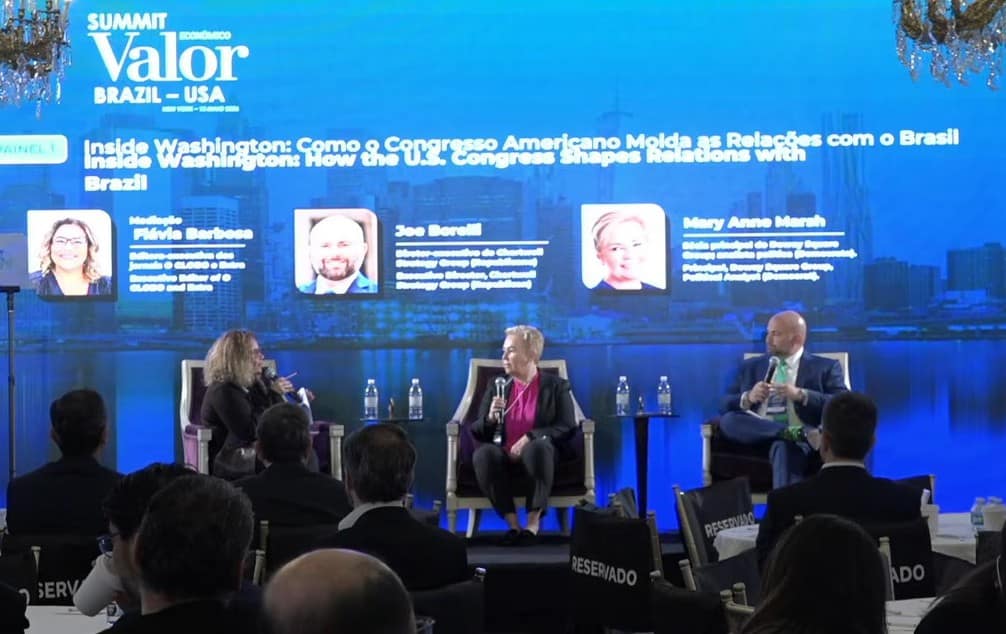
Democratic and Republican views on Brazil in the United States were the opening topic of the Summit Valor Brazil-USA 2026 in New York on Wednesday (13).
In the panel “Inside Washington: How the U.S. Congress Shapes Relations with Brazil,” Joe Borelli, executive director of the Republican-leaning Chartwell Strategy Group, and political analyst Mary Anne Marsh, a senior partner at the Democratic-leaning Dewey Square Group, exchanged views on the priorities of politicians from both parties in relations with Brazil.
The two participants also discussed what to expect from President Donald Trump regarding Brazil, as well as the U.S. midterm elections and Brazil’s presidential election.
The panel was moderated by journalist Flávia Barbosa, executive editor of the newspapers “O Globo” and “Extra.”
Borelli and Marsh said that the fact that President Lula and Trump did not speak to reporters together after their meeting at the White House last week indicated they were unable to reach an understanding on issues central to both sides.
Borelli cited some points Republicans currently see as crucial—and that may have influenced the talks. “The path to cooperation, according to Republicans, has to do with critical minerals and the threat posed by China’s growing influence in the region,” he said.
“There is something they were unable to reach an agreement on,” Marsh agreed.
In her view, the impasse could open the door for new measures by Trump regarding Brazil. “It is not impossible that he [Trump] will do something before Brazil’s October election. Maybe tariffs, which he loves. It may or may not happen,” she said.
Borelli noted that, under Trump, U.S. relations with other countries depend partly on his rapport with those countries’ leaders.
And, like Marsh, he believes the U.S. president’s political and ideological affinity with sectors of the Brazilian right will ultimately lead Trump to make statements or adopt measures aimed at influencing the October presidential election.
“Trump has the ability and could appear in any newspaper in Brazil or here,” the analyst said. “If there is an opportunity to influence the election at the last minute, I think he will do it.”
While Brazilians will elect their next president in October, Americans will go to the polls in November to choose new members of Congress. Both elections are likely to shape Brazil-U.S. relations.
In the U.S., the current pressure point is the surge in gasoline prices due to the war between the United States and Iran. In U.S.-Brazil relations, the key issue is likely to be some kind of agreement on Brazil’s critical minerals.
Borelli believes Brazil is interested in joining a group of countries that supply the U.S. He added: “American companies will invest if they believe there will be a safe way to develop components for American products to meet [U.S.] industrial needs.”
In Marsh’s view, much of what has defined the U.S. approach to relations with other countries, including Brazil—tariffs, trade rules, and other issues—will change. “All of that will change if Democrats win a majority in Congress.”
This article was translated from Valor Econômico using an artificial intelligence tool under the supervision of the Valor International editorial team to ensure accuracy, clarity, and adherence to our editorial standards. Read our Editorial Principles.
Experiencing art, literature, and music alongside experts in different parts of the world is the promise of cultural tourism, a segment that is attracting growing interest
Political scientist Jairo Nicolau launches book analyzing how voting patterns have changed in 20 years and the resulting impacts on the elections of presidents Bolsonaro and Lula
Vale and L’Oréal accelerate initiatives focused on Black professionals; ID-BR held the ninth edition of the ‘Yes to Racial Equality Award’ on Wednesday
Ministry of Agriculture has been investigating fraud complaints
Executive says quality of life is emerging as the key trend in luxury consumption
Felipe Nunes says it is still too early to predict the winner of Brazil’s presidential race
Gilberto Tomazoni says 50% of JBS’s global revenue now comes from the United States
CEO Gustavo Werneck says steelmaker does not base its investments on short-term volatility
Executive says conglomerate remains heavily tied to Brazil’s energy and agribusiness sectors