
With the absence of Brazil, Canada, Colombia, and Mexico, Trump gathers allies in Miami to launch a military offensive in the Americas – Fundação Perseu Abramo
published 24/03/2026 at 18:55
Fernanda Otero
Although it brought together 12 leaders from Latin America and the Caribbean aligned with Washington, the meeting did not include representatives from the region’s largest powers and populations, covering only 46% of the continent’s inhabitants.
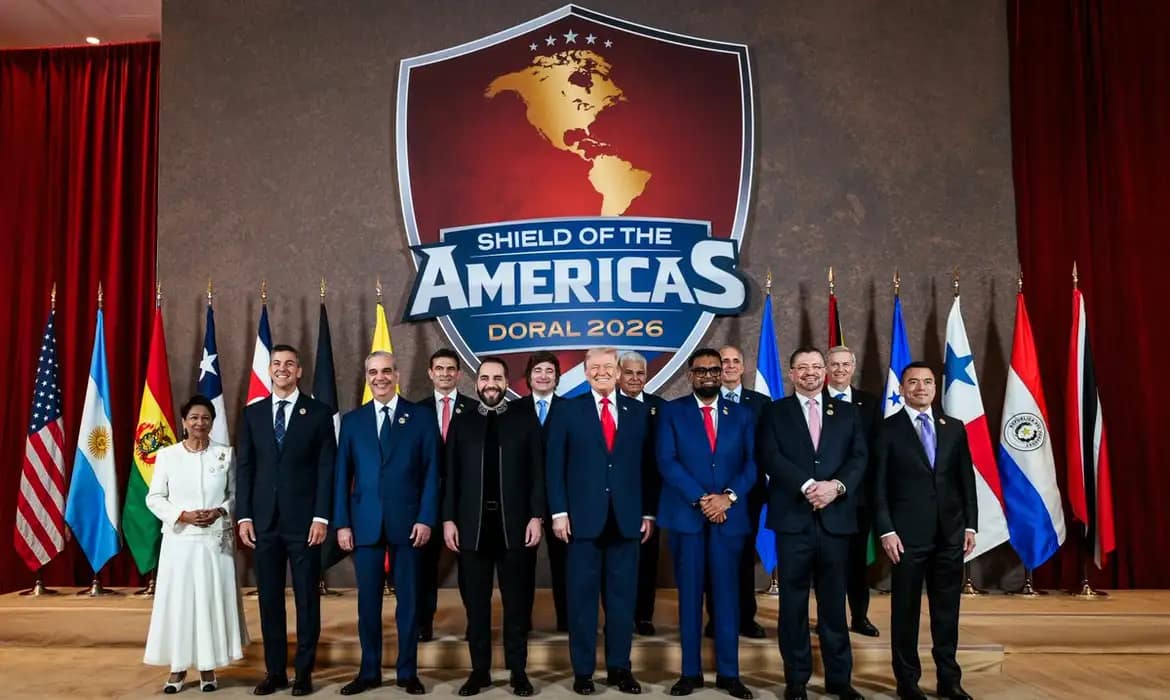
U.S. President Donald Trump gathered a dozen leaders from Latin America and the Caribbean on Saturday, March 7, at his golf club in Doral, in the Miami area, to launch what the White House called the “Shield of the Americas” summit—a regional military coalition. During the meeting, Trump advocated the creation of a regional alliance against drug cartels and stated that the group should act in a coordinated manner to confront security threats and China’s economic and political influence in the Western Hemisphere.
According to The Guardian, leaders from Argentina, Bolivia, Chile, Costa Rica, the Dominican Republic, Ecuador, El Salvador, Guyana, Honduras, Panama, Paraguay, and Trinidad and Tobago attended.
The summit was marked by diplomatic absence: although it gathered 12 leaders aligned with Washington, it lacked representatives from the region’s largest powers and populations, such as Brazil, Mexico, Colombia, and Canada.
“Just as we formed a coalition to eradicate ISIS, we now need a coalition to eradicate the cartels,” Trump told those present. He stated that “the epicenter” of cartel-related violence is in Mexico and claimed that criminal groups are “fueling and orchestrating” much of the violence in the hemisphere. Trump praised Mexico’s president, Claudia Sheinbaum—who did not attend the meeting—but said the cartels are “getting worse” and “taking over the country.”
Former Secretary of the Department of Homeland Security Kristi Noem—who left her position the previous Thursday and is now serving as a U.S. special envoy to the coalition—said the initiative aims to coordinate countries to “defend sovereignty,” “security,” and “economic prosperity.” She added that “now that America is safe and our borders are secure,” the U.S. wants to “focus on neighbors” and assist with border and regional challenges.
Cartel leader killed in Mexico and abduction in Venezuela
The meeting brought together only leaders from countries politically aligned with the current U.S. president. When asked about the absence of Brazil, Mexico, and Colombia, Trump reportedly said he “thought” they had been invited.
Recent U.S. actions in the region indicate an escalation of interventionism. An operation in Mexico—with support from U.S. intelligence—to capture Nemesio Oseguera Cervantes (“El Mencho”), identified as the leader of the Jalisco New Generation Cartel (CJNG), resulted in his death. He was reportedly wounded in a shootout and died while being transported to Mexico City.
Referring to Mexico’s president, Trump said he “likes her very much,” calling her “a very good person.” He also remarked that “she has a beautiful voice” and is “a beautiful woman.” He even insinuated—seemingly mimicking President Claudia Sheinbaum—that she had asked him “not” to eliminate the cartels.
In January, a U.S. military operation captured Venezuela’s president Nicolás Maduro, who is currently detained in U.S. territory awaiting trial on charges involving drug and weapons conspiracy.
During the meeting, according to Le Monde, Trump encouraged leaders to use military force against what he called the “cancer” of cartels and said the U.S. could support allies with missile strikes against drug trafficking leaders. The newspaper reports that the coalition is described by the White House as a commitment by regional governments to use “hard power” against security threats.
Cuba
Trump also spoke about Cuba. According to The Guardian, he again predicted the country’s collapse and said he expects “a big change” soon, claiming that Cuba is “at the end of the line” and that its government wants to negotiate with the United States. Le Monde reports similar statements, noting that Trump said Cuba is in its “final moments,” criticizing the regime and mentioning shortages of money and oil.
Chinese influence
On the diplomatic front, Trump presented what The Guardian describes as a regional cooperation strategy to counter Chinese influence, including references to the Panama Canal. Secretary of State Marco Rubio thanked Trump for prioritizing the Western Hemisphere, praised the attending leaders, and said the U.S. sees advantages in reciprocal relations with “friends and allies.”
Defense Secretary Pete Hegseth stated that the U.S. had spent too much time focusing on “borders in distant places” rather than on its own region and the Western Hemisphere.
“American” representativeness
The current population of the Americas, based on the UN’s 2024 revision (World Population Prospects), considering North America, Central America, South America, and the Caribbean, is approximately 1.055 billion inhabitants.
In official reports, the UN groups Mexico within “Latin America and the Caribbean,” while North America (including the U.S., Canada, Mexico, Bermuda, Greenland, Saint Pierre and Miquelon, and Caribbean territories) totals 514.7 million people. Of these, only the host country attended the meeting.
Central America, with seven continental countries and a population of 52.8 million, saw the absence of two nations.
South America, whose largest population is Brazil (217.6 million), includes 12 countries plus French Guiana and the Falkland Islands, totaling 442.8 million inhabitants.
According to UN data, the countries that attended the event represent 46.41% of the continent’s population.
Terms of use and Privacy policies