
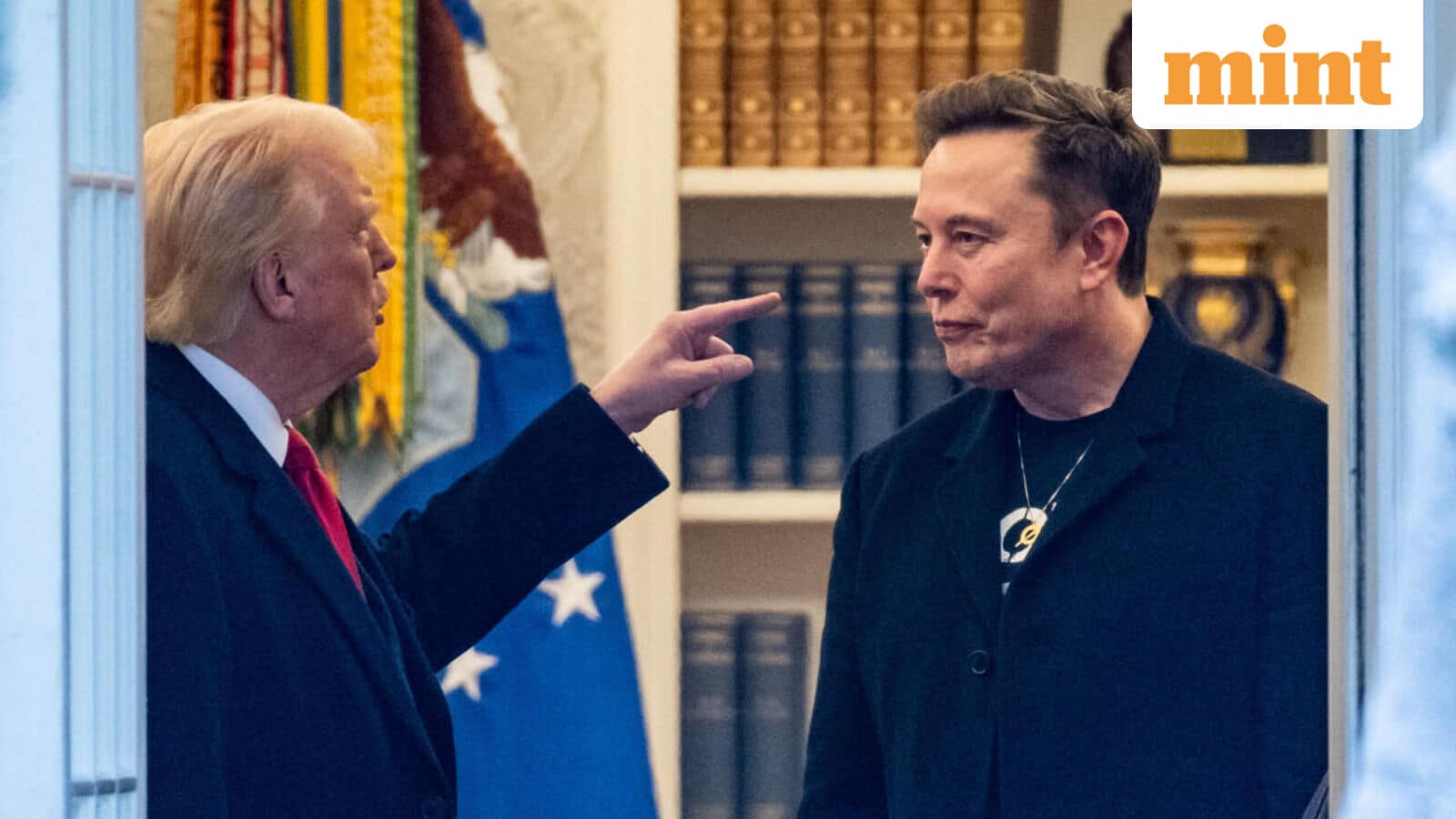
Trump invites Elon Musk, Tim Cook, Larry Fink for China trip: Full list of CEOs joining Beijing summit with Xi Jinping – Mint
US President Donald Trump has invited more than a dozen of America’s most powerful corporate chiefs to accompany him to Beijing this week. The visit is for a high-stakes summit with Chinese President Xi Jinping. Washington aims to stabilise a trade relationship worth hundreds of billions of dollars whilst navigating deepening tensions over artificial intelligence, rare-earth minerals and the ongoing Iran war.
The White House has confirmed that Trump’s delegation to Beijing will include some of the most recognisable names in global business. Tesla chief Elon Musk, Apple’s Tim Cook, BlackRock chief Larry Fink and Boeing chief Kelly Ortberg are among those invited to join the presidential trip. A White House official, speaking on condition of anonymity as the list had not been formally announced, revealed the names to CNBC.
Also travelling with the delegation are Blackstone’s Stephen Schwarzman, Cargill’s Brian Sikes, Citigroup’s Jane Fraser, Coherent’s Jim Anderson, GE Aerospace’s H Lawrence Culp Jr, Goldman Sachs’s David Solomon, Illumina’s Jacob Thaysen, Mastercard’s Michael Miebach, Meta Platforms executive Dina Powell McCormick, Micron Technology’s Sanjay Mehrotra, Qualcomm’s Cristiano Amon and Visa’s Ryan McInerney, reported CNBC.
People also ask
AI powered insights from this story
Several high-profile CEOs were invited, including Elon Musk (Tesla), Tim Cook (Apple), Larry Fink (BlackRock), and Kelly Ortberg (Boeing). Other notable attendees included Stephen Schwarzman (Blackstone), Brian Sikes (Cargill), Jane Fraser (Citigroup), and David Solomon (Goldman Sachs).
President Trump aims to stabilize the U.S.-China trade relationship, which is worth hundreds of billions of dollars. The summit agenda is expected to cover trade, artificial intelligence, export controls, Taiwan, and the Iran war, with a focus on extending the existing trade truce.
Several issues could complicate the talks, including China's control over rare earth minerals, US restrictions on advanced computer chips, China's dominance in the automotive sector, ongoing tariff disputes, and US sanctions related to Iranian oil transport.
The summit could pose a risk to the chip stocks rally. Concerns include potential deals involving rare earth materials for ASML lithography machines, which could lower chip prices and impact market share for major chipmakers if China gains access to advanced technology.
Taiwan is considered a major point of risk in the bilateral relationship. Beijing has urged Washington to scale back security commitments and revise its policy toward the island, which China claims as its own territory.
Cisco confirmed that its chief, Chuck Robbins, received a White House invitation but was unable to attend due to the company’s earnings schedule.
Notably absent from the group is Nvidia chief Jensen Huang, who said in a recent interview: “We should let the president announce whatever he decides to announce. If invited, it would be a privilege, it would be a great honor to represent the United States.” General Motors, Disney and Alphabet, all of which have significant interests in China, were also not listed among the attending companies.
Trump told reporters last week: “We’re doing a lot of business with China and making a lot of money. We’re making a lot of money, it’s different than it used to be.”
The summit agenda is expected to cover trade, artificial intelligence, export controls, Taiwan and the Iran war, with both sides entering the talks after weeks of escalating tensions in West Asia. The summit is primarily focused on keeping the economic relationship stable, with only modest policy announcements widely anticipated. A trade truce reached last October is likely to be extended, while China may announce plans to purchase American soybeans, beef and Boeing aircraft.
US officials have also signalled the possible creation of a Board of Trade designed to keep both sides engaged on economic matters. US Trade Representative Jamieson Greer has said he “highlighted” in a 30 April call with Chinese Vice Premier He Lifeng the value of a “new government-to-government Board of Trade,” indicating the body could improve trade in goods that do not raise national security concerns, such as agricultural products, whilst excluding sensitive technology like computer chips.
Brett Fetterly, a managing principal at the consultancy, The Asia Group, that focuses on China, said some within the Trump administration believe “the outcome that matters more than any set of deliverables is stability and space for continued engagement, both to build domestic resilience and to facilitate future deal-making.”
Despite the upbeat rhetoric, the underlying trade data present a more sobering picture. China bought nearly 50 billion dollars less in American products last year than it did in 2022, according to US Census Bureau data. The trade imbalance between the two countries totalled 202 billion dollars last year.
China’s share of goods imported to the US has also fallen sharply, dropping from 22% at the start of Trump’s first term in 2017 to just 7.5% in the first three months of this year, according to government data analysed by Chad Bown, a senior fellow at the Peterson Institute for International Economics and co-author of the book How to Win a Trade War.
The United States now imports more goods from Taiwan than from China, a shift driven in significant part by the artificial intelligence race, which has American firms purchasing computer chips and servers from the self-governing island. Meanwhile, China has increasingly routed its US-bound products through other Asian countries, whilst American companies have shifted supply chains for electronics to Vietnam and India.
Beneath the diplomatic pageantry, a fundamental divergence in priorities between the two governments complicates the path to any durable agreement.
“Washington and Beijing are competing at different levels and different domains, with different theories of victory,” said Michael Sobolik, a senior fellow specialising in US-China relations at the Hudson Institute. “President Trump leveraged tariffs not as a weapon against China but as leverage to secure a trade deal. Xi Jinping is angling to win a cold war with the United States.”
Ali Wyne, a senior research and advocacy adviser on US-China relations at the International Crisis Group, pointed to the Iran war as another source of strategic divergence, noting that the disruption to energy shipments through the Strait of Hormuz is affecting each country’s industrial calculations differently. “The structural frictions between the United States and China, they are growing in number and severity,” Wyne said.
Citigroup’s Jane Fraser, speaking to CNBC ahead of the trip, offered a more measured perspective from the business community: “I think it’s very important to see engagement” between the two economic superpowers, adding, “we all need that engagement to be occurring.”
Several unresolved issues lie beneath the surface of this week’s talks and could unsettle any agreements reached.
China controls the majority of global rare-earth mining and almost all processing for minerals widely used in electronics, a chokepoint the Trump administration is working to address through new partnerships and domestic investment, though analysts say this strategy would unfold over several years.
On technology, the US has been pushing to restrict China’s access to the most advanced computer chips, including those designed by NVIDIA and AMD, which carry the processing power needed to advance artificial intelligence development.
China’s dominance in the global automotive sector also remains a point of friction. Its worldwide vehicle exports increased by 21 per cent last year, according to the China Association of Automobile Manufacturers, with Chinese electric vehicles priced significantly below those produced by American, German, Italian, Japanese and South Korean manufacturers.
Tariffs, too, remain a live issue. The Supreme Court ruled that Trump lacked authority to unilaterally impose many of last year’s tariffs, while a federal court last week deemed his temporary replacement tariffs illegal. The administration has since launched national security investigations under the Trade Act of 1974 to construct a new tariff framework that may prove legally durable.
US sanctions on a Chinese oil refinery and dozens of tankers and shipping firms for their role in transporting Iranian oil have added further strain, with Beijing responding by demanding that no party abide by the US penalties against Chinese businesses. The two countries are also at odds over the management of the Panama Canal.
Sayantani Biswas is an assistant editor at Livemint with seven years of experience covering geopolitics, foreign policy, international relations and global power dynamics. She reports on Indian and international politics, including elections worldwide, and specialises in historically grounded analysis of contemporary conflicts and state decisions. She joined Mint in 2021, after covering politics at publications including The Telegraph. <br> She holds an MPhil in Comparative Literature from Jadavpur University (2019), with a specialisation in postcolonial Latin American literature. Her research examined economic nationalism through Eduardo Galeano’s Open Veins of Latin America. She also writes on political language, cultural memory and the long shadows of conflict. <br> Biswas grew up in Durgapur, an industrial town in West Bengal shaped by migration, which drew families from across India to the Durgapur Steel Plant. As the only child in a joint family, she spent years listening—almost obsessively—to her grandparents’ testimonies of struggle, fear and loss as they fled Bangladesh during the Partition of 1947. This formative exposure to lived historical memory later converged with her training in Comparative Literature, equipping her to analyse socio-economic structures and their reverberations. <br> Outside the newsroom, she gravitates towards cultural history and critical theory, returning often to texts such as Paulo Freire’s Pedagogy of the Oppressed. As a journalist, she is committed to accuracy, intellectual rigour and fairness, and believes political reporting demands not only clarity and speed, but historical depth, contextual precision, and a disciplined resistance to spectacle.
Stay updated with the latest Trending, India , World and US news.
Download the Mint app and read premium stories
Log in to our website to save your bookmarks. It'll just take a moment.
Oops! Looks like you have exceeded the limit to bookmark the image. Remove some to bookmark this image.