
Which U.S. Presidents Have Been Impeached? | Andrew Johnson, Bill Clinton, Donald Trump, Richard Nixon, & History – Britannica
Our editors will review what you’ve submitted and determine whether to revise the article.
Andrew Johnson, Bill Clinton, and Donald Trump are the only U.S. presidents to have been impeached. Trump is the only president to be impeached twice.
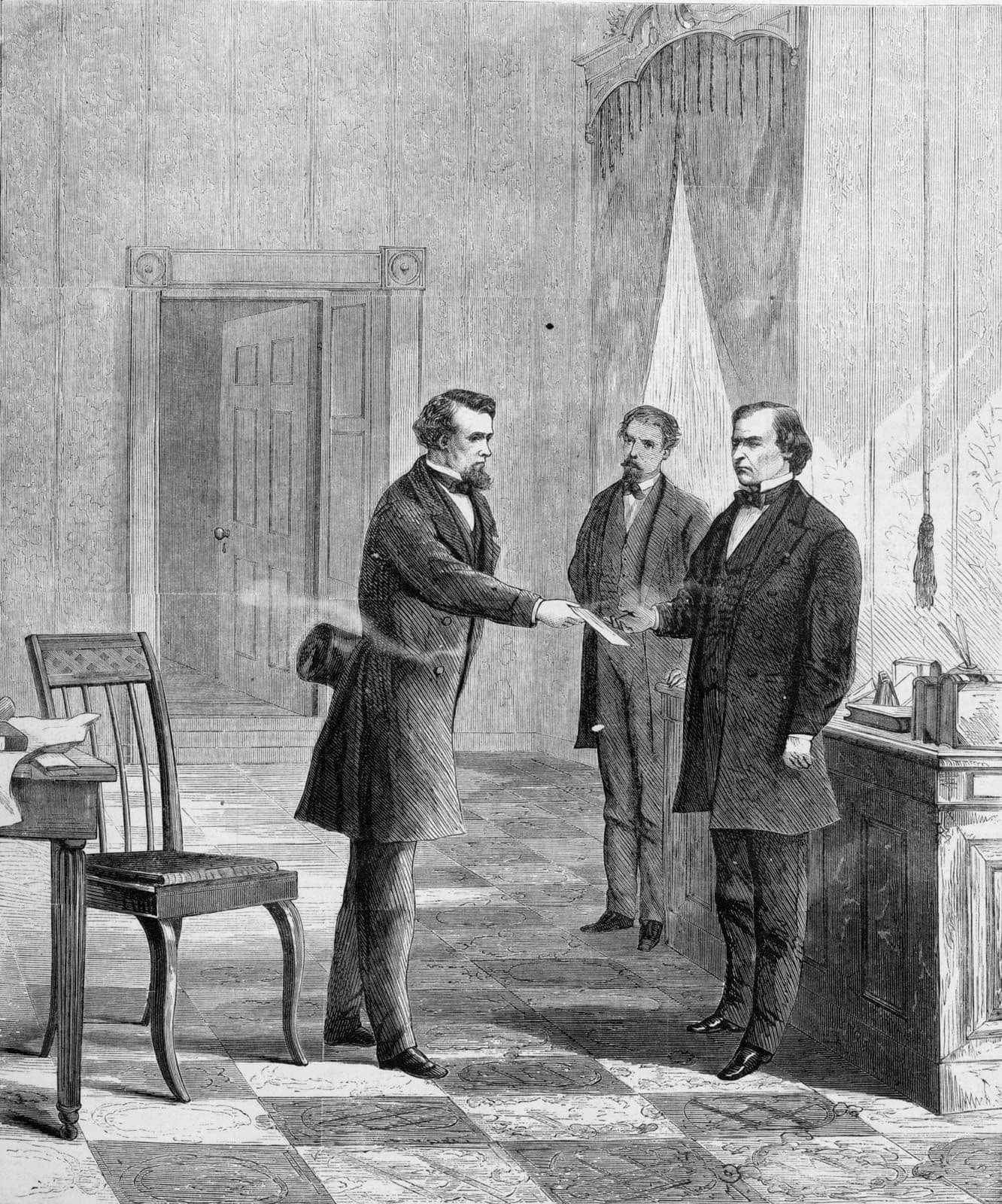
Andrew Johnson was impeached for violating the Tenure of Office Act by firing Edwin M. Stanton as secretary of war, leading to a power struggle with Congress.
Bill Clinton was impeached for perjury and obstruction of justice related to his extramarital affair with Monica Lewinsky and lying under oath about it.
Donald Trump’s first impeachment was due to allegations of attempting to extort Ukrainian Pres. Volodymyr Zelensky to interfere in the 2020 U.S. election, involving a quid pro quo for security assistance. His second impeachment, in 2021, came in the wake of the January 6 attack on the U.S. Capitol.
Richard Nixon was not impeached, because he resigned before the impeachment process could proceed, in the wake of the Watergate scandal.
The short answer is: Andrew Johnson, Bill Clinton, and Donald Trump (twice). But to truly understand what happened in each of those cases, it helps to understand the impeachment process overall. So, let’s start with just a bit of background.
• The impeachment process, outlined in the U.S. Constitution, is a congressional check on the power of the executive branch. Remember, the Founding Fathers were very skittish about a president becoming a monarch. Alexander Hamilton wrote in the Federalist papers that impeachment should be used to address:
Those offences which proceed from the misconduct of public men, or, in other words, from the abuse or violation of some public trust.
Benjamin Franklin was more straightforward, pointing out that, as a method for removing a corrupt leader, impeachment was better than the alternative of assassination.
• Impeachment is only part of the process to remove a president. The Constitution gives the House of Representatives to power to impeach—or charge—a president with what the Constitution calls “high crimes and misdemeanors.” If the House, by a simple majority vote, determines that there are worthy allegations of wrongdoing, the next step kicks in.
• Conviction for an impeachable offense then falls to the Senate. For a president to be convicted—and thereby removed from office—two-thirds of the members of the Senate must vote for it. That threshold is why, despite three presidents having been impeached, none have been removed from office.
• The offense: At the heart of Andrew Johnson’s impeachment was a very real controversy over the powers of the federal government. In March 1867 Congress passed the Tenure of Office Act, which prohibited the president from firing certain federal officials whose appointment needed Senate approval. Johnson vetoed it, setting up a classic power struggle and an existential one: Would the power to fire officials, including cabinet officers, rest with Congress or the president?
The trusted destination for professionals, college students, and lifelong learners.
In vetoing the Tenure of Office Act, Andrew Johnson set the stage for a constitutional showdown. He got one. You can read his rationale for the veto here.
Johnson decided to test the constitutionality of the act and fired Edwin M. Stanton as secretary of war. This infuriated Johnson’s opponents in the House of Representatives, who were still exorcised by Johnson’s veto (which Congress overrode) of the first Reconstruction Act in 1867. In addition to charging him with violating the Tenure of Office Act, the House accused Johnson of bringing “into disgrace, ridicule, hatred, contempt, and reproach the Congress of the United States.”
• The outcome: On February 24, 1868, Johnson became the first U.S. president to be impeached. The vote was 126–47, along party lines. Eleven articles of impeachment were delivered to the Senate. During a trial that lasted for nearly three months, the Senate debated whether the Tenure of Office Act applied to Stanton, if the act was constitutional, and if Johnson had disrespected Congress. The Senate held three votes between May 16 and 26, 1868. Each vote was 35–19, one short of the required two-third majority. Johnson wept at the news that he had not been convicted, but his political career was largely over. For its part, the Tenure of Office Act was repealed partly in 1869 and entirely in 1887 and in 1926 was declared unconstitutional by the U.S. Supreme Court.
• The offense: The impeachment of Bill Clinton stemmed from a lawsuit alleging sexual misconduct by Clinton before he was president. As part of that lawsuit, Clinton testified in a deposition that he had not had an extramarital affair with Monica Lewinsky, who had been a White House intern. When evidence of the affair was reported—first in the Drudge Report and subsequently by major media sites—an investigation into Clinton on other matters by special prosecutor Kenneth Starr expanded in scope to include whether Clinton had lied under oath. Lewinsky, who had previously testified that there was no affair, was taped by the FBI discussing her relationship with Clinton. She later testified that she and Clinton had indeed had an affair. Clinton ultimately admitted to lying under oath.
• The outcome: After an investigation, the House voted to send two articles of impeachment against Clinton to the Senate. The first involved perjury and the second obstruction of justice. On December 19, 1998, the House voted to impeach Clinton by a vote of 228–206 on the perjury charge and 221–212 on the obstruction charge. Clinton was only the second president to face impeachment in more than 200 years. The Senate then held an impeachment trial that began on January 7, 1999. On February 12, 1999, Clinton was acquitted by a vote of 55–45 (perjury) and 50–50 (obstruction), neither vote reaching the 67 needed for conviction.
• The offense: In August 2019 an anonymous whistleblower, later determined to be an official of the CIA, filed a complaint alleging that in a July 25 phone call with the newly elected president of Ukraine, Volodymyr Zelensky, Donald Trump had attempted to extort a promise from Zelensky to interfere in the 2020 U.S. presidential election on Trump’s behalf. Specifically, according to the complaint, Trump strongly implied that some $400 million in congressionally mandated security assistance to Ukraine would not be provided unless Zelensky carried out two requests, which Trump introduced by saying, “I would like you to do us a favor though.”
In September 2019, after the press began reporting that at least one of those requests may have involved a “quid pro quo,” the aid to Ukraine was finally released, and the White House later issued what it called a “rough transcript” of the phone call. Later that month Speaker of the House Nancy Pelosi opened impeachment proceedings, saying that Trump’s attempt to extort a foreign leader to interfere in a U.S. election constituted a betrayal of his oath of office and therefore warranted a formal impeachment inquiry.
• The outcome: In December the Judiciary Committee drafted two articles of impeachment against Trump, one for abuse of power and the other for obstruction of Congress. Those articles were adopted by the House in two party-line votes on December 18 (230–197 on abuse of power; 229–198 on obstruction of Congress). The votes made Trump the third president in U.S. history to be impeached. Trump was acquitted by the Senate in February 2020 (on votes of 52–48 and 53–47, respectively).
• The offense: On January 6, 2021, Trump spoke to a rally near the White House where he encouraged thousands in the crowd to “walk down Pennsylvania Avenue” to the Capitol building, where the ceremonial certification of the 2020 election, which was won by Joe Biden, was to take place. He also urged those in attendance to “fight like hell” or “you’re not going to have a country anymore.” Within hours the Capitol was under siege, as rioters stormed the building and sought out leaders including Pelosi and Vice Pres. Mike Pence. Trump watched the scene unfold on national television and initially refused pleas from members of his administration, House Minority Leader Kevin McCarthy, and even his family members to tell the rioters to end the violence. He ultimately recorded a video telling his supporters to “go home” more than three hours after the attack started.
• The outcome: On January 13, 2021, the House of Representatives, by a vote of 232–197, adopted a single article of impeachment against Trump for “incitement of insurrection,” making him the first president in U.S. history to be impeached twice. At his Senate trial in February, which began three weeks after he left office on January 20, there was some debate about whether the Senate could try a president who was no longer in office. Trump was ultimately acquitted after only 57 senators, 10 short of the required two-thirds majority, voted to find him guilty.
In popular culture, perhaps no president is more associated with impeachment than a president who never was impeached: Richard Nixon.
Nixon’s White House covered up the president’s role in what became known as the Watergate scandal, named for the Watergate complex that housed the offices of the Democratic National Committee. It was the scene of a botched burglary in June 1972 when political operatives hired by the Committee to Re-elect the President (CREEP) tried to get information that Nixon could use in the 1972 presidential election. Over the course of the next two years, largely buoyed by the reporting of Bob Woodward and Carl Bernstein of The Washington Post, the breadth and depth of Nixon’s involvement became evident. In the wake of criminal indictments and resignations of top aides, televised hearings that riveted the nation, and adverse Supreme Court rulings, Nixon resigned on August 9, 1974. In a bid to avoid becoming the second president to be impeached, he became the first to resign.