
Commentary: Elon Musk learns that bullies aren't your friends. Now what? – Los Angeles Times
The thing about bullies is they don’t have real friends.
They have lieutenants, followers and victims — sometimes all three rolled into one.
Most of us learn this by about third grade, when parents and hard knocks teach us how to figure out whom you can trust, and who will eat you for lunch.
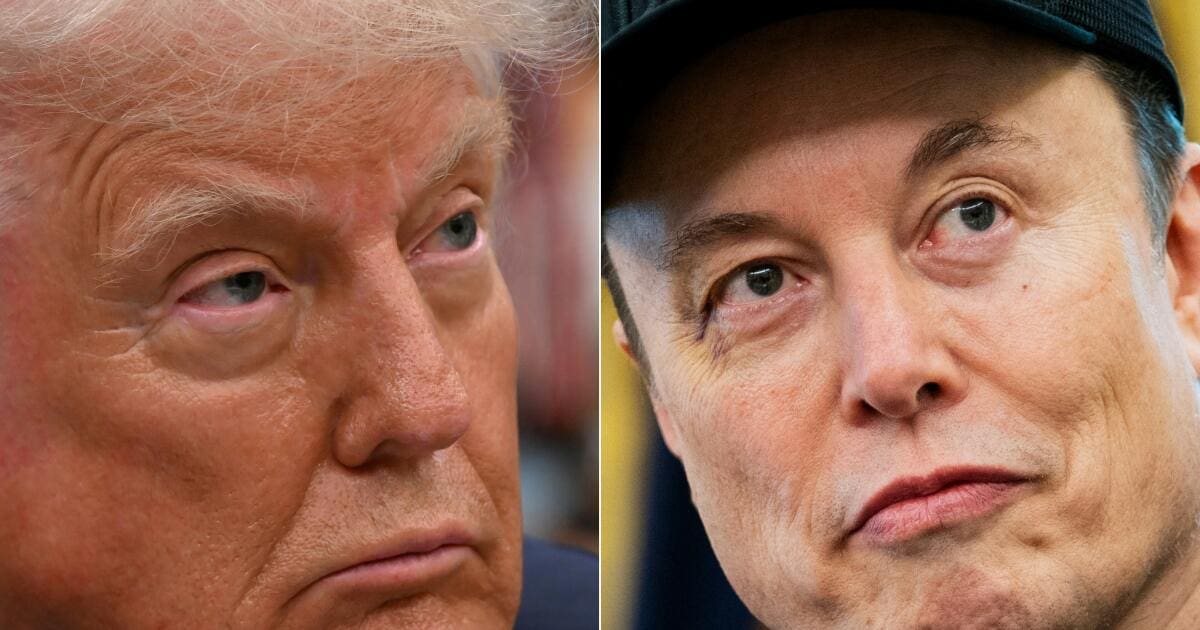
Elon Musk, at age 54 with $400 billion in the bank, just learned it this week — when his feud with our bully-in-chief devolved into threats that the president will have the South African native deported.
Speaking about Musk losing government support for electric cars, Trump this week warned that Musk “could lose a lot more than that.”
“We might have had to put DOGE on Elon,” Trump said, referencing Musk’s cost-cutting effort called the Department of Government Efficiency. “DOGE is the monster that … might have to go back and eat Elon. Wouldn’t that be terrible?”
Yes, I know. Schadenfreude is real. It’s hard not to sit back with a bit of “told ya” satisfaction as we watch Musk — who has nearly single-handedly demolished everything from hurricane tracking to international aid for starving children — realize that Trump doesn’t love him.
Politics
Elon Musk, the world’s richest man, threatened to fund primary challenges against supporters of President Trump’s sprawling tax and spendng bill ‘if it is the last thing I do on this Earth.’
But because Musk is the richest man in the world, who also now understands he has the power to buy votes if not elections, and Trump is grabbing power at every opportunity, there’s too much at stake to ignore the pitiful interpersonal dynamics of these two tantrumming titans.
What does it have to do with you and me, you ask? Well, there’s a potential fallout that is worrisome: The use of denaturalization against political enemies.
In case you’ve been blessedly ignorant of the Trump-Musk meltdown, let me recap.
Once upon a time, nine months ago, Musk and Trump were so tight, it literally had Musk jumping for joy. During a surprise appearance at a Butler, Pa., political rally (the same place where Trump was nearly assassinated), Musk leaped into the air, arms raised, belly exposed, with the pure delight of simply being included as a follower, albeit one who funneled $290 million into election coffers. Back then, Musk had no concern that it wasn’t his own dazzling presence that got him invited places.
By January, Musk had transitioned to lieutenant, making up DOGE, complete with cringey swag, like a lonely preteen dreaming up a secret club in his tree house. Only this club had the power to dismantle the federal government as we know it and create a level of social destruction whose effects won’t be fully understood for generations. Serious villain energy.
But then he got too full of himself, the No. 1 sin for a lieutenant. Somewhere along the line, Trump noticed (or perhaps someone whispered in the president’s ear) that Musk was just as powerful as he is — maybe more.
Cue the fallout, the big “see ya” from the White House (complete with a shoving match with another Trump lieutenant) and Musk’s sad realization that, like everyone else in a bully’s orbit, he was being used like a Kleenex and was never going to wind up anyplace but the trash.
So Musk took to his social media platform to start bashing on Trump and the “Big Beautiful Bill,” which passed in the Senate on Tuesday, clearing the way for our national debt to skyrocket while the poor and middle class suffer.
“If this insane spending bill passes, the America Party will be formed the next day. Our country needs an alternative to the Democrat-Republican uniparty so that the people actually have a VOICE,” Musk threatened, conjuring up a new political party the same way he ginned up DOGE.
Musk even promised to bankroll more elections to back candidates to oust Trumpians who voted for the bill.
“And they will lose their primary next year if it is the last thing I do on this Earth,” Musk wrote. Presumably before he leaves for Mars.
It was those direct — and plausible — threats to Trump’s power that caused the president to turn his eye of Sauron on Musk, flexing that he might consider deportation for this transgression of defiance. It might seem entertaining if Musk, who the Washington Post reported may have violated immigration rules, were booted from our borders, but it would set a chilling precedent that standing up to this president was punishable by a loss of citizenship.
Because the threat of deporting political enemies didn’t start with Musk, and surely would not end with him.
For days, Trumpians have suggested that New York City mayoral candidate Zohran Mamdani, who was born in Uganda and became a U.S. citizen in 2018, should be deported as well, for the crime of backing policies that range in description from progressive to socialist to communist (pretty sure the ones labeling them communism don’t actually know what communism is).
On Tuesday, Trump weighed in on Mamdani.
Trump and Mamdani are both charismatic leaders who have bucked their parties and tapped into the current political ethos that eschews traditional loyalties.
“A lot of people are saying he’s here illegally,” Trump said, which of course, no one is except for Trump’s attack dogs. “We’re going to look at everything.”
Denaturalization for immigration fraud — basically lying or misrepresenting stuff on your official application — is nothing new. Obama did it, as did Trump in his first term, and it has a long history before that.
But combing the documents of political enemies looking for pretexts to call fraud is chilling.
“This culture of weaponizing the law to go after enemies, it’s something that is against our founding principles,” Ben Radd told me. He’s a professor of law and an expert in political science at UCLA.
“It is very much an abuse of executive power, but [Trump] gets away with it until there’s a legal challenge,” Radd said.
While Musk and Mamdani have the power to fight Trump in a court of law, if it comes to it, other naturalized citizens may not.
There are about 25 million such citizens in the United States — people who immigrated in the “right” way, whatever that means, jumped through the hoops, said their pledge of fealty to this country and now are Americans. Or so they thought.
In reality, under Trump, they are mostly Americans, as long as they don’t make him mad. The threat of having citizenship stripped for opposing the administration is powerful enough to silence many, in a moment when many immigrants feel a personal duty and impetus to speak out to protect family and friends.
Aiming that threat at Musk may be the opportunistic anger of a bully, and even seem amusing.
But it’s an intimidation meant to show that no one is too powerful to be punished by this bully, and therefore, no one is safe.
L.A. Times Insights delivers AI-generated analysis on Voices content to offer all points of view. Insights does not appear on any news articles.
The most important California stories and recommendations in your inbox every morning.
By continuing, you agree to our Terms of Service, which include arbitration and a class action waiver. You agree that we and our third-party vendors may collect and use your information, including through cookies, pixels and similar technologies, for the purposes set forth in our Privacy Policy such as personalizing your experience and ads.
Follow Us
Anita Chabria is a California columnist for the Los Angeles Times, based in Sacramento. Before joining The Times, she worked for the Sacramento Bee as a member of its statewide investigative team and previously covered criminal justice and City Hall. Follow her on Bluesky at anitachabria.bsky.social and on X at @anitachabria.
World & Nation
World & Nation
World & Nation
World & Nation
After the first sign of fire was spotted in the foothills above Altadena, a WhatsApp chat meant to set up pickleball games started going off. As the devastation became clear, that chat soon turned into a community disaster hub.
In the final episode of this four part series, we’ll talk to historian William J. Mann about his new book on the Dahlia case, which points to the same long-forgotten suspect whose name has been linked to a Zodiac cipher.
In this specially released bonus episode, Madison McGhee and Jami Rice share some extremely opinionated opinions about everything from the Menendez Brothers to Jax Taylor.
California
California
California
California
Subscribe for unlimited access
Site Map
Follow Us
MORE FROM THE L.A. TIMES