
On covering Biden's and Trump's aging issues – Seth Masket | Substack
Two things I think we can agree on:
Joe Biden and Donald Trump have each demonstrated some of the challenges of aging — both physically and mentally — while serving in office as the two oldest Presidents in U.S. history
The political media have covered those challenges extremely differently
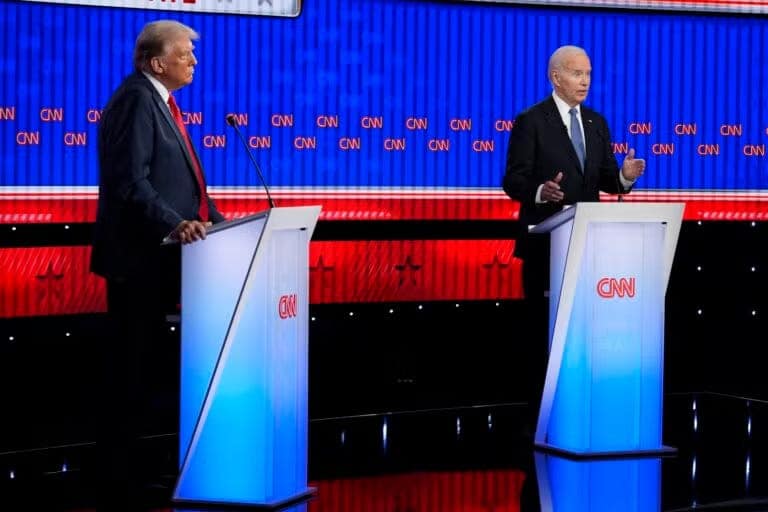
Julia Azari has a smart piece up about the differences in coverage. As she notes, this divergence really kicked in after the debate between Biden and Trump in June of 2024. Biden looked very bad and was difficult to hear and understand; Trump sounded energetic and forceful and said a litany of untrue things. The bulk of the media coverage was about Biden’s frailness, not Trump’s falsehoods.
As Julia argues, these different approaches can be partially explained by just who is in the parties. Democrats just tend to be younger and thus somewhat more concerned about issues related to aging. Democrats also represent groups that have more traditionally been out of power and are thus more concerned about sub-par messengers for their causes. This is an oversimplification on my part but do check out her post.
the @smotus report is a reader-supported publication. To receive new posts and support my work, consider becoming a free or paid subscriber.
I have a different take, although I fully accept the premise that there have been vast differences in coverage. (I mean, a CNN news anchor literally wrote a book on how bad it was that Biden was occasionally forgetful and needed naps.)
In my view, this has to do with political reporters’ professional norms about critical coverage. It is a longstanding tradition among those covering politics that you’re not supposed to appear biased toward a candidate or incumbent. Particularly with presidential candidates, you’re supposed to provide negative coverage. Some research by Zaller and Hunt demonstrates that negative coverage of presidential candidates tends to increase when a) they’re more likely to win, and b) they’re incumbents. It’s part of a journalist’s professional rules to be critical. And honestly that’s a useful norm.
But it also means that when there’s not enough obvious things to criticize, political journalists will try to find some. That is, they have a negative coverage bucket to fill. Now, Trump makes it easy on them, involving himself in countless scandals, lawsuits, and criminal investigations and making multiple statements throughout each day that defy political norms, offend large portions of the country, and threaten the rule of law. Indeed, a Shorenstein Center study in Trump’s first term found that roughly 80% of media coverage of him was negative.
But there’s something of a curse if you’re successful at avoiding scandal. Biden’s was hardly an error-free administration, but he did the basic parts of governing well and without major scandals. He pushed a range of large legislative proposals, negotiated with Congress, got a good deal of his priorities passed, didn’t threaten to hang anyone, didn’t demolish part of the White House, didn’t put his name on the entrance of the Smithsonian — you know, basic presidenting stuff. And for political reporters, that makes filling the negative coverage bucket more challenging. So they ended up focusing on a small number of things that seemed problematic. For Biden, that was a) the pullout from Afghanistan that resulted in the deaths of 13 U.S. servicemembers; and b) being old.
Barack Obama’s presidency presented a similar challenge for journalists. Coverage of him tended to be unusually positive in 2008, and many sought to correct for that when he was in office. Yet he didn’t give them a ton to work with. He relentlessly followed existing political norms, and ran the White House in a remarkably scandal-free way. Which is how we ended up with a media hyper-focus on him wearing a tan suit in 2014.
In some ways you can view the 2016 campaign through a similar lens. Trump began courting negative coverage very early on, criticizing John McCain for being a prisoner of war just two days after announcing his presidential candidacy. And he didn’t let up after that. Hillary Clinton, meanwhile, had plenty of detractors, but largely ran a disciplined and competent campaign. For political reporters, this presented a challenge — they couldn’t just say Trump’s campaign was scandal-plagued, as that would make them appear in the tank for Clinton. So they tried to focus on the most obvious proximity to scandal for her — her use of a private e-mail server.
In August of 2016, Gallup asked survey respondents what words they’ve heard to describe both Clinton and Trump. Then they made word clouds out of the answers, with the most frequent terms appearing in the largest fonts. Note the difference: people had heard a lot of things about Trump, mostly focused on immigration. What they’d mostly heard about Clinton was e-mails. It was the easiest thing for journalists to home in on when trying to provide some kind of balance.
Again, in the summer of 2024, there was plenty for reporters to talk about when providing critical coverage of Trump. But to try to fill the negative coverage bucket for Biden, they went with the obvious one that everyone could see: being old. It’s now what the public largely remembers from his presidency.
Share
No posts


