
Resisting in Plain Sight: Six Everyday Acts of Resistance in the Age of Trump – Ms. Magazine


More Than A Magazine, A Movement
The Trump administration’s relentless assaults on anything that threatens its narrow vision of the status quo—one rooted firmly in patriarchy and racism—have made something unexpectedly clear: Authoritarians target culture because culture shapes how we understand ourselves.
The attacks on democracy and marginalized communities are now so pervasive that everyday choices can carry political meaning.
Activities we once considered leisure, education or self-expression have become forms of resistance, simply because they affirm the people and communities this administration seeks to silence, exclude or erase.
Here are six examples.
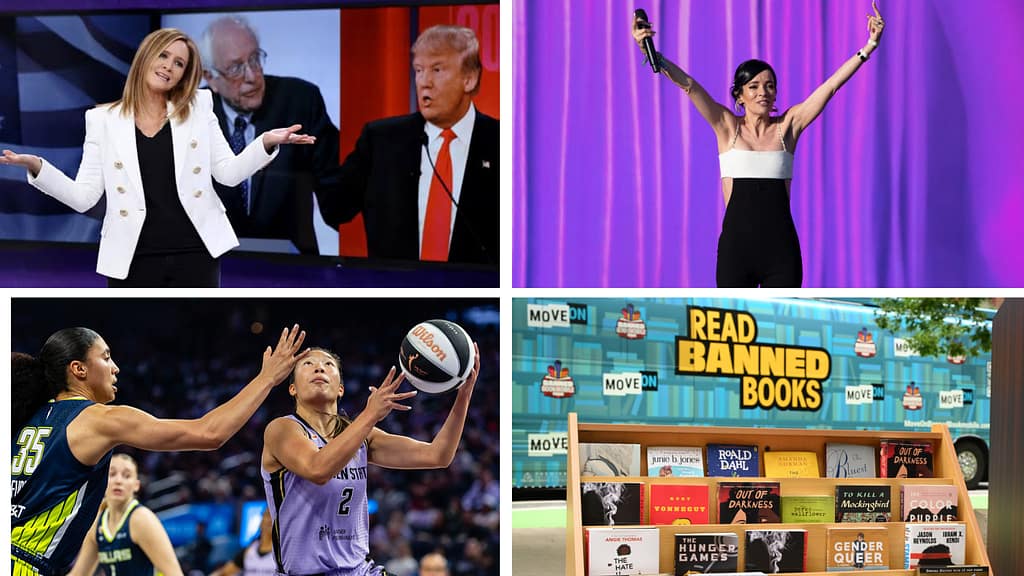
I would like to think teaching children to read, write and learn would be celebrated! Who doesn’t want a more literate and intellectually engaged community? Apparently a lot of people. According to PEN America, during the 2024-2025 school year there were 6,870 instances of book bans across 23 states and 87 public school districts. Over half of the banned books centered LGBTQ+ and/or BIPOC characters.
If these stories didn’t matter, the right would not work so diligently and systematically to erase them.
Our role? Support independent bookstores, particularly during Banned Book Week. Additionally, ask your librarians to purchase so-called banned books, buy those books for your kids’ classrooms, and incorporate them into your home.
Like children’s books, music helps shape culture, build community and give voice to experiences that might otherwise go unheard. Throughout history, music has fueled social movements, sustained people through periods of repression and helped communities imagine a different future.
Whether through protest songs, queer anthems, feminist punk bands or artists challenging racism and misogyny, music reminds us that resistance can be creative as well as confrontational.
A post shared by FEMINIST (@feminist)
We can gauge the power of music by looking at Trump’s repeated attacks on musicians. People rarely lash out at voices they find irrelevant. The administration’s hostility toward artists is a reminder that music can challenge power, build solidarity and inspire action.
Consider Bikini Kill, the feminist punk pioneers whose riot grrrl ethos transformed music into a vehicle for feminist organizing and consciousness-raising. Reflecting on a 2022 Bikini Kill concert, I wrote that the band did not merely provide entertainment; their music “expunged the toxic masculinity that is our body politic.” Lead singer Kathleen Hanna spoke openly about sexual assault, consent and patriarchy, creating a space where survivors felt seen, heard and supported.
That tradition continues with The Linda Lindas. The young Asian American and Latina punk band burst onto the scene in 2021 with their viral song “Racist, Sexist Boy,” transforming an experience of anti-Asian racism into a rallying cry against hate. They remind us that while misogyny and white supremacy start young, so does loud and creative resistance.
Our role? Support loud, independent and alternative voices.
Organized sports have historically built community. From youth leagues and pickup games, to professional clubs, sports give athletes and fans opportunities to join forces, release energy and experience joy. This has always been true for women’s sports, though the broader culture is finally starting to catch up. Women’s soccer has a loyal following, women’s hockey fans are equally enthusiastic, and the WNBA continues to expand its reach and influence.
Nonetheless, Trump continues to undermine protections for women athletes (including Title IX), attack transgender women and girls in sports, and publicly target prominent athletes who speak out.
As with books, music and education, the attacks themselves are revealing. People do not target what they consider irrelevant. The growing effort to police women’s sports is a reminder of their cultural and political power.
Our role? Cheer women on, go to games, frequent women’s sports bars. As Megan Rapinoe regularly reminds us, with proper funding and promotion for women’s sports, the fans will be there.
As Stephen Colbert recently told The New York Times, “Authoritarians don’t like anybody who doesn’t give them undue dignity. Comedians are anti-authoritarian by nature.” Colbert should know. CBS canceled The Late Show amid a proposed Paramount-Skydance merger requiring federal approval, prompting concerns that corporate leaders were eager to avoid conflict with the Trump administration.
Yet women comedians have long faced similar pressures with far less public outcry. Long before Colbert’s cancellation, late-night television had already been largely cleared of women. When Full Frontal with Samantha Bee was canceled in 2022, many viewers were heartbroken, but the decision generated nowhere near the solidarity and alarm sparked by Colbert’s departure. Bee gave voice to women’s anger at misogyny, violent masculinity and sexual violence with biting, incisive humor. She helped audiences process painful realities without ever minimizing their seriousness.
Our role? Support feminist comedians. Help them hold tightly to the microphone so they can continue speaking truth to power. HBO’s Hacks offers a window into the misogyny women face in comedy, both onstage and behind the scenes. And performers like Megan Stalter continue to forge their own paths, rejecting Hollywood’s narrow expectations and demonstrating that humor can be both deeply personal and quietly radical.
Black feminist poet and activist Audre Lorde continues to shape feminist movements decades after her death. Her understanding of self-care feels especially urgent in this political moment. As Lorde famously wrote, “Caring for myself is not self-indulgence, it is self-preservation, and that is an act of political warfare.”
Authoritarian movements thrive on fear, exhaustion and isolation. When people are overwhelmed, burned out or convinced they are alone, they are less able to care for themselves, their communities or one another. That is why acts of care—both personal and collective—remain essential. The Trump administration’s decision to eliminate federal support for the LGBTQ+ youth crisis hotline sent a chilling message about whose lives are valued and whose suffering can be ignored.
Our role? Protect your own well-being and help sustain the well-being of others. Find moments of joy, rest and connection. Check on the people in your life who are under attack. Build community. Support organizations like The Trevor Project and United We Dream. In a political climate that seeks to marginalize, isolate and erase entire communities, caring for ourselves and one another is more than self-preservation—it is a refusal to give up on each other.
Finally, as a feminist studies professor, I need to end with the long game: This administration would not be attacking gender, women and sexuality studies (GWSS) at every turn were our work not so important.
Our role? If you are a current or future student, take our classes, major in GWSS. If you have loved ones in K-12 schools, talk to teachers and librarians about integrating age-appropriate feminist studies. Don’t know where to start? Try Kate Schatz’s Rad Women series.
And when attacks on education happen, document them. Write op-eds, share your experiences and speak publicly about what is being lost. The stories collected in Ms.’ Banned! series demonstrate the power of bearing witness to book bans, censorship, attacks on DEI and efforts to restrict how race, gender and sexuality can be taught. Authoritarians depend on silence; telling these stories is its own form of resistance.
I wish I was overreacting. I wish a kindergartener’s board book, a women’s basketball game or a comedian’s microphone didn’t feel like acts of resistance. I wish mere survival couldn’t count as some sort of victory. Yet here we stand, in the throes of authoritarianism to which we must not succumb.
The reporting you just read is possible because of readers like you. Since 1972, Ms. has delivered independent, feminist journalism that tells the stories too often overlooked by other news media, challenges systems of inequality and holds power to account. We have no corporate owners, no advertisers and no billionaires dictating what we cover. Instead, we answer to our readers and our mission. If you value reporting that centers women and girls—and covers the issues others leave out—please support Ms. today by making a tax-deductible donation, becoming a member to receive a magazine subscription, or gifting a membership to a friend. Together, we can continue reporting, rebelling and truth-telling.
Ms. is wholly owned and published by the Feminist Majority Foundation


