‘Great settlement’: Trump calls off Iran strikes, claims peace deal could be signed this weekend – The Age
Updated ,first published
You have reached your maximum number of saved items.
Remove items from your saved list to add more.
Dubai/Washington: President Donald Trump said the US and Iran could sign a peace deal as soon as this weekend that would reopen shipping traffic through the Strait of Hormuz, but Tehran countered that it had not reached a final decision on an agreement.
The agreement, if finalised, would be the most significant diplomatic breakthrough yet to end the three-month-old war, which has killed thousands of people and sent global energy prices sharply higher.
Iran’s semi-official Fars news agency reported that Tehran was likely to approve the agreement, though it has yet to give a formal response.
But Iranian media reported Foreign Ministry spokesperson Esmaeil Baghaei as saying that large parts of the negotiating text have not been finalised and that Iran would not compromise on its “red lines”.
“Iran has not yet reached a final conclusion on an agreement,” he said.
Since mid-March, the US president has repeatedly claimed that a deal with Iran to end the war is close. CNN reported earlier this week that Trump has claimed at least 38 times – in social media posts, public appearances and phone calls with the media — that a deal was close or Iran was desperate to make one.
After Trump’s announcement, sounds of explosions were heard near the Iranian port city of Bandar Abbas early on Friday. Shortly after, state media reported that Iranian forces had prevented a tanker from entering the Strait of Hormuz without coordination to pass.
Hours later, a US official said American forces had shot down two Iranian one-way attack drones as Tehran appeared to attempt to strike commercial ships transiting the strait. “Traffic flow through the strait continues,” the official said, speaking on condition of anonymity.
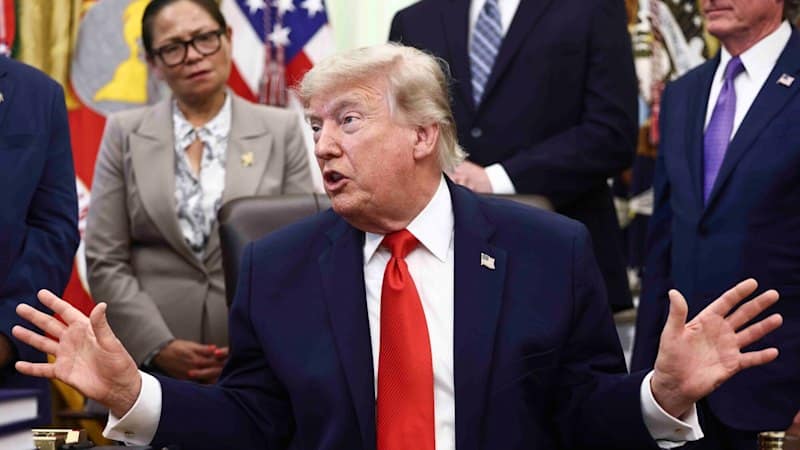
Earlier, Trump told reporters in the Oval Office that he had made a “great settlement of the war with Iran” – just hours after he threatened to escalate the war.
He said Vice President JD Vance would attend a US-Iran deal signing, which was expected to take place in Europe this weekend, and that the Strait of Hormuz would open as soon as it was signed.
US stocks rallied to record their best day in two months, and oil prices fell on Trump’s announcement.
When asked whether Iran’s Supreme Leader, Mojtaba Khamenei, had approved the deal, Trump said: “I understand the answer is yes.”
Trump described the deal as “a very strong memorandum of understanding”, adding it was “a little conceptual, but it’s something that’s going to get done”.
Later, Trump told an evening tele-rally for Burt Jones, who’s running for the US Senate in Georgia, that “we ended the war with Iran today”. During another tele-rally for Barry Moore, a Senate candidate in Alabama, the president said, “It’s pretty much, pretty much completed. We got everything we wanted.”
Trump has repeatedly said that any peace deal must ensure Iran cannot develop a nuclear weapon.
“Most importantly we have a deal that Iran will never have a nuclear weapon, which was the whole purpose of what we had to go through to get this. So it was a very big thing,” he said on Thursday.
Iran’s demands include the lifting of international sanctions, the release of billions of dollars in frozen assets and recognition of its control of the Strait of Hormuz.
Trump and Israel’s Prime Minister Benjamin Netanyahu spoke on Thursday. Israel was “not a party to the memorandum of understanding”, and Netanyahu expressed his appreciation for Trump’s commitment to securing a final deal that includes resolving the issue of enriched nuclear material, according to a readout from Netanyahu’s office.
The US president said he had also spoken with the leaders of Qatar, United Arab Emirates, Saudi Arabia, Bahrain, Kuwait and others. He said he would soon speak to Turkey’s President Tayyip Erdogan.
Earlier, Trump said on social media that the agreement had been approved by “the highest level” of Iranian leadership, as well as other countries in the region including Israel, Saudi Arabia, Qatar and the United Arab Emirates.
“Based on the fact that discussions with the Islamic Republic of Iran have been brought to the highest level of Iranian leadership and approved, I have, as President of the United States of America, cancelled the scheduled strikes and bombings against Iran this evening,” Trump said in a post on Truth Social on Thursday, Washington time (Friday morning AEST).
Just hours before that, Trump had posted that the US would be “hitting Iran … VERY HARD TONIGHT”.
“At some point in the not too distant future, we will be taking Kharg Island, and other oil infrastructure points, and assume total control of their Oil and Gas Markets, much like we have with Venezuela,” he said online.
In an interview with Fox News’ Fox & Friends on Thursday morning (Washington time), Trump added: “There will be more bombing tonight. It will be bigger, bigger, more powerful.”
“My preference has always been – take Kharg Island … my preference would be that. I don’t know that America has the stomach for it,” he said.
Trump later said a US military operation against Kharg Island was off the table for now.
The two sides have traded strikes throughout the week, straining the ceasefire announced in April. Still, Iranian and Western sources said earlier on Thursday that efforts to reach an interim deal to end hostilities had intensified.
Three Iranian sources said a political understanding had been reached, but some issues remained to be discussed in detail, including a mechanism for the release of tens of billions of dollars of Iranian oil revenues frozen in foreign banks.
It was unclear whether such a deal would satisfy critics within Trump’s Republican Party who say that any agreement must close Tehran’s path to developing a nuclear weapon.
The escalation in hostilities began earlier this week with the downing of a US Apache helicopter near the Strait of Hormuz, which sparked a series of tit-for-tat attacks across Iran and on US bases around the region.
It was the most serious threat to the fragile ceasefire, dampening hopes for a swift end to the war that started in late February with massive US-Israeli joint air strikes on Iran.
The war has killed thousands and disrupted roughly a fifth of global supply of crude oil and liquefied natural gas, sending prices sharply higher.
Reuters
Get a note directly from our foreign correspondents on what’s making headlines around the world. Sign up for our weekly What in the World newsletter.
You have reached your maximum number of saved items.
Remove items from your saved list to add more.
More: